• So, who am I, anyway?

Life Unscripted

~ Living Life as I see it… or Don't

Life Unscripted

Tag Archives: autonomy

My sorta Kinda Maybe (in)accessible Life: The More Things Change, the More they Stay the Same

22 Friday Apr 2022

Posted by blindbeader in blindness, My Sorta Kinda Maybe (In)accessible Life

≈ 1 Comment

Tags

autonomy, blindness, dignity, disability

It’s been two weeks since I last checked in here. So much has stayed the same, but things are starting to pick up, especially now that I have the energy to actually do anything more than the absolute bare necessities (thank you very much, covid/not covid!)

Getting out There

Once I was legally permitted to leave my house – in addition to actually having the mental and physical capacity to do so – I couldn’t wait to get out and do things. Exciting things… like going to the pharmacy to fill a prescription, or the bakery the last possible day they were open before closing for Passover. But heading out to pick up a couple things from our local Buy Nothing group proved to be less intuitive and more frustrating than anticipated.

My first “gift” from the Buy Nothing page was a microwave chip maker. It came in its box – practically brand new! – with two trays and a slicer. My Buy Nothing group is in a fairly small area – I can technically walk anywhere to pick things up. However, this area is very easy to get lost in. An avenue suddenly curved slightly and became a street. There was no simple way to tell where along the block the house was located, as the “block” was broken up by multiple avenues (1 Ave, 1A Ave, 1B Avenue). Thankfully, I was able to text the giver, who came out and met me on her sidewalk. I’ll do anything for chips – even get myself lost in a neighborhood that’s supposed to be on a grid pattern!

The second gift was a smart plug – ironically located only a handful of blocks from the chip maker. Knowing the avenue curves and turns into a street, I thought I was prepared for being able to locate the house easily. Not so much… GPS said I was at the house a full two blocks – at the far end of an avenue and a street and around a corner – before I made it there. I loaded Aira to provide visual information since GPS proved useless. After ten minutes of angling, trying to read house numbers ($2.50), a smart plug was in my hand. Unfortunately for me, I still haven’t been able to get my phone to recognize it, and it sits unused, waiting for a time when I have the patience and energy to find some obscure solution I haven’t tried half a dozen times yet.

10 minutes of house locating: $2.50

Work

My second week of working from home felt more like putting one foot in front of the other, and just doing the best I could with what I had. However, what I did learn was that Government Web Site (GWS) #1 – which is mostly accessible, still has that hiccup when certain conditions are met. I was over the moon when I got an email about those conditions that normally means someone else has to click stuff for me, and found I was able to use a touch screen to access information that is not accessible with a keyboard. However, this is definitely not a truly accessible solution – it feels like I have to stand on my head and click my heels three times; without a touch screen, every now and again someone else has to drop everything to help me out.

GWS #2 is still not accessible. Unfortunately, I have twice needed to use it (read: ask someone else to access it for me). I have even spent ten minutes trying to use GWS #2 with the touch screen on my computer (the one that made GWS #1 usable), and even my phone… No dice.

GWS #3 has always been a fully accessible system. It is not overly intuitive – which I honestly believe is part of accessibility – but I have the ability to input and access all the information I need. I used this web site twice over the past two weeks, and ran into zero issues at all.

When my colleague and I set up our accounts on GWS #4 earlier this week, I was told that it had a blue button, and did not look dissimilar to GWS #2 – even the login and setup process was similar. The dread I felt was so powerfully intense… as was the relief I felt when I was able to access all edit fields and buttons completely independently. I guess you can’t really put a price on anxiety, can you?

2 X “outsourcing” = $100; 10 minutes trouble shooting $2.50

Health and Fitness

I am running a half marathon in ten days. Covid/not Covid put a damper on my training, so I have no clue what the race will be like. But my main social outlet is running and runners. Depending on the day, the distance, and the ability and willingness of humans to guide, I can either run independently with Jenny (who is still willing to run!) or I run with a friend guiding me by using a tether. My main running tracker is an app whose android app finally – six years after I started using it – labeled the buttons on its tracking screen. I had previously labeled the buttons myself, but new app updates or resets always reset the labels, too! Being able to just tap a button has taken a load off I hadn’t realize I had been carrying.

Another app I am excited to try is the Revision Fitness app. It’s been developed by a visually impaired Paralympian, and at first glance all of the workouts are fully described – something that’s generally missing from most workout apps on the market. I had planned to use my free trial during the first week of April… and we all know how that went.

Home and Personal Care

Last week, one of my favorite bath and body shops (L’Occitane) had a huge sale on their entire store. I scooped up some old favourite products, and decided to try a few new ones. When my box arrived, I was happy to receive my pampering items, but a part of me was disappointed, too. L’Occitane’s foundation has proclaimed that they are committed to labeling as many of their products as possible in braille. For years, I have purchased products, knowing that I could read the label on the bottles of shower gel or cardboard sleeves around a perfume without even having to use my sense of smell at all. Even their travel bottles had their full product name (“Cherry shower gel”, “Lavender Foaming bath”) on the bottles. My new products just said “shower gel” without any other identifier. I think it might be a blip – I’ll probably treat myself around my birthday this summer – but having something that’s so accessible be changed in such a way felt like something had been taken from me. Imagine going through your pantry, and your boxes of crackers – instead of saying “Ritz” or “Wheat Thins” or “Triscuit” – every box in your pantry just says “crackers”. Could you open your box and smell the crackers? Sure! Could you shake the box to determine your choice by weight? Of course. But the simplest way to tell your items apart is to read the label on the packaging. As it stands, I placed an elastic band around one “shower gel” to tell it apart from the other “Shower gel.” Now I just have to remember which one has the elastic!

I finally got the hang of the Covid test thing. I got to the point where over a 4-day period, I only needed fifteen minutes of Aira (read: working eyeballs!) to read my Covid test results. Still all negative, thankfully!

I’ve also chosen to not do business with a local business because their web sites are not accessible. One web site had a contact form that wouldn’t let me select anything in a drop-down menu – keyboard, touch screen, it didn’t matter. I spent fifteen minutes trying both, in case I missed a mandatory field. But nope… if there was a drop-down menu, I had no access to it. I seriously debated contacting the business/web site provider, but it was in the middle of Covid/not Covid, and I just didn’t have the mental energy to explain that I was really just trying to get in touch with them, and by the way I was having challenges accessing their web site, so would they mind fixing it so I could give them my business? I decided against this approach for two reasons: (1) I have other options out there for that particular service; and (2) the company mentioned a heavy reliance on technology, so I wasn’t confident that accessibility wouldn’t be an issue during our entire business relationship.

15 minutes of test result reading ($3.75) + 15 minutes of inaccessible web site navigation ($3.75) = $7.50

The Bottom Line

If it looks like I am throwing a pity party, I’m not convinced I’m not. I thought this exercise – quantifying the “little things” in my day that make this blind life harder – would be interesting and informative. Instead, while I am grateful for the things that put me on an equal playing field, I’m seeing how very very far we have to go.

I am respectfully submitting an “invoice” in the amount of $112.50 + a box of elastics.
My Sorta Kinda Maybe (in)Accessible Life: The COVID/not COVID Edition

08 Friday Apr 2022

Posted by blindbeader in My Sorta Kinda Maybe (In)accessible Life

≈ 2 Comments

Tags

autonomy, blindness, dignity, disability, personal

When I first conceptualized this experiment, the one thing I didn’t expect was life grinding to a screeching hault! I received word over the weekend that I had come into contact with someone who tested positive for COVID-19. And, what do you know! I had symptoms! So… I got to go approximately nowhere, and see approximately no one.

But after a week of fatigue and brain mud… I still had a few hiccups along the way.

A Quick Adjustment to Calculations

In my initial post, I provided a monetary value for certain inaccessible systems/experiences of ableism/etc. The one thing I failed to consider was: What would I do in a situation where I had no choice but to ask someone to do something for me that I cannot do for myself… at all? Especially if it’s a thing I should – in any other instance – be able to do for myself. So, I have implemented a flat rate for those instances of $50. This is because I not only have a history of trying to work through something I should be able to do, but I need to take someone else away from their life because of it. $50 – no matter the complexity or duration of an activity – could “compensate” for my loss of dignity, as well as taking into account someone else’s time.

Social Life

Seriously, what social life? I’ve been stuck at home for nearly a week! I did attend a restaurant last Friday to celebrate my partner’s and my third anniversary. The menus were accessible online, and the staff was great (read: not patronizing or weird). No unpaid emotional stuff here!

Around the House

For someone who has lived for two years during a global pandemic, I’m surprised I haven’t had to take a COVID test before now. A friend dropped off two tests for me on Sunday. I found the instructions for the test confusing and clunky, though I could read the information online or on my phone. However, I was not able to read the test results myself.

Over the past six days, I have taken six COVID tests. For the record, they have all come back negative. Over the past six days, I have spent 80 minutes using a service called Aira (an online service that connects blind people with employees whose eyes work better than ours and who provide visual information that we cannot see). The fact that Aira has a free promotion for COVID-related tasks and information is hardly the point. I can’t access my test results independently and privately (the same is true for pregnancy tests, for the record).

80 minutes at $15/hour: $20

Work

I love being able to work from home, especially feeling like this! This makes me blessed and privileged, and I don’t take that lightly.

Did you know that PDF documents – particularly ones that are scanned – are often not accessible to screen reader users like myself? This is because they are usually scanned as images by default. In order to read any PDF that gets sent to me, that involves a – paid – upgraded license of Adobe. Wait… Someone needs to pay so that I can read standard document formats? Yup! If I wanted that same functionality at home, I would have to pay $20 per month. I’m adding this to my ledger because it’s absurd.

I regularly use government web sites (GWS) in order to do my job. GWS #1 is mostly accessible, except when certain criteria are met. I ran into such a situation with GWS #1, where I could not physically click a link myself and had to get someone else to do it for me ($50). Once that was done, I was ready to run, but still I couldn’t do this thing myself and had to “subcontract” someone else.

GWS #2 presented a whole other problem. A few months ago I had an extremely long conversation (a total of 2 hours – $30) with the developers of GWS #2. It came to light that because I use a screen reader, GWS #2 doesn’t play nice (with any screen reader); the presence alone of a screen reader means that I have no ability to use GWS #2 at all. Even after a minimum of two new releases, GWS #2 is still inaccessible. I was placed in a position this week where someone else had to use GWS #2 for me ($50). I am blessed to work with understanding people… but what if I didn’t? Thankfully, most of the rest of my work-based activities are intuitive and accesible.

2 outsourced tasks from GWS ($100) + 2 hours of troubleshooting with no results ($23) = $130

The Bottom Line

I made it through this week, and I am none the worse for wear. On the (in)accessibility/emotional labour front, I respectfully submit an invoice in the amount of $150.

Ungrateful Passenger

04 Wednesday Aug 2021

Posted by blindbeader in blindness, Ultimate Blog Challenge

≈ 3 Comments

Tags

autonomy, dignity, independence, travel

“Hey, need a lift?”

If you have a driver’s license and reliable access to a vehicle, you’ve probably asked this question at one point in your life – maybe even regularly, sometimes to the same person or people.

For obvious reasons, I do not drive. I am overwhelmed sometimes by the number of people who are willing and able to drive me places. I am regularly driven to or from long Sunday runs, turning what would be a 60-minute bus ride into a 10-minute drive with pleasant company besides. A few times a year, I need to run errands where taxis or rideshares are either impractical or prohibitively expensive. Before I started my new job, I was invited to a house party in the middle of nowhere, and had multiple offers of rides to get there and back. The generosity of strangers and friends alike is something that both makes me extremely grateful, and extremely uncomfortable.

I don’t feel guilty for calling a taxi or taking an Uber. I pay the fare, the driver provides the service. When I had to provide an urgent signature for legal documents, I ordered an Uber; I didn’t want to leave anyone hanging out downtown for me to take an hour in a law office. But there’s a certain uncomfortable feeling when accepting a ride from someone you know when they are driving you somewhere, even if they have a reason to go there themselves.

There’s a certain power imbalance. The person with the wheels, the keys, and the license, has the ability to make any decisions they see fit. If the driver wants to leave before the passenger is ready to, or doesn’t want to run that errand or attend that event, the passenger needs to locate their alternate transportation arrangements – if there are any at all. If the driver wants to stay at the party, the boring meeting, the holiday dinner, then the passenger performs some form of mental gymnastics about whether their desire to leave is worth bringing up at all.

I came to this realization when discussing travel with a friend. I’ve taken multiple trips over the years, sometimes alone, and sometimes with my (now former) husband. My friend asked me what my favourite trip was, and of all the ones I’d taken, I couldn’t help but realize that New York and the intrepid Journey were, by far, my preferred trips when I take a tour down Memory Lane. Don’t get me wrong, the Epic Road Trip of Awesome was… well…. awesome! But I realized that the fondest memories I have were on trips that didn’t include large amounts of car travel. In new York, the only car trips we took were the trip to and from the airport… and the ride back to my B&B with a performing jazz band; the rest of the trip was all made on foot or by Subway, giving both my husband and I an immense amount of personal autonomy. The Intrepid Journey may not have covered as much ground, or been quite as scenic as the Epic Road Trip of Awesome, but I realized that I could do whatever I wanted, held only to the timetables of the inter-city bus trips I booked (and got canceled before traveling, but that’s another story). In both cases, I could travel when and where I wanted, go back and sleep if I wanted, try new things that would bore almost anyone else on this planet… but I didn’t require the consultation of anyone else, beyond a courtesy “I’ll be back at place X by Y time… I’ll text you if anything changes.” I wonder if this is what driving feels like; it’s just on two feet rather than four wheels.

I am truly grateful for my army of support who are more than generous in sharing their wheels. And yet I am an ungrateful passenger. I’m frustrated by the need to ask – even though a part of me knows that rides wouldn’t be offered if they weren’t offered freely. I feel frustrated by any sense of mismatch in timelines – if I’m having fun, I have the feeling like I’m keeping someone somewhere they don’t want to be; if I’m exhausted and just want to go home, I feel like I’m taking someone else away from their fun for my benefit. Maybe it’s not the wheels I resent so much, but the perceived and actual casualness that comes with possessing them.

To the Parents of Blind Children, Part 2: Your Child Deserves More

27 Saturday Jan 2018

Posted by blindbeader in blindness

≈ 1 Comment

Tags

autonomy, blindness, children, dignity, disability, independence, parenthood, parenting, pity

I stated in my previous post that I am not a parent. I will probably never know first-hand what challenges a parent faces. Throw an unexpected disability into the mix, and I can honestly say I have no idea what decisions I would reach or mistakes I would make. We are all human; mistakes are inevitable. But they don’t have to determine the course of a child’s life.

I’m a blind adult who has experienced the joy of being a child, whose parents truly did some amazing things to make sure I was as happy, healthy, and autonomous as possible. It wasn’t until I started high school that I began to realize that not all of my peers – especially my blind friends – were given such opportunities and freedoms. As I grew older – through my twenties and now that I’m in my thirties – I frequently notice a truly stifling dynamic toward blind children by their parents. Will some parents be helicopter parents anyway? Absolutely! But when there’s a clear difference in how siblings are treated along disability lines – something I observe regularly – it becomes abundantly clear that blind children are frequently short-changed.

It doesn’t have to be this way. Your blind child deserves so much more…


Your Child Deserves more than A Diagnosis

A diagnosis of vision loss can be devastating, or it can offer a sense of relief. it should neither be hidden from your child nor the focal point of everything they do. I have several friends who struggled so unnecessarily as adults because their parents chose to withhold their child’s vision-loss prognosis from them altogether or denied their child’s expressions of frustration about not being able to process visual information. Others struggled to learn the life skills their siblings learned by imitation because their parents feared their lack of vision would make the tasks impossible. Many have expressed to me that they would have felt less alone if their parents had chosen to be open about their medical information, and they would’ve felt more secure in the world if they didn’t have to learn basic tasks as an adult because their parents were so “stuck” on their blindness. Growing up is enough of a challenge without having to overcome years of denial and lowered expectations.

Vision impairment or blindness is not the only aspect of your child’s growth and development. Just as your height or race or gender is one aspect to your humanity, your child’s blindness is only one lens through which they experience the world.

Your Child Deserves More than Hope for a Cure

I’m one of those people who would not want a cure for blindness if such an opportunity presented itself. Even with my limited vision, I find visual input extremely overwhelming, and the idea that I am broken because my eyes are is truly bizarre to me. And yet I truly respect the desire that some have to regain the use of vision they or their children have lost, or halt the progression of the deterioration of their visual world. Ultimately, the hope for restoring or improving vision should never be at the expense of showing a child how to live confidently and successfully in the here and now; in no way are the two mutually exclusive. Just as a child with diabetes can hope for advances in science and technology to improve their condition and the care of it as they grow older, they still have to learn to monitor what they eat, be aware of their body’s signs of illness, and advocate for what they need if they need to, a blind child can do the same. Why does blindness sometimes facilitate hope for the future at the expense of the present?

But some parents (and medical communities) look into the future and see only fear. The fear of blindness itself. Some fear blindness SO much that they gamble with their child’s life.

One cause of blindness in children is retinoblastoma, a malignant tumour that begins in the retina. Because the tumour can spread to other parts of the body, it is frequently necessary to choose between radiation and the removal one or both eyes when the child is very young. Some parents – on the advice of a medical community that frequently view life without vision is worse than no life at all – choose to take drastic measures to save their child’s vision rather than their life. Is vision really worth more than a full and complicated and messy life? More than a life like the one that you live?

And yet, there are some parents who I can only applaud. They are choosing to treat their daughter’s retinoblastoma with a revolutionary treatment. I not only admire them for their hope and belief in the progress of medical treatments, but because they want to save their daughter’s life and her vision (because, at this point, her vision seems unaffected by the tumor). A quote from her mother in the above article has stayed with me since I read it: “I know that Dania will be successful in whatever she does and if she does have her eye or if she doesn’t have her eye, I think she’ll be fine.”

She will be fine.

Vision is never ever ever worth more than a life.


Your Child Deserves More than Isolation

Sure, some kids are introverts, some are extroverts. I happen to be an incredibly outgoing introvert, which confuses people on many levels; it wasn’t until I was in my mid-twenties that I truly began to embrace my introverted personality, and I find myself better for it. These days, I’m an adult, and I choose when and with whom and for how long I interact. But when I was growing up, I was greatly encouraged to be social, and there were many neighborhood children who were willing to hang out with me. Sure, I didn’t “get” cartoons – even as a child, my idea of “entertaining” TV was an episode of “Jeopardy!” with my parents before bed – but when I had more vision I was more than content to rollerblade or ride my bike or traipse around the neighborhood with my friends. When it came to school, I was content to do my own thing on the playground – sometimes with other kids, sometimes without – but I didn’t make a solid group of friends until high school. I hung out with the science nerds who were more content to get good grades than to party on the weekends, and that suited me fine.

But even as a teenager I noticed how frequently my other blind friends isolated themselves behind books and games and computer screens – not necessarily because they wanted to, but because they felt too awkward to approach their peers (and, in Canada, most of your peers are people who can see). Sure, even the most outgoing person faces insecurity about how they are perceived, and I would never presume that unhealthy or bad “friendships” are better than no friendships at all. But many of my blind friends were left on their own in their rooms to read or chat online or otherwise isolate themselves while their siblings were encouraged or supported to go out there and hang out with their peers. As an only child who saw many sibling dynamics play out, those between my blind friends and their sighted siblings – and how their parents frequently treated their social development – stood out in stark contrast to me.

Of course, social development can never and should never be forced. I hated it when a teacher singled me out (on the rare occasions they did) for other students to work or play with me. My friend Meagan has poignantly described the dynamic she faced as an introvert who was strongly encouraged to go make new friends, and I would never belittle “Internet Friendship“. But she also describes the socially awkward behaviors that continue into adulthood when there is no sense of meaningful communication of any type with a peer group. And all children deserve the opportunity to socialize naturally (not forcibly) with their peers.


Your Child Deserves More than Learned Helplessness

I wrote above about how I have witnessed a troubling pattern of parents doing everything for their blind child. Of course, there is always a learning curve to mastering new tasks  – whether you’re sighted or blind, a child or an adult – but never giving a child the freedom to succeed or fail doesn’t enable them to learn the skills they will need for adulthood. My friend Holly wrote about parents being completely unaware of the advances in technology that have enabled blind people to live, study and work independently and effectively. Of course, not everyone is going to be aware of everything out there, and not all technology is great, but even having an awareness of what’s on the market can greatly increase the future prospects for your child. But a more troubling conversation was detailed in Holly’s post, particularly as it pertains to parents cleaning up after their blind child, even going so far as to enable their child to spit toothpaste into the bathtub instead of the sink because it would be easier to clean. When it was pointed out by blind adults that such behavior is not only socially inappropriate, but sets a very low expectation for a blind child, there was a tone of defensiveness so strong that some chose to leave the conversation altogether.

OK, so you don’t go that far… but how often do you swoop in at the first sign of your blind child struggling with a skill or task? Do you tell them you don’t want them to cook in your kitchen, travel independently, or try a new hobby they might enjoy? I know many blind children – who are now blind young adults – who still struggle to learn new skills or try new things because they spent so many years being told “no”… for no other reason than because they are blind. Some teach themselves how to live independently, others learn these skills at a training program far away from home, and still others simply allow this dynamic to continue.

It should never be this way.


Conclusion

Do you hope for good things for your sighted children? An education, a place of their own, a life partner, children, travel, a good job, a healthy social life, hobbies they enjoy? Most parents do. Any and all of these things are possible for your blind child as well, and you have the power to either stifle them or feed them until they grow into beautiful fruition.

There are many blind adults who have come from environments like mine, like Meagan’s, like Holly’s, and those that have struggled with the family dynamics I’ve listed above. Many of us are open to talk, to listen, to answer questions. Some of us may know what it’s like to be a parent; some of us don’t. But we know what it’s like to be blind, and many of us would be open to helping you help your blind child flourish and succeed.

“Um… Dad? I got a Tattoo…”

05 Saturday Aug 2017

Posted by blindbeader in blindness

≈ 3 Comments

Tags

autonomy, dignity, disability, Jenny, personal, tattoos

I recently celebrated a birthday. I chose to celebrate it by attending a stellar performance of “Phantom of the Opera” with my husband and a good friend, silencing my phone’s frequent ringtones heralding “HAPPY BIRTHDAY!” messages from all corners of the technological world, and capping it off with a personal-best-speed 6-mile run. In the midst of all this, I received several birthday wishes and instruction from my father, that I could get ANYTHING I wanted…. except a tattoo.
That’s great!
because… I already have one tattoo… and I don’t want any more.
When I told my father this, he seemed surprised. “How did that happen?” he texted me.
Well, in the manner of all things sarcastic, I texted back that I consulted a tattoo artist, had a design drawn, sat in the chair, and got it done.
Isn’t that how all tattoos “happen”?
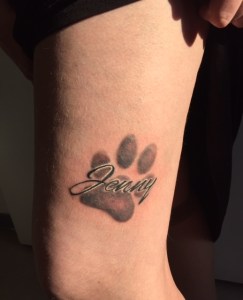
I never intended to keep my tattoo a secret. In fact, my dad reads my blog; I mentioned it here. But for people who’ve just met me or don’t read my blog or missed the whole half-a-sentence mention my tattoo got six months ago… here’s some details!
I chose to get it where it can be concealed in the workplace and shown off in a more casual summer atmosphere. Originally I wanted mine on my shoulder blade, but many friends told me in general tattoo-based conversations about their shoulder pain horror stories, so I nixed that idea. At the time I was working in business-to-business sales, and many colleagues had tattoos. I asked a couple of them where they got theirs done, called a couple of shops, and went in for one consultation.
I know many people who have TONS of tattoos; others are terrified of needles. I fall much closer to the “terrified of needles” camp, so I was kind of scared to get this done. Several friends (blind friends in particular) asked me about my experience getting a first tattoo, if it hurt, what my artist was like, how I knew things would be OK… the whole bit. I had to think a lot about it, because I lucked out; my one consultation was so easy and fluid that I never even considered getting another.
When choosing a tattoo artist, you’re effectively finding a doctor, a therapist and a graphic designer all in one. It’s an intensely intimate process and both artist and “canvas” need to be able to effectively communicate, otherwise…. not-cool things could happen… and they’re pretty permanent!
When I walked in for my consultation on an unseasonably warm Friday in January, I had no idea what I would be getting myself in for. The entire staff was warm and welcoming, and Jessie (the artist who would design and place my tattoo) and I sat and chatted about what I wanted, where, and how she could best describe her design for me as a blind customer. I’m pretty no-muss-no-fuss, and I wanted something I would be happy with but that wouldn’t be too elaborate (see above comments about needles). It was one of the easiest service-provider/customer conversations I’ve ever had in my life, and I knew I’d found the right tattoo artist. Money was pretty tight at that time, and so I told Jessie I would give her a call once things picked up and I could justify the expense, but I definitely wanted the tattoo. Not three weeks later I got my current job offer, paid my deposit, and asked for Ben’s thoughts on some drawings. He wanted his own tattoo, but different from mine, and on the first concept drawings Jessie hit the ball out of the park for both of us.
The designs had been chosen, I left Jenny at home, and I made my way back to the tattoo shop. I don’t know what I expected (some cubicle-style room with a curtain across it? Dingy dark corners where tattoos are applied in secret?) but the open airy room I entered with huge windows along the back wall definitely wasn’t it. While I was nervous about getting the tattoo, Jessie was great about putting me at ease. I even got to put on gloves and feel the tattoo gun (without needles) as it vibrated, and touch the needles in their sterile packaging. As I sat in the chair, Jessie went to work, describing everything she was doing, giving me fair warning if she was using a different needle (yes, they feel different), offering me a break if I needed. We talked about other things, too, like good food and dogs and work and business ownership… life, really. The time flew by, and while the tattoo application hurt a little, it really wasn’t that bad. Just over an hour after we got started, a bandage was placed over my freshly-tattooed skin, and it was done.
I remember telling Jessie at the time that I seriously don’t think anyone has ever just “gotten” communicating with a blind person so well. She admitted to feeling slightly uncertain about how much information to give, but she knew that everything she did would have to be described. One never would have guessed that I was her first blind client, though not her first with a disability (she mentioned having done piercings and tattoos for Deaf clients). Not only did I get a cool-looking tattoo, I got the seamless experience – the true luxury – of not having to explain anything at all about blindness or accommodations or humanity and disability. Remember when I wrote about a tattoo artist being like a doctor, a therapist and a graphic designer rolled into one? I hit the jackpot.
So, if you’re in Edmonton, hit up Jessie at Shambhala Tattoo. Tell her Jenny sent you… because, in a way, she did.


My tattoo of Jenny’s paw print with her name inside it


Summertime… when I Feel More… Respected?

24 Saturday Jun 2017

Posted by blindbeader in blindness

≈ 1 Comment

Tags

autonomy, blindness, dignity, employment, respect, sunglasses

This time last year I remember (and facebook reminded me) getting up for a 9:00 AM job interview. I opened my eyes and got hit with a sudden burst of intense stabbing pain… right in both eyes. I had two options: reschedule the interview (as I had already done the day before because I was feeling absolutely awful) or attend the interview with a light-sensitive migraine. If I chose the second option, I had two options stemming from that: suffer through it, or do the somehow stereotypical “blind” thing and walk in with sunglasses.
It was far from an easy decision. To me, sunglasses were for sunny days, not moderately cloudy ones, and absolutely never ever ever indoors. I looked so… blind in them (I still don’t know what I meant by that thought). When I asked several people I knew – sighted and blind – through the instant question-answer format of social media, I received so many answers, and many conflicted with each other. All paraphrasing is mine, but the general ideas went something like this.
“Absolutely not! Your interviewer NEEDS to at least have the semblance of eye contact.”
“Why not? Your eyes hurt; you need to be functional.”
“It’s SUCH a blind thing to do.”
“If they’re fashionable, wear them!”
I chose to wear the sunglasses. They had been purchased years before and were both fashionable and moderately functional for my purposes. The frames were basic black with round lenses, and they didn’t scream “blind person!” to anyone who looked at them. The instant I put them on, just before leaving my house, I felt my entire face relax, and the stabbing pain in both eyes magically disappeared.
The interview bombed. It bombed worse than almost any other interview I went on the year I was unemployed. It had nothing to do with my glasses, my headache, or anything else. The job and I were simply not a good fit.
But when I left the interview and went about my day, my sunglasses still in place, I noticed something else I hadn’t considered before.
People treated me better.
You see, if you were to look at my eyes directly, you would know that I am blind. My left eye is, for all purposes, unusable. My right eye won’t stay still. Walking down busy downtown streets that morning – even with a guide dog – while wearing those sunglasses, people seemed more inclined to make general non-blindness-related conversation with me, or accepted my assertions that I didn’t require their assistance. This old pair of sunglasses seemed, in a way, to be magical to me, to open a doorway to some previously rarely-found milieu of autonomy and dignity.
During the course of a few weeks, the more I wore my sunglasses, the less blind I appeared to others. The less blind I appeared, the more people left me alone (or at the very least respected my polite declining of their assistance, something they offered less frequently). I loved how it felt.
But those glasses I wore to that interview no longer flattered my face the way they had years ago when I had first purchased them. I needed, as a friend stated, a more fashionable pair.
So what does a girl do when she needs a stylish pair of sunglasses that she doesn’t need to see clearly through? She goes to Walmart, and finds the coolest, most professional-looking pair of sunglasses they have that also covers her eyes and flatters her face. I spent a grand total of $15 on my sunglasses, and the complements from friends, family, and strangers make me feel like I should’ve spent more. And when I wear them, people generally treat me better, like I’m any other office worker or customer or pedestrian.
I wonder why that is.

And I wondered why I had resisted them for so long.

When discussing this topic, I had no idea the types of division I would stir up. Some people were very comfortable with their choice to wear glasses, others firmly confident in their decision not to, and many fell somewhere in the middle. Comments ranged from “No blind person should wear glasses, ever, because it makes them look pathetic,” to “I wear them on sunny days because the glare bothers me, but I’m still uncomfortable doing so… it’s such a blind thing to do,” to “I wear glasses because my eyes hurt otherwise,” to “I wear them because I know my eyes are damaged due to accident or illness, so I wear them for the general comfort of those around me.” Others hadn’t considered them one way or the other, either because they were never encouraged to wear them, or because it was really never an issue; while my sunglasses made me look “less blind”, some believed that their wearing them would call attention to their blindness in a way that their uncovered eyes never do. Still others believe that wearing sunglasses means that they are hiding a part of themselves – their blind eyes – even if they are imperfect.

But one friend, whose blindness is due to Retinoblastoma, described in vivid detail being forced by parents or teachers to wear them. She would get in trouble in school if she took them off, and even now – as a grown woman – if she’s in her family’s company, the comment is made that she needs to wear them. Like it or not, she is judged on her appearance. Retinoblastoma can sometimes lead to facial scarring that may be off-putting to some, so some may argue that if it can be covered by makeup or glasses, then why not use them? And yet, my friend has a very complicated relationship to glasses today, for the simple reason that they were pushed at her so much as a child and teenager and even now as an adult.

A simple accessory to some, to others a way to make it through the day. To some they bring freedom, to others a sense of complicated shame. I had no idea that the job interview a year ago would start me on this journey of asking questions about an accessory that most people wear without a second thought. It’s opened up far more questions for me than it’s answered, and yet, I’ve made my own piece with my sunglasses. My cute sunglasses make others more comfortable with me, which makes me more comfortable with myself. I hate that this is so. And I hate that others would receive the exact opposite reaction because their uncovered eyes don’t make them look blind.

So for now, while the days are long and the sun is so bright that almost everyone has to squint to navigate the world visually, I’ll take that automatic respect that these lenses and frames seem to have granted me. Now the question is… can this continue in the winter?

Sugar and Spice and Everything Nice? Not on MY Life!

13 Saturday May 2017

Posted by blindbeader in blindness

≈ 10 Comments

Tags

autonomy, disability, grabbing, hard truths, respect

About three months ago, I started a brand new job. I love my job, the people I work with, the location… all of it. Working in a big building downtown wasn’t something I ever thought I’d do again, but I’m thrilled to be where I am. Jenny and I have been welcomed with open arms by colleagues, managers, building regulars, fellow transit passengers… just about everyone.

But working in a big crowded building also brings to the forefront something every disabled person has dealt with at one time or another: the grabbers. Sure, I’ve dealt with them before in other jobs or other places, but working in a very large building open to the public 5 days a week puts me in touch with many amazing people… and many grabbers.

And you know what?

I’m done being nice to grabbers.

Over the span of the past month, I’ve had numerous encounters with someone (several someones) who thinks that grabbing my body to direct me is acceptable. My shoulders have been turned to direct me, someone steered me by the waist, my hands and arms have been grabbed so frequently (and at one point so hard) that I swear I can still feel marks on my body from the other person’s fingers. Depending on the situation, the closeness of quarters, and the willingness of the other party to observe both visual and verbal queues, my reaction is situationally specific, made in a split second, when I’m not stunned motionless and speechless by someone’s lack of personal boundaries.

But why should I have to think about it? Why should I need to make judgment calls on an appropriate reaction on a frequent basis simply because I have a disability and people get weirded out about it? Why should I have to be nice because someone “meant well”? Meaning well means asking first. Meaning well means listening to my response. Meaning well means not doing something that would reasonably get one punched, kicked, screamed at or sprayed in the face if the action was directed at anyone without a disability.

And think I’m exaggerating?

A blind friend on a facebook discussion on this very topic “only gets rudely grabbed twice a week or so.”

Only?

ONLY?

There is no ONLY!

This behavior is unacceptable. We can all agree that able-bodied people aren’t frequently grabbed, manhandled, pushed, prodded, or otherwise bodily manipulated. We can all agree that such behavior is wrong. So why does disability make it right? The fact that it happens so frequently to people with visible physical disabilities that we think it “only” happens twice a week or so should appall you. The only time to grab someone is if they are actually falling and you need to catch them, or you need to pull them back from real danger (like an oncoming bus a split second away). That does not happen twice a week or so.

My tongue bleeds sometimes from my biting all of this back, from keeping quiet, from being nice. If I had fingernails, the palm of my right hand would have half-moon shaped scars from clenching my fist in my pocket. But I’m done bleeding and scarring because of my own desire to blend in, to simply go about my day. Grabbers, you are the problem, and I’m done taking out my frustration on myself. I’m done being nice because being nice has gotten me – and society – nowhere. So your intentions don’t matter; keep your hands to yourself. I’m taking my equality into my own hands. A woman without a disability can fend off an attack? Your firm grip on my hand, wrist, arm, shoulder, hips, waist, or mobility aid without my knowledge or consent is an attack, and I will respond accordingly. If grabbing me is your way to ensure my safety, I plan on learning and training and finding out how I can keep myself safe… from you. You don’t ask me if I want your help; you think you can and should decide for me. That decision is not yours to make.

Book Review: The Untold Story of the Talking Book

31 Saturday Dec 2016

Posted by blindbeader in Book reviews, Nonfiction

≈ 1 Comment

Tags

access, audio books, autonomy, censorship, reading

I remember taking a road trip nearly 20 years ago and wondering what in the world I would do during the 9 hours I’d spend in transit each way. I visited my father not long before I left, and he handed me three plastic cases from the local public library, each of which contained two or three cassettes. This was my introduction to talking books. Sure, as a child, I had books with songs or sound effects, but so did the neighborhood kids. Braille books were always available, but they were big and bulky and cumbersome to transport – if I finished the volume(s) I brought with me, I could find myself without reading material at all, and bringing more than one or two volumes would take up just as much room as a small suitcase. At eleven or twelve years old, those three plastic cases with their two or three cassette tapes were my entree into the world of a more portable reading solution.
Over the past twenty years, the world of audio books has changed drastically. From those first books – abridged, in my opinion, to their detriment – to the unabridged audio books on tape or CD that became popular (if costly) at the turn of the century, to the repositories of digital downloads for rent or purchase… no one can deny that audio books are here to stay.
When I first discovered Matthew Rubery’s “The Untold Story of the Talking Book” I waited for months to read it. Of course, I listened to it in audio format; it just seemed most appropriate.


About the Book


Histories of the book often move straight from the codex to the digital screen. Left out of that familiar account is nearly 150 years of audio recordings. Recounting the fascinating history of audio-recorded literature, Matthew Rubery traces the path of innovation from Edison’s recitation of “Mary Had a Little Lamb” for his tinfoil phonograph in 1877 to the first novel-length talking books made for blinded World War I veterans to today’s billion-dollar audiobook industry.
The Untold Story of the Talking Book focuses on the social impact of audiobooks, not just the technological history, in telling a story of surprising and impassioned conflicts: from controversies over which books the Library of Congress selected to become talking books – yes to Kipling, no to Flaubert – to debates about what defines a reader. Delving into the vexed relationship between spoken and printed texts, Rubery argues that storytelling can be just as engaging with the ears as with the eyes and that audiobooks deserve to be taken seriously. They are not mere derivatives of printed books but their own form of entertainment.
We have come a long way from the era of sound recorded on wax cylinders, when people imagined one day hearing entire novels on mini phonographs tucked inside their hats. Rubery tells the untold story of this incredible evolution and, in doing so, breaks from convention by treating audiobooks as a distinctively modern art form that has profoundly influenced the way we read.


A Note about Audio


Many of my readers access reading material through audio book libraries, whether through their state or federal library for the blind, through their local public library, or through online resources featuring books on CD or digital downloads for rent or purchase. The narrator of Rubery’s book, Jim Dennison, reads the book straight through, with neither dramatic flare nor flat intonation. It was mildly disconcerting listening to such a narrator reading a passage about “How to Read a Talking Book.” But Dennison is a good narrator choice for this book, letting the text stand on its own… and stand, it does.


Blindness is Prominent


Unlike many authors that include a few token quotes from blind people, Rubery shies away from making them out to be incompetent or demanding or whiny. He describes blind people as having particular needs (inclusion, literacy) and vastly different opinions of what that would look like. Some were portrayed as grateful for any literature at all, while others are more particular about the types of books available. Some wanted to read about those who went through the journey of blindness, while others preferred escapism. This provides a look into blind people as individuals, with different personalities, preferences and expectations. He also describes the challenges of learning braille later in life, or transporting braille volumes for those who read braille, or the limited number of books made available. In addition, he provides compelling scientific evidence (written in an accessible style) that reading with the fingers or the ears uses the same brain activity as reading with the eyes, putting the visually impaired only at a disadvantage to their sighted friends or family due to the lack of access to reading material.


Not a Dry (Audio) Book


Rubery not only discusses the history of talking books – from their inception to the present – but does so logically and with nuance. From the early days where the hope for talking books was surpassed by the technology available at the time to the present day where almost everyone has some form of talking book somewhere (on their phone, in their car), he takes us on a wild ride. I found myself most interested in the inception of talking book libraries in the 1930s. How were books chosen? Was there censorship involved? Were the blind needing protection from unpleasant topics? Did narration matter? With a finite supply of funds, what would appeal to the widest variety of people? When audio books became more popular, what made some publishers more successful than others? From “public” playing of talking books in one’s living room (a BIG no no!) to the idea that any form of “hearing” books being viewed by society as “lazy”, I found myself wrestling with some of those questions, even as I read an audio book while making dinner or going for a run.

And talking books are constantly changing, even today. Now, books on CD are still available for purchase by consumers and libraries, even as digital repositories are gaining popularity. Some audio books for adults have included (as they did for children all those years ago) sound effects and music to enhance the experience. Rubery provides a compelling case that there is room in the marketplace for audio books as they are, and as they will become in the years ahead.


Conclusion


A seasoned audio book consumer, I learned a lot from this book. From the little things (like why some libraries for the blind include warnings about violence or strong language in their book descriptions) to the big things (wondering how the printed word became so “sacred” after cultures used oral storytelling for centuries), there is much to take away from this book. Whether you read it with your eyes or your ears, it provides much food for thought and interesting discussion.

4/5 stars.

The Easy Life

09 Friday Dec 2016

Posted by blindbeader in blindness

≈ 9 Comments

Tags

autonomy, dignity, disability, employment, love, marriage, perception

One thing I’ve noticed over the years, particularly as it comes to interpersonal dynamics, is the idea that my life with a disability is so hard. I frequently encounter perceptions of strangers that I am unable to cook a meal, hold down a job, or raise a family, all because of my disability. Then there’s the confusion about what disability I actually DO live with every day. I, a blind woman, am perpetually told that I MUST need the elevator, rather than the flight of stairs to which I was asking directions. My friends who are deaf or hard of hearing have frequently told me of their experience of being spoken to in very. slow. and. measured. words – complete with sweeping arm and hand gestures – or having written conversations in what amounts to broken English because of the perception that they do not understand complete sentences. I’ve witnessed a friend in a wheelchair being spoken to like a small child, rather than the competent adult she is, simply because she is seated and therefore shorter than most adults.
Do you know what all this has in common? It’s someone else’s discomfort around disability… and not the challenge of disability itself. Most of us with disabilities have reached a place where the tools of disability are second-nature to us – how to navigate the world, prepare food for ourselves, take care of our bodies. We realize that many people haven’t gone through Disability 101 (a seemingly mandatory course in the school of Disability Acceptance that sometimes takes months, sometimes years to master), and we’re generally understanding of mistakes along the way. What doesn’t seem to make sense to us is the idea that a non-disabled person’s job is to make our life “easier” or “better.” Not only that, but the perception is that it’s up to the non-disabled person to decide what we require – a seat on the bus, a spot closer to the front of the lineup, an elevator instead of stairs – frequently putting us in situations where we have to firmly make our needs known because we were never asked in the first place. This then causes the “well-meaning” non-disabled person to call us ungrateful, rude, abrupt, or pushy for simply asserting our autonomy… because, after all, they “meant well.” We often are forced to have nerves of steel, to bottle up feelings of frustration and anger, not because our disability is so hard, but because it’s so exhausting being used as a “teachable moment“, or having to assert our desires and rights to work and play and access the same facilities that are so often taken for granted.

But you know what/ I’ve discovered? I can have nerves of steel, I can advocate perfectly for myself, I can say all the right things with a perfect tone… and I STILL am misunderstood. I hate that I have to write this, because admitting it means I need something from you. It actually IS your job to help make my life easier, and that of other disabled people in your sphere of influence. But you don’t get to pick and choose what would make our lives easier. In a beautifully eloquent post, my new friend Chris so eloquently wrote about the things that are easy – opening doors, giving us your place in line, offering your seat on the bus. In reference to the big things, the important things, the things that include us in society (work, education, opportunity) “… you’d gladly give me a seat on the bus, but how would you feel giving me a seat on the Board?”

What we want from you takes work on your part… and yet, it, too, is easy. It’s letting go of your perceptions and allowing us to be human beings, with the same hopes and dreams and desires and weaknesses that you have. Would you like to be the only person sitting in the living room during Christmas dinner preparations, twiddling your thumbs, offering to help and being told no, just sit there and look pretty? It happens to disabled family members all the time, and when we attempt to insert ourselves, it becomes an argument that ultimately makes everyone lose. Would you like to be told that you can’t get married to the love of your life? It happens to disabled couples all the time – either due to meddling family members or frustrating bureaucracy. Would you like to be told that your work experience is perfect but then get told that the company hired someone else, but that you’re so “inspirational” for showing up? I have lived this and witnessed this unprofessional attitude over and over again. How about stating a preference for certain activities and being told that it’s “so stereotypical” or too outlandish… for YOU, not for anyone else. Yep… lived that, too.

This is the big stuff, the stuff that makes life textured and complex. It’s frustrating that my own autonomy is so dependent on a non-disabled public listening and learning and letting go of their preconceptions. It’s frustrating that being treated with dignity and autonomy and respect, being provided with helpful information the first time we ask, being listened to when we politely self-advocate is the very rare exception to the rule. I’ve been offered more bus seats than I believe I’ve been thoughtfully considered for jobs for which I am qualified. I’ve been grabbed to direct me more often than I’ve been told that my husband and I are a cute couple just because we love each other, even as the ring on my finger is immediately obvious. I’ve been offered assistance and guidance for which I am extremely grateful, but I’ve also had it foisted on me. The little things do make our lives easier, and they do matter, and they matter a lot. But the big things – employment, education, love, autonomy, respect, consent – matter more, and those things truly do make our lives easier.

You’d gladly give me a seat on the bus, but how would you feel giving me a spot in your kitchen, an important position in your office, an evening babysitting your children, an opportunity where my skills and experience can stand on their own, a day at the altar… or a seat on the board?

Book Review: The Reluctant Midwife

30 Wednesday Nov 2016

Posted by blindbeader in Book reviews, Fiction

≈ 2 Comments

Tags

autonomy, compassion, disability, midwifery, parenthood, sexuality

There are three topics that will almost always make me want to pick up a book: the Great Depression, midwifery, and Appalachia. Put them together, and I HAD to read Patricia Harman’s Hope River novels: The Midwife of Hope River (TMOHR) and The Reluctant Midwife (TRM). While TMOHR, in this reader’s opinion, has much more charm and depth, I am reviewing TRM due to its themes of disability that run through much of the novel.


About the Book

The Great Depression has hit West Virginia hard. Men are out of work; women struggle to feed hungry children. Luckily, Nurse Becky Myers has returned to care for them. While she can handle most situations, Becky is still uneasy helping women deliver their babies. For these mothers-to-be, she relies on an experienced midwife, her dear friend Patience Murphy.
Though she is happy to be back in Hope River, time and experience have tempered Becky’s cheerfulness-as tragedy has destroyed the vibrant spirit of her former employer Dr Isaac Blum, who has accompanied her. Patience too has changed. Married and expecting a baby herself, she is relying on Becky to keep the mothers of Hope River safe.
But becoming a midwife and ushering precious new life into the world is not Becky’s only challenge. Her skills and courage will be tested when a calamitous forest fire blazes through a Civilian Conservation Corps camp. And she must find a way to bring Isaac back to life and rediscover the hope they both need to go on.


A note about Audio

As many readers of this blog read via audiobook, I will say that the narrator, Heather Henderson, is competent but not stellar. There are portions that would have been conveyed more clearly with a second narrator; they are written in first-person point of view, like the majority of the book in Becky’s POV, but Henderson’s voice does not change enough to make this distinct shift. It’s not a bad audiobook, but these are quibbles to keep in mind.


Disability: Center Stage

TRM visits many characters first introduced in TMOHR. It is probably best that TMOHR is read first, but Harman deftly describes what the reader may have missed. In theory, four years have passed since the end of TMOHR, but so much has stayed the same, even as a couple of characters have married or moved on. There are several physically disabled characters in this book (TRM), many of them mothers or women who wish to become mothers, who had brief side roles in TMOHR. This is a terrific departure from most fiction, which seems to portray disabled characters as having no sexuality. What’s also refreshing is that no one seems to bat an eye at Lily, a blind woman (who possesses angelic qualities and finely-tuned senses of hearing and smell – with which I have my own quibbles), raising a child with her husband. Ideally, Harman could have further explored this avenue of Lily’s life – as it’s not uncommon for parents with disabilities to have to prove their fitness as parents – particularly since Lily interacts frequently with Becky Myers, the nurse/midwife. Another character, paralyzed due to polio, uses a wheelchair to navigate her home, and consults Becky when she believes she is pregnant. Again, no one seems to think twice about her carrying a child due to her disability (though there are concerns due to the polio itself and a painful loss of a child years ago). Spouses and employers seem to want to make accommodations as needed for loved ones or employees to maintain their dignity and independence – wider doorways in the home, lower countertops and workbenches, setting up work projects for a blind spouse on bed rest. Again, this is a refreshing dip of the toes in the water of disability, dignity, sexuality, and parenthood, which could have made this book thoroughly enjoyable, but…


Some Big problems

Maybe it was a reflection of the times. Maybe it was the author’s point of view. Maybe it was an ending that was too neat and tidy. But Becky Myers herself was truly unlikable and seemed to lack the compassion of those in the helping professions. She worries about everything and is truly inexperienced as a midwife, something I found bizarre for a woman who ran a women’s health clinic for years. When the doctor she’s been assisting for years develops disabilities of his own, she totes him around like a pet, speaks to him like a dog, resents his presence, presumes him incompetent… Becky may have nursing training, but either has no compassion for some of those in her care or hasn’t developed the skills to avoid burnout. Words like “cripple”, “wheelchair bound”, and “sightless” are used to describe the townspeople with disabilities.

Dr. Blum begins the book unable to care at all for himself, but slowly gains independence once others presume his competence. He poignantly describes having words to say but being frequently unable to express them verbally. But he himself is manipulative, knowing he can perform personal care tasks for himself but allowing Becky to do them for him, reads Becky’s journal without her permission or consent. Even so, he performs complex surgery when pressed into service and recovers too neatly and tidily, feeding the idea that illness needs to be cured completely in order to be happy…


Conclusion

TRM lacks the depth, humour and charm of TMOHR. Even so, it takes some important steps in the right direction, making physical disability intersect sexuality and parenthood. But it missteps in some painful, ableist ways as well. It’s worth a read particularly if you like TMOHR (which is warm and poignant a la “Call the Midwife”), but it’s worth noting some concerns about mental illness or other disabilities whose cause and symptoms are unknown or unpredictable. One can argue, maybe even successfully, that the language and attitudes were products of that particular time and place, but that can only take one so far. Some of the words, attitudes and ideas still persist today – even if beneath the surface – and it’s important to acknowledge that.

3/5 stars.

← Older posts

Subscribe

  • Entries (RSS)
  • Comments (RSS)

Archives

  • December 2025
  • January 2024
  • December 2023
  • April 2023
  • January 2023
  • December 2022
  • October 2022
  • June 2022
  • April 2022
  • January 2022
  • December 2021
  • October 2021
  • August 2021
  • June 2021
  • April 2021
  • March 2021
  • February 2021
  • January 2021
  • November 2020
  • October 2020
  • August 2020
  • July 2020
  • June 2020
  • April 2020
  • February 2020
  • January 2020
  • December 2019
  • November 2019
  • September 2019
  • March 2019
  • February 2019
  • January 2019
  • December 2018
  • September 2018
  • August 2018
  • July 2018
  • June 2018
  • May 2018
  • April 2018
  • March 2018
  • February 2018
  • January 2018
  • November 2017
  • October 2017
  • September 2017
  • August 2017
  • July 2017
  • June 2017
  • May 2017
  • April 2017
  • March 2017
  • February 2017
  • January 2017
  • December 2016
  • November 2016
  • October 2016
  • September 2016
  • August 2016
  • July 2016
  • June 2016
  • May 2016
  • April 2016
  • March 2016
  • February 2016
  • January 2016
  • December 2015
  • November 2015
  • October 2015
  • September 2015
  • August 2015
  • July 2015
  • June 2015
  • May 2015
  • April 2015
  • March 2015
  • February 2015
  • January 2015
  • December 2014
  • November 2014
  • October 2014
  • September 2014
  • August 2014

Categories

  • Blind Lady Gets Sh*t Done
  • blindness
    • My Sorta Kinda Maybe (In)accessible Life
  • Book reviews
    • Fiction
    • Nonfiction
  • Epic Road Trip of Awesome
  • Exploring Edmonton
  • Finance Friday
  • Guide Dog 2.0
  • New York vacation
  • The Empowered Series
  • The Intrepid Journey 2018
  • Ultimate Blog Challenge
  • Ultimate Blog Challenge, Part 2
  • Ultimate Blog Challenge, Part 3
  • Uncategorized

Meta

  • Create account
  • Log in

Support my blog!

Buy Me a Coffee at ko-fi.com

What’s gotten folks talking?

RoseQuartz's avatarRoseQuartz on If you Had Told Me…
Carol anne's avatarCarol anne on If you Had Told Me…
Annie Chiappetta's avatarAnnie Chiappetta on If you Had Told Me…
Carol anne's avatarCarol anne on Guide Dog 2.0: One Year L…
Carol anne's avatarCarol anne on Guide Dog 2.0, One Year Later:…
Carol anne's avatarCarol anne on Guide dog 2.0, One Year Later:…
Carol anne's avatarCarol anne on Guide Dog 2.0, One Year Later:…

Enter your email address here and receive new posts by email!

Join 207 other subscribers

Blog at WordPress.com.

  • Subscribe Subscribed
    • Life Unscripted
    • Join 207 other subscribers
    • Already have a WordPress.com account? Log in now.
    • Life Unscripted
    • Subscribe Subscribed
    • Sign up
    • Log in
    • Report this content
    • View site in Reader
    • Manage subscriptions
    • Collapse this bar
 

Loading Comments...