• So, who am I, anyway?

Life Unscripted

~ Living Life as I see it… or Don't

Life Unscripted

Author Archives: blindbeader

Feeling Comfortably Uncomfortable

07 Friday Nov 2014

Posted by blindbeader in blindness

≈ 2 Comments

Being  blind (or visually impaired) seems to engender the kindness and politeness of the general public.  But would you be surprised to find that many things that the public view as kindness are actually awkward at best or offensive at worst to the recipient?  I am not saying this to be ungrateful, vicious or mean; simply to point out that we receive some of the most patronizing – or the most gracious – acts and comments that you can imagine.


Let’s start with the word “blind”, which seems to have fallen out of favor due to avoiding hurt feelings.  The term “blind” seems to offend some people, as though I will break into tears if someone acknowledges my lack of sight.  I live with it every day, so am quite OK with someone else making note of it by simply calling it what it is.  But in their effort to avoid using the dreaded “b” word, strangers have stumbled over “sightless,” “visually challenged”, “sight impaired,” and more awkward or inaccurate descriptors.  I know a couple of totally blind people who take the term “blind” literally, so they will very rudely point out that they are not partially sighted, they are BLIND; conversely, I know some that have some vision who seem to be offended that someone dared to use the “b” word to them.  No wonder people try so hard to be inoffensive that they stumble all over themselves!  FYI, just speak naturally to me or anyone else who can’t see; a very very very very small minority of us get hung up on the language, or get offended at words like “blind,” “see” and “look.”


The general public seems to have a fascination with blindness and how we live our lives, so much so that we get asked quite rude questions.  Perhaps this is a way of making us feel like we belong, but in fact the opposite is true.  Several years ago, I was shopping for produce, and an employee was offering me assistance around the store (it takes less time and is more hygienic than groping all the produce to identify it).  We were on our way from the sweet potatoes toward the cucumbers when the employee – not unkindly, but rather suddenly – asked, “So, were you blinded in an accident?”  I was so surprised that I honestly couldn’t figure out how to best answer his question whilst picking my jaw up off the floor.  I assure you that questions regarding the cause of my blindness are not uncommon occurrences; I keep wanting to make up this terribly tragic story about a nasty chemical explosion that also gave me super powers, but I couldn’t do it with a straight face.


On the flip side, I often get told of advances in science that will restore sight (“Isn’t that awesome?”) or that I should get an operation so that my eyes will look normal (someone has actually told me this).  I suppose that since blindness is feared more than premature death, I suppose the general public assumes that anyone without sight would jump at these chances…. but I would not.  My life is too settled now to undergo such a risky procedure – and a risk is all it would be.


I have occasionally had well-meaning strangers shove money in my hand – this happened to my parents when I was a child, and only rarely to me personally as an adult.  I know that in some cultures the blind are unable to work, and in our own western culture the blind are woefully under- or unemployed.  Thankfully I do work full-time, and have not recently had someone put me in the awkward position of accepting a cash handout (though a while ago someone offered to pay for my lunch at a local diner, which I did accept).


But what happens when someone does something well-meaning and you have no way to decline and, frankly, you don’t wish to decline such an outrageous form of generosity?  I was faced with this several months ago when ten or twelve of us from our goalball team went out to eat for dinner after a practice.  We had ordered our food and drinks, and the staff was starting to bring our meals to the table, when the waitress came up to us and said that the gentleman at the table behind us wanted to pay for our meals, so our bill up to that point had been taken care of – appetizers, entrees, drinks, tip…  This was just so astounding to us – 10-12 visually impaired people (not all of whose visual impairment was obvious.  To this day I doubt I will ever forget it.  But I am not alone in receiving this kind of generous act; someone else put it better than I ever could, so I will let her speak for herself.


All this to say that I doubt we as blind – or visually impaired – people will completely eliminate the seeming awkwardness that surrounds our “otherness”.  But I think the more comfortable I am with myself, perhaps the more comfortable others will be around me.  But perhaps that has nothing to do with my blindness.  Perhaps it’s simply the way all people should try and live – with head high, saying things as they are but tempered with grace, a sense of humour, and the occasional funny story at the end of the day… chemical explosion, anyone?

All about guide dogs!

30 Thursday Oct 2014

Posted by blindbeader in Uncategorized

≈ 3 Comments

In the past year working with a guide dog, as well as hearing stories from friends who work with them, I figured it’s about time that I did a post solely dedicated to all things dog-with-job, specifically the general public’s reaction to them.

Why Now?

If for no other reason than I have been bombarded with inaccurate information and/or tons of questions over the past week.  Sure, I’ve had persistent questions before – and probably always will – and inaccurate information given to me from well-meaning people who might have seen a guide dog on TV; but the sheer number of them lately has prompted this.

Guide Dog Attitudes/Etiquette

I have been incredibly blessed to not deal with many extremes on this front:

– People trying to pet my dog.

When a dog’s harness is on, even if she’s laying down, she is working.  Yes, she’s cute, but please don’t pet her.  Some handlers will allow their dogs to be petted in harness, but only if you ask.  I am not one of them; my dog can be easily distracted on occasion, and it’s generally a bad idea to pet a dog you don’t know anyway.  Some people use signs on their dogs’ harness that say “Please don’t pet me; I’m working” or something similar.  I choose not to, simply because the less visible she is, the less likely I am to run into people indiscriminately petting her.

– People being afraid of my dog.

I play goalball on a sports team – and work in an office – where someone is afraid of dogs.  I have learned to keep full control on my dog so that contact between her and these individuals is minimal to nonexistent.  I only rarely come across strangers who are at the very least audibly freaking out at my dog.  Granted, on the rare occasions she will bark in harness, her bark is BIG, but her presence alone is not exactly frightening.

– Well-meaning people who offer assistance and then try and grab the leash/harness.

I haven’t gotten this myself, but I hear of it often.  Just as you wouldn’t grab the back of someone’s wheelchair, just don’t… please. Thanks.

– People feeding/leaving food for the dog.

Thankfully, this has been nonexistent for me.  I had one person once ask if they could feed her some beef jerky, but hey, asking questions isn’t a crime, even if I cringe at the thought.  But I have spoken to others who’ve had strangers come up and start feeding their guides while they are sitting on the bus, or throwing leftovers toward the dog.  Just don’t…

– People talking to the dog.

This is probably the one I get most often.  Someone will say “Good girl” to her if she does what I ask, or tell her directions when we are following them.  If Jenny is focused, I say something later, but if she’s being distracted I will stop and make her sit, tell whoever to please not talk to the dog, get an apology, and on we go!

Common questions/comments:

– “What’s your dog’s name?”

I don’t give this out in public, though I am sure that if I give her commands or try and re-focus her, her name does come out.  Most people understand this and are not offended.  I used to think about giving a fake name that didn’t sound like Jenny, but then it would perpetuate talking to the dog, sooooo…

– “What breed?”} (along this line) “Lab?”} / “How old?” (along this line) “She looks young!”

Jenny looks young, and sometimes acts young.  And she looks ALL Lab.  I suppose people ask these questions because guide dogs and their training is so fascinating.  Most schools use Labs and Golden retrievers, but there are German Shepherds, Dobermans, poodles, and other breeds that are trained as guide dogs; teams usually finish formal training (either school-based or owner-training) when the dog is 18-24 months, though occasionally a dog will graduate much earlier or later, or a match just doesn’t work out and a team completes training when the dog is 2.5-3 years old.  I don’t mind answering these questions (black Lab, 2.5 years old, in case your curious).

– “My uncle’s girlfriend’s cousin has a dog like that; it detects epilepsy!”

That’s nice… so?

– “How does the dog know when the light’s green?”

This one makes me laugh.  Dogs see the world similar the way a red-green colorblind person might, and rely on their handler’s input to cross the street.  Last year I unknowingly told Jenny to cross a street on a red light because there was no traffic pattern to follow and no audible signal at that crossing.  A coworker told me later that “Jenny had made a big mistake.”  I told him that she did what I asked, because all the information I had said that it was safe to cross the street.  It was MY mistake, not hers.

– “Your dog is so protective!” (along this line) }Does your dog bite?”

Ironically, I get given the comment, but not asked the question.  I have started asking people if Jenny’s baring her teeth or showing other protective behavior, which gets the response of “no, she’s just watching, and she’s so focused on you!”  How is that being protective?  Curious minds, and all that…

– “Does your dog bark?”

Yes.  She’s a dog.  She almost never barks in harness – most guide dogs don’t bark in harness – but yes, she has the lung power and capacity and volume to bark, and convincingly, too!

– “How does your dog know when to get off the bus?”

She doesn’t; that’s my job!  Although, she has a pretty good judge of where we are.  Often times, if we go a stop past where we normally get off, she will turn her head to nudge me.  I haven’t decided if this is a signal that I am an idiot, that she has to go to the bathroom, or that she knows where we usually get off and wants to tell me that there’s a change in routine… I’ll keep you posted.
– “Does your dog ever get to be a ‘normal’ dog?”

um… Yes, most definitely! Guide dogs are, above all, dogs. They need love, praise, stimulation, and yes, playtime.  Jenny is living proof that a dog can have too many toys – our house is littered with squeaker toys, tug ropes, balls, bones, and a whole bunch of other stuff.  She will initiate play, but will drop a toy with a thud when I use the words “Not now.”  She is probably pampered too much by some guide dog handler standards, but she knows she is loved and what is expected of her.  And as for socializing with other dogs…

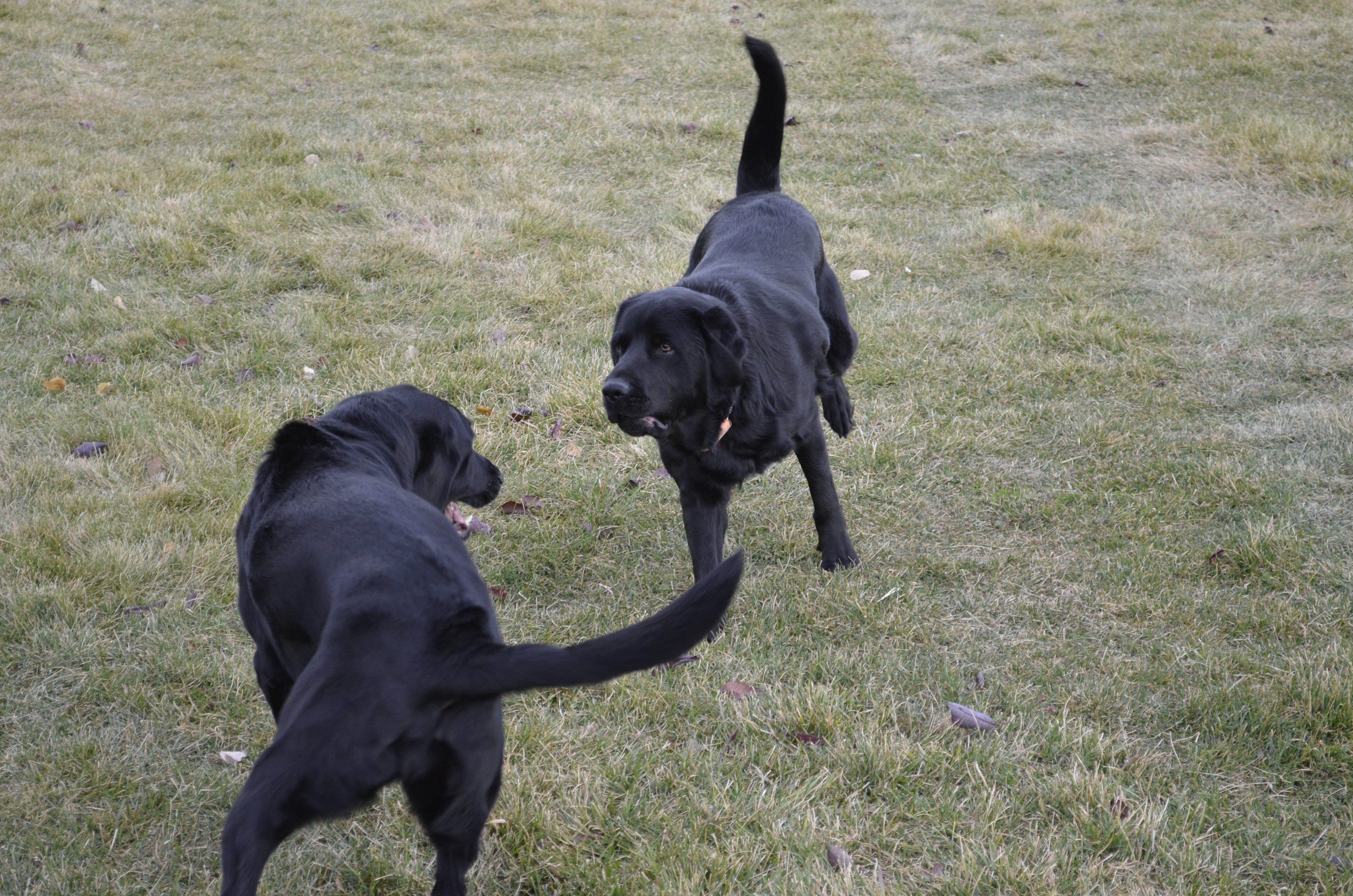
Jenny has a doggie… er… boyfriend? (picture courtesy of Benjamin Lang)

There will be further posts on guide dogs in the future – choosing to get a dog, why some people shouldn’t get dogs, access issues, traveling with your guide dog… but thanks for indulging my catharsis in writing an FAQ post.

Inspirational in the Ordinary

16 Thursday Oct 2014

Posted by blindbeader in Uncategorized

≈ Leave a comment

I have a rather ambiguous and complicated thought process when it comes to celebrities with disabilities, specifically blindness.  I love their accomplishments – Kayaking the Colorado River, traveling around the world on a motorcycle, safely exiting the World Trade Center on 9/11, inventing an alphabet so that other blind people could read and write, or being one of the best-known musicians of all time – for the ability to allow all blind and sighted alike to dream big, defy seemingly insurmountable odds, and battle fear, the elements, and forces beyond their control.  But I think their celebrity can sometimes do unintended harm to those of us who simply wish to belong.


What about those of us who live the seemingly ordinary life?  Are our careers, marriages, families, hobbies, hopes and dreams any less valuable to society?  I would argue that, in our ordinariness, we are just as valuable as those who make huge contributions in literacy, sport, or the arts.  As much as I hate to admit it, our desire to succeed is an “inspiration” to many (“If the blind girl can get a good job, marry, or have children, then what’s my excuse?”)  Conversely, I am often asked if all blind people sing like Ray Charles or Stevie Wonder, or display remarkable courage, or – on the other end of the spectrum – are socially awkward, or need someone to care-take us.  Today I saw a blog post following up this previous blog entry, and I love the lively debates that posts such as this, and their follow-up engender.


All blind people are different, just as all sighted people are different, and few if any of us wish to be viewed as inspirational.  On one hand, we are commended (primarily by a sighted public) for doing what we would consider ordinary tasks and criticized (especially by “super blind people“) for not doing more.


So, are we inspirational for doing inspirational things?  By living our ordinary lives?  By simply being content?  Does blindness in and of itself make us – me – inspiring?  I can’t say I have all the answers; perhaps you, my ever-enlightened readers, can help me out.  But for now, I have to go back to my ordinary job, text my ordinary husband a “Have a great afternoon!”, and be thankful every day for my ordinary – inspirational? – life.

Getting personal: On Belonging

09 Thursday Oct 2014

Posted by blindbeader in Uncategorized

≈ 2 Comments

Now that I’ve turned the great age milestone of 30 years old, you’d think that I would be more secure in my place in the world.  Funny thing is, I think I belonged more in my teenage years than I do now.


Being blind makes me stand out, period.  Most of my friends don’t mention it, bring it up, or even skirt around its edges unless strictly necessary.  But walking around and living my life, I am ever more reminded of it.  Little kids ask why my eyes “don’t look normal”; adults ask questions about my guide dog or offer assistance.  I am sure that my sighted husband, friends and family are kind enough not to tell me about the public staring at me, which would probably make me become unglued.  Any blind person on the planet who doesn’t think they stand out, even just a little, clearly doesn’t understand human nature.


Some Ways I Don’t Fit in in a Sighted World:

– I don’t like most movies or TV shows.  To me, they seem shallow, and I can’t get a mental picture of what’s going on around the characters and why they do what they do.  I have also found that I am sensitive to and overwhelmed by sound effects in many movies/TV shows.  Ironically, I’m married to a HUGE movie buff.

– How I use a computer or cell phone differs from those who can see.  Many people ask questions about how I navigate programs, read email, etc.  Sometimes this makes me feel like a bit of a zoo exhibit, but for the most part I don’t mind answering questions.

– I navigate the world through sound, using a guide dog.  Even using a cane, sound was my best navigating aid.  If I’m standing around looking like an idiot, more often than not I’m listening to try and catch my bearings.


On the other hand, I am feeling increasingly isolated from the so-called “blind community”, that seemingly all-powerful populus of blind people.  I felt this a little bit in high school, a little bit once I graduated… but in the land of social media, I acutely feel my unbelonging.  I recently emailed with another “loaner” like myself, who for years has been the only blind student in their school, workplace, college, whatever; it’s with these people I feel I belong.


Several Ways I don’t Fit in in the Blind Community:

– I am not a technology brand die-hard.  When I was growing up, technology was a tool to get work done; today, it is everywhere.  The blind community populus tends to tout companies like Apple while slamming others simply because of mistakes that were made years ago.  If someone wants to use an Iphone, it works for them, great!, but don’t judge me for using something different.

– I try my utmost to stay out of drama.  The “blind community” is a very very very small world.  Remember that “Six Degrees of Separation” craze years ago?  In the blind community, it’s like 2.  I can meet a blind person at a goalball tournament across the country who knows my best friend’s boyfriend.  Many blind people get into relationships with each other, and the ending of such relationships gets messy because of the truly small nature of who knows whom.  Yes, some of the relationships work out, and work well, and I am so happy for those people, but I’ve seen several of my blind acquaintances date each other and break up and not be able to maintain a clean break.  Honestly, I stay out of it, which adds to some of my isolation.

– I do not online radio-broadcast, and don’t understand the appeal.  On my Twitter feed, I see so many advertisements for 3-hour slots on online radio stations.  If it’s one’s hobby, and one does well, good for them… but I don’t need to see it all day from those I follow on twitter, who for various reasons don’t appear to be interested in school or looking for work.


This is not to say that I don’t have sighted friends, or blind friends… but the friends I do have are strong, confident, capable people who enrich my life as a human being.  My sighted friends love me for who I am, and the fact that we just sit and talk for hours; my blind friends have shared their burdens with me, and I’ve called them on bad days where I just don’t want to be blind.  What these people have in common is their own sense of belonging in the world, the confidence to take what life gives them, and to stretch beyond their own comfy bubble, blind or sighted, to befriend a grumpy 30-something billboard for someone who’s different.

Getting sappy: A very special day!

03 Friday Oct 2014

Posted by blindbeader in Uncategorized

≈ 3 Comments

Tags

anniversaries, blindness, guide dogs, travel

365 days ago, almost to the minute, I found myself walking into a Smitty’s restaurant in Westmount mall in Edmonton, Alberta, Canada with my guide dog, Jenny.  My heart was pounding and I remember steadying my breathing as not to give away my nervousness.  We got to the Smitty’s, and I sat down at a table with my husband and two other people…


This sounds innocuous, this walking into a restaurant with your guide dog to meet family and friends for breakfast… but it was graduation day!  On October 3, 2013, a BC/Alberta Guide Dogs trainer did one last supervised walk several hundred yards behind me, and, after terrific coffee and a yummy breakfast, Jenny’s harness was officially put in my hand for unsupervised guiding!


This all came on the heels of the most exhausting four weeks of my life.  I had quit my job the previous December, and it took me five long months to find employment at a call centre for a chain of pizza restaurants.  Most days after training with Jenny, we went straight to work, where Jenny conked out on a bed under my desk, and I used my cane while she heeled at my left side, wearing her stylish blue “In Training” jacket.  I learned how Jenny moves when she is happy, focused, distracted, had to use the bathroom, and wanted to get my attention; she learned how I wanted her to pace herself, give me clearance around objects beside or above me, and what behaviors were permissible and which were not.  We had good days – like the day of our first busy street-crossing when she pulled me out of the path of an oncoming bus – and bad days – like the first time she took the LRT and whined and shook the whole trip and tried to bolt off the train at every stop – and everything in between.  Even when she was off-duty and I was using my cane, she would still find me doors to the 7-Eleven or bus stop poles, sit quietly on the bus, and behaved herself impeccably while I was at work.  The last day of training ended at 2:30PM, and I remember being so drained that I sprawled out on the couch at 4:00 PM, and blearily got up long enough to go to the bathroom and climb the stairs to my bedroom where I slept until 5:00 the next morning.


It was an amazing rush, that morning of October 3, 2013.  It had signified that I had done it – I had survived the rigeur of training with a new young dog, and I had many of the tools I would need over the next 8 years.  It was also nerve-wracking; I couldn’t sit down with our trainer every morning and tell her the good, the bad and the ugly of the previous day.  I couldn’t always ask why Jenny did XYZ; I was, more or less, completely on my own..  I remember picking up that harness on October 3, 2013, and having no idea what to expect, not really.  I was full of knowledge from training, confidence in my dog, and thrilled for the journey to come.


The previous 365 days have not all come up roses.  I have made big mistakes; Jenny has made big mistakes.  Thankfully we have more good days than bad lately; I have been both encouraged by and encouraging to others who are in the complicated and wonderful trenches of guide dog travel.  Even on a bad day (like, er, yesterday) I would not trade the past year for anything.  I have been stretched, stressed, and blown away by the complicated canine that is Jenny.  She has nailed complicated tasks and completely flubbed basic ones; kept calm in an endless parking lot when we were unintentionally lost, but once got us lost in our own neighborhood; laid calmly for hours on her bed while I’m working and yet been unable to stay still while I am working out at the gym for an hour.


Unbeknownst to me, October 3, 2013 was just the beginning of a journey; it’s been well worth the work, the tears, and the moments of wonder.  As of this moment, Jenny is no longer a rookie guide dog!


Here’s to you, Jenny Pen, and to many more October 3s!

When compliments are Insults

24 Wednesday Sep 2014

Posted by blindbeader in Uncategorized

≈ 6 Comments

Tags

chatterbox challenge, comments, disability

“What a shame, you’re so pretty!”

Thus begins this article by the Huffington Post, bringing awareness to a social media campaign called the Chatterbox Challenge.  The aim of the challenge is to use the hashtags #ChatterboxChallenge and #heardwhilstdisabled to break the seemingly public yet unacknowledged silence and give voice to the hurtful comments that are leveled at people with disabilities, as well as raise funds for several Australian disability-centric charities.


I myself added a couple of tweets with the ChatterboxChallenge hashtag, figuring I could put into words things that I hear all the time as a blind woman.  I didn’t think anything more about it – much less considered writing a blog post about it – until two fairly well-known personalities got into hot water for heartless comments aimed at two people who just happen to be in wheelchairs.


Ten days ago, social media was abuzz when Kanye West called out two fans who did not stand like the rest of the crowd during one of his songs at a concert in Australia.  One of them waved a prosthetic limb in the air to show security (yes, security) that they were unable to do so, and the other was in a wheelchair.  The reviews of a follow-up concert indicated that Kanye changed his schtick to something like “If you are able, I want everyone to stand.”  Whatever one thinks about Kanye’s music, there is no reason for pressure to be exerted by a performer to all but force anyone for any reason to do something they are not willing or able to do.


Then yesterday I saw this tweet:


<blockquote class=”twitter-tweet” lang=”en”><p>Nothing sadder than a hot person in a wheelchair.</p>&mdash; Ken Jennings (@KenJennings) <a href=”https://twitter.com/KenJennings/status/514125105426071553″>September 22, 2014</a></blockquote>
<script async src=”//platform.twitter.com/widgets.js” charset=”utf-8″></script>Ken


Jennings is quite possibly best known as the man who won 74 rounds of “Jeopardy!” back in 2004.  Since then he has appeared on other game shows and written several books, along with many other pursuits.  For someone who is seemingly so intelligent, comments like this demean both the utterer and the recipient.


Personally, the comments along this vain are backhanded compliments and full-frontal insults.  To say that it’s too bad that an attractive person has a disability indicates the worthlessness of that person.  Sure, everyone likes to be told they’re attractive, but to throw the disability into the equation removes any compliment that was intended.  People without disabilities would feel angry and insecure if someone walked up to them and told them that it’s too bad they have blue eyes because they are truly attractive otherwise.  But you don’t hear that happen, at least not publicly; instead, we with disabilities seem to be open season for insensitive comments that no one else would be expected to tolerate:


Ironically, it’s issues of employment and family life (and the issues that surround them) that seem to draw the most insults.  I have posted before a brief synopsis of my employment journey, so I will not belabor the point beyond saying that it is incredibly demoralizing to be told that we have the smarts, skills and education, but… well, sorry!  We’re just meant to be inspirational for living our lives the way other people expect to see as a “disabled” life.  As for families?  medical “professionals”, social workers, and even families act surprised and shocked that a person with a disability wishes to get married or have children.  Someone I follow on Twitter posted that a former friend told his wife that she shouldn’t have babies with him because he’s blind.  In a worst case scenario, parents with disabilities seem to be at increased risk to have the children they do have taken away from them because of the perception that they are unable to take care of themselves, much less the most vulnerable of our society.


I have no problem answering honest questions about how I do things – cook, know where things are around my house, match my clothes – for the simple reason that people question what they don’t know.  Heck, I’m not above asking a few questions myself.  Last year I worked with a woman who used a manual wheelchair, and I had this crazy question for her.  I was a bit embarrassed, but I asked her what she did with all the cupboards above her apartment’s kitchen counters.  I know it sounds silly, but I honestly just didn’t know.  She laughed and told me she crammed everything in the lower-level cabinets and put things she didn’t use often into the upper cabinets with the help of family and friends.  This is the difference between asking questions and making patronizing comments that demean.  Here’s an idea: if you don’t want someone saying such a comment about you, keep your mouth shut and your hands off the keyboard.

I don’t want to be blind today

18 Thursday Sep 2014

Posted by blindbeader in Uncategorized

≈ Leave a comment

A friend on twitter posted a link to this blog today.  While for the most part, I do not like to complain about being blind, sometimes it is frustrating, and other times I just want to stand in an open parking lot and scream to high heaven and wonder why I am this way – not so much because I can’t emotionally handle blindness, but I can’t emotionally handle others’ perceptions of me being blind.


Thankfully, I have many sighted friends who can see beyond blindness, and blind friends I can call on days when I really and truly hate it.


I Don’t Want to Be Blind Today.

Did you hear that?

18 Thursday Sep 2014

Posted by blindbeader in Uncategorized

≈ 1 Comment

Tags

blindness, hearing, travel

One of the most common comments or questions I get is whether or not my hearing is more “in tune” than those who can see.  While science does indicate that the brain does compensate for lack of sight, I personally believe I hear as well as I do because I am more used to using my ears to hear the world around me.


The one main downside to this, as opposed to being able to see, is that there are only a handful of things that can obstruct one’s vision, but many many things that can change what one hears and how one relates to the world.


SNOW

Alberta (particularly southern Alberta) experienced snow in September last week.  Thankfully, the snow didn’t stick here, so I was in good shape to travel.  But after a big dump of snow like that, it makes travel much more challenging (ever hear of the saying “blind man’s fog”?)  It is very easy to get yourself turned around when there’s 3 inches of snow on the ground, unshoveled, and snow keeps flying; thankfully my guide dog is an old pro at navigating through such a quiet, occasionally slushy mess.  My friend Meagan wrote a very descriptive blog post that describes the challenges of navigating the snow; I will not belabor it.


RAIN

I grew up near Vancouver, affectionately dubbed the “wet coast”, so you’d think I would be completely familiar with changing my spacial relation when we get a big rainfall or a bunch of puddles on the roads.  Nope!  More than once I have waited more than one light-change cycle because cars driving through puddles sound like they might be in the turning lanes.  This isn’t a problem once that rain as stopped, but I don’t like the rain, refuse to carry an umbrella, and have a dog that hates to get rained on so much that I bought her a rain poncho; if it’s raining hard outside at the immediate moment, I am unable to multitask or think much about anything beyond putting one foot in front of the other and hope I don’t get splashed by vehicles speeding through the puddles.


HEAD COLDS

Thankfully for me, this is quite rare, but I am currently recovering from a pretty intense head cold.  Just before the worst of it hit, I came across a situation that I didn’t expect.  My ears were slightly plugged, and my nose was stuffed up beyond belief.  I took Jenny for a walk around the block, and at one point she slowed down.  Usually when she does this it means she’s found something yummy on the ground that she’s debating about picking up.  I waved her forward, and she took a right-hand turn nearly at a run.  For about two seconds, I thought “What in the world are you doing?”  And then I heard the car zooming past my left shoulder.  If we’d gone forward, we would have crossed a busy street with no crosswalk against the light into traffic.  Yikes!  I’ve since become much more cautious when I have a head cold.


CROWDS

Crowded buildings have a sound all their own.  Get a hundred people together in a room, particularly one with echo, and it’s anyone’s guess where anyone or anything is!  Even if it’s a familiar place, like a mall, sounds of laughter, footsteps, and screaming children bouncing off walls can make it a veritable “maze of mirrors” for the ears.


These are just a few things that continually change the dynamic of my auditory world.  We are more used to interpreting our world through sound, largely through necessity rather than desire, but it all does work more often than not.  We are continually forced to adapt, and for the most part, at least to me, it’s second nature.  Thankfully, today is sunny, my cold is nearly gone, and I am not going to be trapped in a crowded echo chamber anytime soon.

Employment: Perception and reality

10 Wednesday Sep 2014

Posted by blindbeader in Uncategorized

≈ 3 Comments

My wonderful friend Meagan has a terrific way of putting things into words as to be classy, confident, and even humorous as the situation calls for it.  Unfortunately, she recently ran in to a situation that could have nearly changed the course of her college degree and, ultimately, her career path.  Luckily for her, she was able to work around it, but the whole situation was based on one professor’s perception of course materials and Meagan’s ability to complete the coursework only in the manner in which it was being taught.


Sadly, this situation is far from unique.  After 30+ years as a blind person on this planet, I would like to think that I am used to having to educate the public on etiquette, access concerns, manners, and simply acting around me as they would anybody else.  Unfortunately, in areas of employment and education, there are still many obstacles to overcome.  Blind people have made leaps and bounds in the professional world, leaving their mark as lawyers, researchers, athletes, translators, business owners, and many others; yet a vast number of us are under- or unemployed.


The year I graduated from high school, I decided to take a one-year college certificate program.  I had even visited the program before applying, and the computer program in use at the time was completely accessible with JAWS, the screen reader software I used in order to use a computer.  One component of the class was a 2-week practicum placement in April.  A month before class started in September, I got a letter from the program coordinator, signed by the Disability Services office, stating (paraphrasing) that since I was blind and unlikely to find employment in this field of work, I would have to find my practicum placement before beginning classes in September.  This was a qualification for me only – my classmates were scrambling in February to find theirs – but lucky for me, my mother had contacts in the field.  I could have fought it, yelled and screamed and made a big stink, but instead we sent in eight letters from organizations across Alberta, BC, and the USA stating that they would be willing to accept me as a practicum student in April.  I was ultimately able to take the class and completed my practicum by doing actual work, rather than just sitting there and job-shadowing like my classmates.


Unfortunately, the disability services coordinator was right.  I applied for any local job I could get in that field, and as soon as it came out that I was blind, the door would just slam in my face.  It didn’t matter that I had gone through rigorous training and had the skills and aptitude for the job; it only mattered that I didn’t have two working eyeballs and needed a piece of software to be loaded on to their computers for access.  This all came to a head when I applied to a federal agency for a job across the country and requested permission to do the pre-employment testing locally.  This agency basically said that because I was blind, there was no way I could perform the duties of the position; one of their many reasons – some legitimate though not insurmountable concerns – was because I couldn’t read body language of coworkers to know that something was going on in an emergency situation (don’t get me started on my opinions on that).  I let it go, moved to Alberta, and tried again for the same job in Edmonton.  They called me in for testing, and I was told that because I was blind, they were sorry, they couldn’t possibly hire me for this job.

  My friends and family told me that I had a legitimate Human Rights complaint, but I was 20 years old and simply wanted to work, period.  I’d hit that point where I didn’t care what kind of work I did so long as I got my foot in the door somewhere and gained the self-respect of working for my pay check.  Looking back, I think perhaps I could and should have pursued it, but I still question the wisdom of taking on a federal government agency.


Fast forward several years, and I was once again back on the job market.  I had been steadily employed for more than seven years in a variety of jobs (the most recent of which had been for five years), and I was sending out resumes as fast as I could.  In this province, we have a shortage of workers; I would say that my callbacks to resumes was about 50% (incredibly high).  Over more than 50 interviews later – some good, some ok, and some terrible – I was still unemployed.  There was the security company that said that I couldn’t possibly be fast enough on a computer to respond to an urgent situation, and no amount of explanation or even demonstration would change her mind.  I had one positive interview with a company that was super excited to go paperless and was even willing to train me in basic accounting, but ended up hiring someone with accounting experience (I do NOT fault them here, as they stated up front that they were backlogged three months).  One company all but told me I could do the job, they would seriously consider my application, and then spent two weeks dodging my follow-up phone calls and then leaving a curt message on my voicemail stating that they had hired someone else…  All of this, and many shades in between.  Thankfully, after five months of unemployment, I wound up at an unglamorous call centre for a pizza place who treated me well and enabled me to train with my guide dog and still remain employed by changing my hours around training.  Once I got bored of that job, I sent out one single resume, figuring that I could be picky about where I applied… and after a 1.5-hour-long interview, I am now employed where I am now.  I work terrific hours, love my job, and my coworkers are fantastic.  My boss went to school with someone who is visually impaired, so he at the very least had some idea of the capabilities of someone who cannot see.  If something isn’t accessible, we brainstorm ways to make it so, or my boss changes the project to something that is accessible.  I am truly blessed indeed.


Sadly, many blind people are not employed as I am – happily, or at all – largely due to lack of experience, due to the perception that we cannot do certain activities (use a computer, keep workspaces tidy, proofread reports).  it is often customary for the blind job applicant to prove they have the skills before being hired – something that is rarely if ever required of a sighted job applicant.  We can dress ourselves up, have the perfect resume, nail the interview with confidence, class and grace… and yet…


I don’t have any easy answers.  Someone, somewhere, has to be brave enough to take a chance.  Many blind people spend years of schooling and thousands of dollars on education and still cannot get a job for which they are qualified.  While I know this is not unique to the visually impaired, statistics show that we are critically under-employed or unemployed (anywhere from 60-75% unemployed, many not even considered as part of the labor force).  We can push and shove and try and legislate, but the truth still remains that if there is a sighted job applicant in the running alongside a visually impaired one, there doesn’t have to be a good reason that the blind applicant does not get that job.


Where do we go from here?  I think it’s up to us to be productive members of society at any cost.  Live a well-rounded life with friends, family, pets, activities, volunteer work, hobbies, etc.  I cannot tell you how many people – sighted and blind – don’t have any real-world interests outside of the virtual worlds of computers and cell phones.  This can only serve to hurt us, and perpetuate the idea that blind people are just too different to fit in.  While some of us like to think that how we portray ourselves doesn’t matter, it definitely does.  If one comes across as ungroomed, socially awkward, and having very few interests and goals, does that not perpetuate the very perception we are trying to overcome?

Getting girlie: on Fashion and other things

04 Thursday Sep 2014

Posted by blindbeader in Uncategorized

≈ Leave a comment

Anyone who knows me will tell you that I am by no means super-girlie. Don’t get me wrong, I like looking nice with coordinated clothes, but I have no use for makeup and brand names by themselves generally annoy me (with the exception of sneakers).

Does this have to do with my blindness? I don’t know. I know many visually impaired women who love nothing better than to spend a day at the mall running around different clothing stores and trying out makeup. What I have noticed is that most of them have considerably more vision than me. Many sighted friends and relatives have told me that if I could just see how makeup can enhance my appearance, then I would probably enjoy fashion and makeup for their own sakes. Whether this makes a difference, or if this is simply a quirk of my
personality, I doubt I’ll ever know.

I do enjoy the occasional trip to the mall, browsing, what have you, but since my eyes don’t catch the displays in the stores, it’s a matter of feeling clothes to find what I like. It doesn’t matter how good something looks; if I hate the fabric, all bets are off. This has resulted in a wardrobe consisting of mainly neutral coloured pants/skirts with some more brightly-coloured tops. I love denim, especially stretchy denim, knit tops, cotton or stretchy shirts – anything with buttons on the cuffs – and long skirts. My shoes are almost always black or navy, if for no other reason than they go with everything.

Makeup? Yeeeeeeech! I have worn makeup several times in my life, and with the exception of some blush and lipstick, it feels really thick and cakey to me. Nothing near my eyes, thank you very much; you can have all the eyeshadow in the world.

I have spoken to several other visually impaired women over the years about this, both those who enjoy makeup and fashion and other girlie things and those who don’t. Thankfully this does not seem to be as divisive an issue as choices in technology, employment, or education in the “blind community”. If only we could all take a page out of this book and accept each others’ personal choices so easily.

← Older posts
Newer posts →

Subscribe

  • Entries (RSS)
  • Comments (RSS)

Archives

  • December 2025
  • January 2024
  • December 2023
  • April 2023
  • January 2023
  • December 2022
  • October 2022
  • June 2022
  • April 2022
  • January 2022
  • December 2021
  • October 2021
  • August 2021
  • June 2021
  • April 2021
  • March 2021
  • February 2021
  • January 2021
  • November 2020
  • October 2020
  • August 2020
  • July 2020
  • June 2020
  • April 2020
  • February 2020
  • January 2020
  • December 2019
  • November 2019
  • September 2019
  • March 2019
  • February 2019
  • January 2019
  • December 2018
  • September 2018
  • August 2018
  • July 2018
  • June 2018
  • May 2018
  • April 2018
  • March 2018
  • February 2018
  • January 2018
  • November 2017
  • October 2017
  • September 2017
  • August 2017
  • July 2017
  • June 2017
  • May 2017
  • April 2017
  • March 2017
  • February 2017
  • January 2017
  • December 2016
  • November 2016
  • October 2016
  • September 2016
  • August 2016
  • July 2016
  • June 2016
  • May 2016
  • April 2016
  • March 2016
  • February 2016
  • January 2016
  • December 2015
  • November 2015
  • October 2015
  • September 2015
  • August 2015
  • July 2015
  • June 2015
  • May 2015
  • April 2015
  • March 2015
  • February 2015
  • January 2015
  • December 2014
  • November 2014
  • October 2014
  • September 2014
  • August 2014

Categories

  • Blind Lady Gets Sh*t Done
  • blindness
    • My Sorta Kinda Maybe (In)accessible Life
  • Book reviews
    • Fiction
    • Nonfiction
  • Epic Road Trip of Awesome
  • Exploring Edmonton
  • Finance Friday
  • Guide Dog 2.0
  • New York vacation
  • The Empowered Series
  • The Intrepid Journey 2018
  • Ultimate Blog Challenge
  • Ultimate Blog Challenge, Part 2
  • Ultimate Blog Challenge, Part 3
  • Uncategorized

Meta

  • Create account
  • Log in

Support my blog!

Buy Me a Coffee at ko-fi.com

What’s gotten folks talking?

RoseQuartz's avatarRoseQuartz on If you Had Told Me…
Carol anne's avatarCarol anne on If you Had Told Me…
Annie Chiappetta's avatarAnnie Chiappetta on If you Had Told Me…
Carol anne's avatarCarol anne on Guide Dog 2.0: One Year L…
Carol anne's avatarCarol anne on Guide Dog 2.0, One Year Later:…
Carol anne's avatarCarol anne on Guide dog 2.0, One Year Later:…
Carol anne's avatarCarol anne on Guide Dog 2.0, One Year Later:…

Enter your email address here and receive new posts by email!

Join 210 other subscribers

Blog at WordPress.com.

  • Subscribe Subscribed
    • Life Unscripted
    • Join 210 other subscribers
    • Already have a WordPress.com account? Log in now.
    • Life Unscripted
    • Subscribe Subscribed
    • Sign up
    • Log in
    • Report this content
    • View site in Reader
    • Manage subscriptions
    • Collapse this bar