• So, who am I, anyway?

Life Unscripted

~ Living Life as I see it… or Don't

Life Unscripted

Tag Archives: inspiration

You Inspire Me! No… REALLY!

27 Wednesday Jun 2018

Posted by blindbeader in blindness

≈ 13 Comments

Tags

dignity, disability, inspiration, language

210208_0120Download

“You really inspire me.”

I hear this phrase regularly. It always makes me a little bit uncomfortable for a wide variety of reasons. Though I can sometimes hog a conversation, I really don’t like having attention drawn to me, and phrases like this make me blush. As an disabled introvert, my desire for anonymity is frequently at odds with the fact that I am highly visible because of my terrific – if sassy – guide dog.

But my own discomfort with being viewed as “inspirational” goes deeper than my desire to blend in, to go about my day, to enjoy my hobbies or go to work or meet friends for coffee.

And it wasn’t until very recently that I started to figure out why.


Inspiration: What it Means


Until writing this post, I had no idea there were so many meanings for the word “inspire.” Merriam-Webster includes phrases such as “spur on, motivate” and “to influence, move, or guide by divine or supernatural inspiration.” The Cambridge English Dictionary has a definition I particularly like: “to make someone feel that they want to do something and can do it.” There are other definitions, too. Some are archaic and are not used anymore – to “breathe upon”, for example. But others – such as Oxford English Dictionary‘s “Animate someone with (a feeling)” – make me think that this is what the general public means when they say I inspire them.

But if that’s the case… what feeling do I animate in them?

And is that all there is?

I argue that there’s more.

So very much more.


(De-)Valuing Inspiration


There are people who inspire me. Some are famous people – who made things or did things that changed the world. Some are everyday people, who show great commitment to their interests, sacrificial love to their families, and generosity to their communities. All of these people inspire me to dream big, to work hard, to learn from others and from myself, to love freely and live courageously. These are people who have made a tangible, quantifiable difference in my life. I don’t throw the word “inspiration” around much, because so often it’s been cheapened when directed at me – for no other reason than I’m a person with a disability getting out there and living my life. I refuse to devalue it – and the people I’m pairing it with – by using it in place of “I’m feeling charitable towards this person” or “this story gives me the warm fuzzies” or “this person makes me smile because they’re them.” These are nice things, in their own way, but not inspirational, especially if they wouldn’t even be talked about if there was no disability in the equation. The late comedian Stella Young put this better than I ever could.


Apologies for Speaking Truth


It appears I’m not the only one who has complicated feelings about telling someone they inspire them. A new old friend of mine just started training for a triathlon, and I recently commented on their Facebook post about how awesome and inspiring it’s been to read their journey and cheer them on through their successes. I waffled about the use of the word “inspiring”, but after some soul-searching I realized it was apt. Their story spurred me on to keep training on days when I just didn’t feel like it (which I found out last week inspired a neighbor to get out there and start her own fitness journey, so around and around it goes). In my friend’s response back to me, they told me that I inspired them by posting updates on my own running journey – even when my time and pace and distance all sucked. I can’t find the comment now, but there was something in there about “sorry to use this phrase, but…”

Just yesterday, a very close friend told me that my way of looking at the world inspired them to look at the world differently – not in a passing-glance kind of way, but in a true, worldview shifting sort of way. “I hope you’ll forgive this wording,” she wrote, “it inspires me every day.”

It broke my heart that such a lovely compliment – a true compliment from a good friend – had to be qualified like this.

And yet, I understand why.


Taking Inspiration Back


Let’s be inspired by true inspirational feats and figures. Let’s stand up and tell our friends and families how they encourage us to make a greater difference in the world and ourselves. Whether fighting injustice, raising a family, providing thoughtful commentary, training for a race, blazing new trails through employment or education or innovation, there may come a time that someone needs to hear that they are truly making a lasting difference in their little corner of the world.

If a stranger inspires us, let’s take a moment to discern why: is what they do and who they are making a difference in their world and/or our lives? If the person standing beside them did that same task or feat, would we view them as inspirational? If the answer is yes, great! If not, it’s time to examine our own thoughts and expectations – are we inspired because who this person is is truly someone to emulate, or are we placing our own limitations on them and they just happen to jump high enough to “overcome” them?

There’s a place in the world – and in our conversations – for inspirations. Let’s reserve them for people – some we know and some we’ve never met – whose example continually spurs us on, rather than brushes up against us and fades into the background.


Who Inspires You?


Since we’re talking about inspirations, who inspires you? Why? How? In what ways have they changed your life? I’d love to read your stories in the comments below!

The Empowered Series: Elegant Insights

03 Sunday Apr 2016

Posted by blindbeader in The Empowered Series

≈ Leave a comment

Tags

business, entrepreneurship, inspiration, taking risks

Believe it or not… some people actually do inspire me. As I have made clear to my readers, I am against the idea of people with disabilities in general (and blindness in particular) being viewed as inspirational for simply existing and going about our days. That being said, I DO feel inspired, and empowered, by people who blaze their own paths through entrepreneurship, creativity, and/or empowering others. As such, I am starting a monthly series on this blog – calling it the Empowered series – featuring an entrepreneur or artist and/or business owner who is blind or with other disabilities. Initially, I had planned this for the 15th of the month, but my first featured artiste is expanding her business through a group fund raiser, and I wanted to give her work some exposure…


Laura Legendary: Elegant Insights

Laura is the driving force behind Elegant Insights Braille Creations. After the sudden death of her husband only months after their marriage, she received a “worry stone” which had the word “survivor” engraved on it. On the other side, the same word was written in braille. The seed of inspiration was planted, leading to a years-long search for companies that provided brailled products that were also fashionable. Nothing quite fit the bill, so Laura started Elegant Insights five years ago, creating necklaces, bracelets, and charms that incorporated braille words like “love”, “cherish” and “hope”, or a customer can customize their own piece.


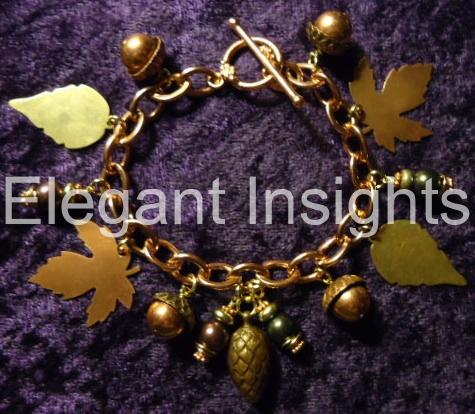
Scattered Leaves Charm Bracelet


A few Fun Facts

– Laura likes beautiful things that sparkle; one of her favorite things to work with is copper because of its shine. She remembers the sight and the “warm glow” of it.
– Not only does Elegant Insights create necklaces and bracelets, but purse charms and cane charms that provide some audible as well as visual style to standard white canes and purses and backpacks.
– One of Laura’s favorite things to do is find new sources for her stones, findings, and components.
– If she had to pick a favorite stone to work with, Laura admits that she’s partial to rose quartz and “anything purple.”


How she Does It

Laura has an eye condition called Retinitis Pigmentosa. Right now she does not have any vision, but she does have visual memory, and from a young age she has had a strong sense of fashion which hasn’t changed with the loss of her vision. She sources beads, findings and gemstones from a variety of sources; it’s one of her favorite parts of the creative process. Along with a small staff, she makes all necklaces, bracelets, and charms by hand, using standard jewelry-making tools. Everything is made in-house, including the braille components, and all staff have workshops or workbenches in their homes. Much of Elegant Insights’ business is done online, but a few times a year they are featured at trade shows and conventions.


What’s Next?

An opportunity has been presented to be featured through Amazon’s Handmade platform. This will greatly increase the exposure of Elegant Insights Braille Creations. In order to expand to meet the expected new demand for product, a crowdfunding page has been created. The funds raised will go to purchasing extra tools, supplies and findings, and hiring and training new staff. Laura would appreciate any donation or further exposure to help her novel business expand.


Even though I have had a hard time with the “inspiration” angle of things, I have a hard time denying that I am inspired by Laura’s creativity, novel products, and willingness to take risks. I appreciate Laura’s willingness to answer all of my nosy questions. Visit her website, support her work, share her insight… and look at all the pretty things!

A purse charm with a sun, moon, and stars motif. The word "Shine" is written in braille

When WE are the Problem

19 Friday Feb 2016

Posted by blindbeader in blindness

≈ 4 Comments

Tags

accommodation, hard truths, inspiration, perceptions

No one can deny that people with disabilities are treated by society at large much differently than able-bodied ones. Social media activism over the past couple of years has given voice to movements like #StopAbleism and #TheAbleistScript, where people with a wide range of disabilities have articulated comments and ideas that have been whispered around us, shouted into our faces, or become internalized in our own lives. This is not to say that the situation is hopeless – far from it – but though a lot of work has been done, we have a long way to go to be treated as equals in a world that simply doesn’t know what to do with us, and occasionally doesn’t seem to care if we speak up for ourselves.


But, you see, my dear readers, there’s a flip side to this equation. If we don’t hold ourselves up as true equals, then how dare we expect others to treat us as such? I’m not talking about receiving accommodations so that we can access the same materials, buildings and facilities as our able-bodied classmates, coworkers and fellow consumers; I’m talking about feeding into stereotypes of low expectations, social awkwardness, and refusing to engage that wider world that doesn’t quite see us as human. Be mad at me if you want, but someone’s got to pull no punches. You and I can be contributors to our own experience of ableism, discrimination, and inspiration porn. Here’s how.


Over-sharing of the Mundane: Low expectations

Blame the selfie if you want, but over the past few months I’ve seen a ton of blind people (in particular) posting frequent videos of themselves working their guide dog, taking the bus or walking through Target. Many of these are not product education, technology or skill tutorial, or even informational videos, which appear to be extremely popular these days, but they’re just chronicles of ordinary people doing ordinary things. Maybe sighted people do this… I don’t know. Or perhaps I have friends online who have better things to do with their time – like make cool bicycle-repair tutorials, or share awesome and obscure tunes from Youtube. Sure, everyone shares pictures of the biggest chocolate cake they’ve ever seen, posts videos of their dog going crazy seeing snow for the first time, or vents about their bad day… that’s all part of the human experience in the social media world. But I’ve seen many videos filmed by blind people that are just… life! And they share it loudly and widely as though it’s a HUGE accomplishment to show the world how their guide dog takes them through a local pharmacy. I’m not against sharing life experiences – the happy, the sad, the ones that make you raise your eyebrows – but these videos about how courageous you are for taking a bus in a new neighborhood (while it might be very true for you) perpetuate the idea that all blind people feel and act this way… and WE DON’T! If you need support and encouragement, YES, reach out and grab it with both hands. If you’re a talented singer or musician, post those videos, by all means… but blindness has nothing to do with your talent. Video is a powerful medium and, for good or for ill, it shows the things that we’re truly proud of in our lives, and frankly I want us to be proud of accomplishments because they are accomplishments in and of themselves. As my new friend Nicole recently wrote so eloquently:

Think about the larger, sweeping, massive ramifications of allowing someone to think your day to day is amazing, inspirational, courageous. Think about the fact that you’re not just allowing it, you’re encouraging it by creating and posting videos or articles that evoke EXACTLY that response.


Social Awkwardness: We Just Don’t Belong

Everyone has foibles, eccentricities, preferences, and quirks. It’s all part of the human experience. But perhaps because we’ve never been taught, many blind people fall into habits that are at best odd and at worst damaging to the rest of us. We should be comfortable with who we are, neither denying our blindness nor emphasizing it so much as to make us look like toddlers who can’t care for ourselves appropriately. A recent hashtag on twitter has become a “parody” of sorts, claiming to represent the “funny” side of blindness.I’m not against laughing at the funny things we’ve sometimes confused with others, but I have never found jokes infantalizing us (“discovering” we’re dressed in matching clothes!) or emphasizing blindie-clique dynamics (see below) funny. In fact, they perpetuate the idea that we’re just too strange and awkward to be taken seriously, and who wants to hire or educate someone so awkward or “other” for anything other than than a source of inspiration?


Social Isolation: Using Sighted People for their Vision

I am by no means belittling the support of others who share the journey of blindness and visual impairment; in fact, I posted about how awesome and supportive it can be not that long ago. But hiding ourselves amongst exclusively those same people does little to dispel the idea that we are somehow “other” and too “unique” to be bothered connecting with on any meaningful level. perhaps out of necessity (Canada has a small enough blind population that this is possible), or perhaps because I am social by nature, my world has been blessed with terrific friends, blind and sighted. But I notice many blind people who never ever seem to socialize much outside the blind community, with sighted people primarily filling in the role of driver or shopping assistant. This isn’t to say that I would turn down a ride offered by a friend, or indicate that I like grocery shopping alone (I don’t). Nor am I indicating friendships can’t spring out of such arrangements. But just as we wish to be viewed as people, we need to treat others in this way. Keeping exclusively, even primarily, to our social blindie cliques and relegating sighted people into primary positions of driver or guide is no better than us being confined to the role of musician or couch potato. In fact, it’s worse; we know how crappy it feels.


Abusing the System: Accommodation at All Costs

I’m a firm believer in computer programs, web sites, and buildings being accessible to people with disabilities. I also believe that it’s essential for workplaces or educational institutions to make all accommodations possible to include us on the job site or in the classroom, not only for our benefit, but for theirs. But it is also our responsibility to ease the way forward for our employers, our service providers, and our professors.If we can make the available mainstream technology work (and much of it works well), then it’s up to us to do so. Using exclusively specialized technology – a note-taker rather than a computer, for example – keeps the barriers to education and employment higher than they need to be, and perpetuates the idea that we’re just too hard to accommodate, so why should an employer or university bother? In many developed countries, it is not uncommon to receive some funding to cover what can be extreme costs of technology. I got stuck in a catch-22 system, where I couldn’t get funding without a job, and I needed that technology to be able to obtain a job. This is sometimes the case in other parts of the world, but sometimes people can receive funding before getting that job, and there are drawbacks to that system as well. Thankfully, it worked out for me, but it makes my blood boil when I hear about people who receive technology for simply searching for jobs who don’t obtain employment due to lack of serious effort, who don’t return loaned equipment, and sometimes don’t even use the technology anymore. It’s important for us to obtain the assistive technology that we need to be able to work, to study, to learn; but if it is not used to those ends, it’s time to be realistic and pass it along to people or agencies who are struggling for basic supplies. Hanging on to unused technology (particularly if it’s been funded) is expecting the preferential treatment we’re trying so hard to avoid. In many developing countries, access to even basic literacy tools like braille writers is almost impossible… and yet I hear of some people who get a ton of technology and don’t even bother looking for work. Stop it! Your complacency and entitlement makes it harder for the rest of us who actually need that technology to be productive. And to say nothing about obtaining employment…


Making Excuses: “Because I’m Blind!”

I am not one of those people who thinks everyone should be able to cook a 4-course meal, have a spotless house, and never ever ever ever EVER ask for help with anything. Frankly, living with the expectation of perfection is exhausting, and no sighted person is held up to those standards either. But it drives me up a wall when I hear the excuse “I can’t [insert activity here] because I’m blind.” OK, even though three years ago a blind man tested out Google’s self-driving car, the technology isn’t quite there for us to drive completely independently. Aside from that, blind people have done tons of great things – big and small – all over the world, from raising families to opening businesses to studying subjects they love. The possibilities are endlesss, truly, even if not all of us have the inclination to climb a mountain or open up a restaurant. But if you aren’t a good cook, or don’t like to clean, or don’t feel safe sky-diving, that’s your humanity talking; it is NOT because you’re blind. Don’t even go there!


Conclusion: Cleaning out the Dirty Laundry

I hate the idea that I am an ambassador for the blind, and yet, in some ways, I really am. And so are you. It’s a fine line between expecting perfection of ourselves and allowing low expectations to dictate the course of our lives. Both are extremely damaging and exhausting, and really not realistic. Ultimately, though, we can’t expect equal treatment until we avoid the pitfalls listed above. I never would’ve written this post had I not seen so many instances of this both in-person and online. And if I’m truly honest with myself, at points in my life I’ve even engaged in some of these problem mentalities and behaviors. But we can move on from this place. We can share our lives from the focus of our humanity, not our blindness. Even if it’s painful, we need to take a look around us and notice which of our behaviors make us stand out unnecessarily. Many people wish to befriend us, and it’s up to us to open ourselves up to the sighted world to challenge us and befriend us, not just serve us. While we still are viewed as needing the right to access, stop confusing our rights to access with abusing the ability to use the supports that are supposed to make it happen. And we must stop using our blindness as a license to be lazy and have everything done for us, because if we don’t, we’ll be back where we started, making videos of us sitting on the couch and writing blog posts…


I won’t pretend any of this is going to be easy. But I hope that confronting some painful realities about ourselves can spur us all to make some necessary changes. Is discrimination and ableism a problem? yes, it is. But sometimes, we’re the problem, and in those instances – and only those instances – we need to get out of the way and give the naysayers, the ableist and the discriminatory no valid reason to think that we’re useless, lazy, manipulative or uneducated. After all, as much as it’s up to us, let’s give them no valid reason beyond their own prejudice to discredit us… then they can look in the mirror and realize how they’ve contributed. But right now, I think it’s our turn…


*** UPDATE: Thanks to John and Brandon for tearing this post apart in a marathon podcast. Because of this, I have kept this post primarily intact, but did change a line you rightfully found offensive. I appreciate your opinions, and the fact that overall they came from a place of respect, even if you disagreed with me. This blog is nothing without readers and friends. I love constructive dialogue, and am willing to listen to any who respectfully disagree with any of my opinions. So, please, I welcome any further dialogue on this and other topics related to blindness, confidence, life…

Subscribe

  • Entries (RSS)
  • Comments (RSS)

Archives

  • January 2024
  • December 2023
  • April 2023
  • January 2023
  • December 2022
  • October 2022
  • June 2022
  • April 2022
  • January 2022
  • December 2021
  • October 2021
  • August 2021
  • June 2021
  • April 2021
  • March 2021
  • February 2021
  • January 2021
  • November 2020
  • October 2020
  • August 2020
  • July 2020
  • June 2020
  • April 2020
  • February 2020
  • January 2020
  • December 2019
  • November 2019
  • September 2019
  • March 2019
  • February 2019
  • January 2019
  • December 2018
  • September 2018
  • August 2018
  • July 2018
  • June 2018
  • May 2018
  • April 2018
  • March 2018
  • February 2018
  • January 2018
  • November 2017
  • October 2017
  • September 2017
  • August 2017
  • July 2017
  • June 2017
  • May 2017
  • April 2017
  • March 2017
  • February 2017
  • January 2017
  • December 2016
  • November 2016
  • October 2016
  • September 2016
  • August 2016
  • July 2016
  • June 2016
  • May 2016
  • April 2016
  • March 2016
  • February 2016
  • January 2016
  • December 2015
  • November 2015
  • October 2015
  • September 2015
  • August 2015
  • July 2015
  • June 2015
  • May 2015
  • April 2015
  • March 2015
  • February 2015
  • January 2015
  • December 2014
  • November 2014
  • October 2014
  • September 2014
  • August 2014

Categories

  • Blind Lady Gets Sh*t Done
  • blindness
    • My Sorta Kinda Maybe (In)accessible Life
  • Book reviews
    • Fiction
    • Nonfiction
  • Epic Road Trip of Awesome
  • Exploring Edmonton
  • Finance Friday
  • Guide Dog 2.0
  • New York vacation
  • The Empowered Series
  • The Intrepid Journey 2018
  • Ultimate Blog Challenge
  • Ultimate Blog Challenge, Part 2
  • Ultimate Blog Challenge, Part 3
  • Uncategorized

Meta

  • Create account
  • Log in

Support my blog!

Buy Me a Coffee at ko-fi.com

What’s gotten folks talking?

Carol anne's avatarCarol anne on Guide Dog 2.0: One Year L…
Carol anne's avatarCarol anne on Guide Dog 2.0, One Year Later:…
Carol anne's avatarCarol anne on Guide dog 2.0, One Year Later:…
Carol anne's avatarCarol anne on Guide Dog 2.0, One Year Later:…

Enter your email address here and receive new posts by email!

Join 207 other subscribers

Blog at WordPress.com.

  • Subscribe Subscribed
    • Life Unscripted
    • Join 207 other subscribers
    • Already have a WordPress.com account? Log in now.
    • Life Unscripted
    • Subscribe Subscribed
    • Sign up
    • Log in
    • Report this content
    • View site in Reader
    • Manage subscriptions
    • Collapse this bar
 

Loading Comments...