• So, who am I, anyway?

Life Unscripted

~ Living Life as I see it… or Don't

Life Unscripted

Tag Archives: blindness

To the Parents of Blind Children, Part 2: Your Child Deserves More

27 Saturday Jan 2018

Posted by blindbeader in blindness

≈ 1 Comment

Tags

autonomy, blindness, children, dignity, disability, independence, parenthood, parenting, pity

I stated in my previous post that I am not a parent. I will probably never know first-hand what challenges a parent faces. Throw an unexpected disability into the mix, and I can honestly say I have no idea what decisions I would reach or mistakes I would make. We are all human; mistakes are inevitable. But they don’t have to determine the course of a child’s life.

I’m a blind adult who has experienced the joy of being a child, whose parents truly did some amazing things to make sure I was as happy, healthy, and autonomous as possible. It wasn’t until I started high school that I began to realize that not all of my peers – especially my blind friends – were given such opportunities and freedoms. As I grew older – through my twenties and now that I’m in my thirties – I frequently notice a truly stifling dynamic toward blind children by their parents. Will some parents be helicopter parents anyway? Absolutely! But when there’s a clear difference in how siblings are treated along disability lines – something I observe regularly – it becomes abundantly clear that blind children are frequently short-changed.

It doesn’t have to be this way. Your blind child deserves so much more…


Your Child Deserves more than A Diagnosis

A diagnosis of vision loss can be devastating, or it can offer a sense of relief. it should neither be hidden from your child nor the focal point of everything they do. I have several friends who struggled so unnecessarily as adults because their parents chose to withhold their child’s vision-loss prognosis from them altogether or denied their child’s expressions of frustration about not being able to process visual information. Others struggled to learn the life skills their siblings learned by imitation because their parents feared their lack of vision would make the tasks impossible. Many have expressed to me that they would have felt less alone if their parents had chosen to be open about their medical information, and they would’ve felt more secure in the world if they didn’t have to learn basic tasks as an adult because their parents were so “stuck” on their blindness. Growing up is enough of a challenge without having to overcome years of denial and lowered expectations.

Vision impairment or blindness is not the only aspect of your child’s growth and development. Just as your height or race or gender is one aspect to your humanity, your child’s blindness is only one lens through which they experience the world.

Your Child Deserves More than Hope for a Cure

I’m one of those people who would not want a cure for blindness if such an opportunity presented itself. Even with my limited vision, I find visual input extremely overwhelming, and the idea that I am broken because my eyes are is truly bizarre to me. And yet I truly respect the desire that some have to regain the use of vision they or their children have lost, or halt the progression of the deterioration of their visual world. Ultimately, the hope for restoring or improving vision should never be at the expense of showing a child how to live confidently and successfully in the here and now; in no way are the two mutually exclusive. Just as a child with diabetes can hope for advances in science and technology to improve their condition and the care of it as they grow older, they still have to learn to monitor what they eat, be aware of their body’s signs of illness, and advocate for what they need if they need to, a blind child can do the same. Why does blindness sometimes facilitate hope for the future at the expense of the present?

But some parents (and medical communities) look into the future and see only fear. The fear of blindness itself. Some fear blindness SO much that they gamble with their child’s life.

One cause of blindness in children is retinoblastoma, a malignant tumour that begins in the retina. Because the tumour can spread to other parts of the body, it is frequently necessary to choose between radiation and the removal one or both eyes when the child is very young. Some parents – on the advice of a medical community that frequently view life without vision is worse than no life at all – choose to take drastic measures to save their child’s vision rather than their life. Is vision really worth more than a full and complicated and messy life? More than a life like the one that you live?

And yet, there are some parents who I can only applaud. They are choosing to treat their daughter’s retinoblastoma with a revolutionary treatment. I not only admire them for their hope and belief in the progress of medical treatments, but because they want to save their daughter’s life and her vision (because, at this point, her vision seems unaffected by the tumor). A quote from her mother in the above article has stayed with me since I read it: “I know that Dania will be successful in whatever she does and if she does have her eye or if she doesn’t have her eye, I think she’ll be fine.”

She will be fine.

Vision is never ever ever worth more than a life.


Your Child Deserves More than Isolation

Sure, some kids are introverts, some are extroverts. I happen to be an incredibly outgoing introvert, which confuses people on many levels; it wasn’t until I was in my mid-twenties that I truly began to embrace my introverted personality, and I find myself better for it. These days, I’m an adult, and I choose when and with whom and for how long I interact. But when I was growing up, I was greatly encouraged to be social, and there were many neighborhood children who were willing to hang out with me. Sure, I didn’t “get” cartoons – even as a child, my idea of “entertaining” TV was an episode of “Jeopardy!” with my parents before bed – but when I had more vision I was more than content to rollerblade or ride my bike or traipse around the neighborhood with my friends. When it came to school, I was content to do my own thing on the playground – sometimes with other kids, sometimes without – but I didn’t make a solid group of friends until high school. I hung out with the science nerds who were more content to get good grades than to party on the weekends, and that suited me fine.

But even as a teenager I noticed how frequently my other blind friends isolated themselves behind books and games and computer screens – not necessarily because they wanted to, but because they felt too awkward to approach their peers (and, in Canada, most of your peers are people who can see). Sure, even the most outgoing person faces insecurity about how they are perceived, and I would never presume that unhealthy or bad “friendships” are better than no friendships at all. But many of my blind friends were left on their own in their rooms to read or chat online or otherwise isolate themselves while their siblings were encouraged or supported to go out there and hang out with their peers. As an only child who saw many sibling dynamics play out, those between my blind friends and their sighted siblings – and how their parents frequently treated their social development – stood out in stark contrast to me.

Of course, social development can never and should never be forced. I hated it when a teacher singled me out (on the rare occasions they did) for other students to work or play with me. My friend Meagan has poignantly described the dynamic she faced as an introvert who was strongly encouraged to go make new friends, and I would never belittle “Internet Friendship“. But she also describes the socially awkward behaviors that continue into adulthood when there is no sense of meaningful communication of any type with a peer group. And all children deserve the opportunity to socialize naturally (not forcibly) with their peers.


Your Child Deserves More than Learned Helplessness

I wrote above about how I have witnessed a troubling pattern of parents doing everything for their blind child. Of course, there is always a learning curve to mastering new tasks  – whether you’re sighted or blind, a child or an adult – but never giving a child the freedom to succeed or fail doesn’t enable them to learn the skills they will need for adulthood. My friend Holly wrote about parents being completely unaware of the advances in technology that have enabled blind people to live, study and work independently and effectively. Of course, not everyone is going to be aware of everything out there, and not all technology is great, but even having an awareness of what’s on the market can greatly increase the future prospects for your child. But a more troubling conversation was detailed in Holly’s post, particularly as it pertains to parents cleaning up after their blind child, even going so far as to enable their child to spit toothpaste into the bathtub instead of the sink because it would be easier to clean. When it was pointed out by blind adults that such behavior is not only socially inappropriate, but sets a very low expectation for a blind child, there was a tone of defensiveness so strong that some chose to leave the conversation altogether.

OK, so you don’t go that far… but how often do you swoop in at the first sign of your blind child struggling with a skill or task? Do you tell them you don’t want them to cook in your kitchen, travel independently, or try a new hobby they might enjoy? I know many blind children – who are now blind young adults – who still struggle to learn new skills or try new things because they spent so many years being told “no”… for no other reason than because they are blind. Some teach themselves how to live independently, others learn these skills at a training program far away from home, and still others simply allow this dynamic to continue.

It should never be this way.


Conclusion

Do you hope for good things for your sighted children? An education, a place of their own, a life partner, children, travel, a good job, a healthy social life, hobbies they enjoy? Most parents do. Any and all of these things are possible for your blind child as well, and you have the power to either stifle them or feed them until they grow into beautiful fruition.

There are many blind adults who have come from environments like mine, like Meagan’s, like Holly’s, and those that have struggled with the family dynamics I’ve listed above. Many of us are open to talk, to listen, to answer questions. Some of us may know what it’s like to be a parent; some of us don’t. But we know what it’s like to be blind, and many of us would be open to helping you help your blind child flourish and succeed.

To the Parents of Blind Children, Part 1: You have SO much Power

12 Friday Jan 2018

Posted by blindbeader in blindness

≈ 2 Comments

Tags

advocacy, blindness, children, disability, education, expectations, parenthood, parenting

Parenthood is a joy and a challenge for most parents. You question yourself, second-guess decisions, worry about your children, and hope that they grow up to be happy, healthy, productive members of society. But what happens if your child is born blind, or becomes blind due to illness or accident, or whose vision decreases over time? Do those worries disappear or amplify? Do those hopes diminish?
I may not be a parent, but I’ve been the child of parents. You may not be blind or know blindness firsthand, but I have, and so have many others who have contributed ideas to this post and the ones that will follow in the coming weeks. You may only recently have received news that your child won’t see the way “typical” children do. You may have fought for a diagnosis or it may have been immediately apparent. Whatever the case, you, as a parent, have both the responsibility and the power to teach your blind child ways to adapt to a world that doesn’t keep them in mind.


You have the Power to Educate


Education is a hot-button topic for many parents. Do you send your child to a public or private school? Is homeschooling the best option? If your child is blind, will they receive an equal education at a school for the blind or at a mainstream school? Many parents of blind children emphasize academics; they realize that blindness does not in and of itself impair intellect, and greatly encourage academic pursuits. Most encourage braille literacy, with which I am in full agreement. As important as education is, it’s also important to listen to your child, to learn their gifts and talents and skills, and not push academia for its own sake. Maybe they want to work with their hands, to become a stay-at-home parent, to create or invent things. If you have sighted children that have the space and encouragement to try new things, to succeed and fail, then don’t deny this to your blind child. Education is important, but higher education is not the only way by which your blind or visually impaired child can succeed.


You have the Power to Empower


Education itself is not limited to the classroom. Children frequently want to explore their surroundings, to learn new skills, to ask questions and get answers. Often times, it’s parents that quell a child’s curiosity because something’s too “dangerous.” Of course this happens with sighted children, too, and of course some activities are dangerous or scary and should be approached cautiously. But experiencing new things is scary for everyone, sighted or blind, and sometimes we do those scary things anyway. You worry about your sighted child riding his bike for the first time, or taking their driving test. Of course you worry when children are young and impulsive and inquisitive. It’s only natural. But blindness doesn’t make a child more of a safety risk than sighted children. You can empower your blind child by harnessing his or her curiosity in productive ways, encouraging them to dream, and letting them make mistakes without swooping in at the first sign of trouble. You, parents, have the power to clip your child’s wings or let them fly.


You have the Power to Inspire


When you think of famous blind people, who comes to mind? Stevie Wonder and Ray Charles both made enormous contributions to the music world. Louis Braille invented the braille code, which allows blind people all over the world to read and write in a wide variety of languages.

But beyond them, blind people have always lived among us. Would you be surprised to know that the inventor of cruise control was blind?

Many of these stories have in common a determined parent (sometimes more than one) who encouraged their child to learn, to dream, to work hard, to persevere.

Blind people are currently holding down successful jobs, serving in political office, raising families, running businesses, volunteering in their communities, climbing mountains… the list is endless. There are blind people in your own community who are shattering stereotypes, working publicly or behind the scenes to make the world a more accessible and inclusive place. And you have the power to encourage your own blind child’s hopes for the future and the world in which they will grow up and live.


You have the Power to Foster Independence


Most blind or visually impaired children are provided with aides to daily living by state, provincial or federal sources. Whether this independence comes in the form of a white cane or a monocular, or later a guide dog, it’s your blind child’s ticket to independence and self-sufficiency.

Not only that, but skills like cooking and cleaning are essential to being the member of any household. Sighted children model what their parents do; blind children need that instruction as well, because most will want to live independently. Not all will be great gourmet cooks or the best housekeepers in the world, but it’s important that they know the skills. And if you can teach and model for a blind child’s sighted sibling, you should do no less for your blind child. Siblings notice inequality, and rightfully would be frustrated at lowered expectations for their sibling. If you’re unsure where to turn, there are blindness organizations with trained staff to help; if those services don’t work for you or your family, the Internet and social media have opened up a wide variety of tutorials and social networks and can get you in touch with blind people themselves who’ve learned to live life non-visually.


You Have the Power to Advocate


As your child grows up, they will likely encounter misunderstanding, inequality, and ableism. When your child is too young to understand these things or express their feelings articulately, it’s up to you to include them in school or church or extracurricular activities. As they grow older, they will begin to model advocacy from what you taught them, and if you teach them both in word and example that they are equally as gifted, valued, and important – with the responsibilities that accompany that knowledge – as their sighted siblings, classmates and friends, the more they will believe it themselves. They will then go on to advocate competently and articulately for their needs as they continue on their life’s journey.


You have all of this power! The power to shape your blind child’s life just as you would have if he or she were sighted. My next post will address what is sometimes accepted as a cheap substitute for this power.


I would love to hear your stories about how you were raised as a blind child. Or, if you are the parent of a blind child or children, what do you wish you had been told at the beginning of this journey? Do you wish your relationship with your parents/child(ren) (as applicable) were different? Parents, are you using the power you’ve been given as a parent, or are you trading it in for a consolation prize? As a blind child, did your parents empower you, or did you need to fend for and empower yourself?

Your stories are important – as parents, as children. Lack of sight does not mean lack of potential, lack of dignity, or lack of worth.

The Epic Road trip of Awesome Day 6: “YAY! EARTH!”

14 Saturday Oct 2017

Posted by blindbeader in Epic Road Trip of Awesome

≈ Leave a comment

Tags

best laid plans, Billings, blindness, Bozeman, camping, Idaho, inadequacy, Montana, Old Faithful, personal, road trip, shopping, travel, Wyoming, Yellowstone National Park

Thursday, August 31, 2017
I don’t notice the time, but I can hear vehicles driving down the highway. A slight breeze ruffles my hair and I burrow deeper into my sleeping bag. For some reason I can’t quite explain, I am more content than I have been in a long time, and I drift off to sleep again.
The next thing I hear is someone’s alarm. It’s 6:30 (though my phone, stuck on Pacific Time, tells me differently). Ben says he woke up at about 2:00 and saw this full complement of stars above his head, and wishes he could’ve shared that moment with Sarah. Sarah, for her part, says SHE woke up at 2:00 AM and saw those stars. I think of those drowsy contented moments with the breeze playing with my hair, and think that maybe, just maybe, we all unknowingly experienced simultaneous magic.
I stretch and we start rolling up sleeping bags and deflating our mattresses. Jenny, annoyed at being cooped up in the car all night, bounds out of the back seat and starts sniffing the area vigorously. After a quick pee and breakfast, she’s further annoyed at being put back in the car so we can load up the roof bag and search for showers. We’ve stuffed our dirty laundry into the bags that normally contain our air mattresses. The glorious foot room from yesterday is no longer available, and I hope this changes soon.
We find washrooms… but no showers.
Ben has cell reception, and he confirms the campsite lists “showers” as an amenity. We drive around the campsite in case we miss something and…
No showers.
After the long drive yesterday, there is no way we are going without showers!
We pull up alongside a couple of women – campers? – and ask if they know where there are showers. They pause (“oh, gosh!”) and consider it, before recommending a nearby campground, or possibly a truck stop in Idaho Falls. Ben rolls up the window and thanks them.
Idaho Falls looks like our best bet.
After fifteen minutes or so of driving, we locate KJ’s Travel Center and pull in to the parking lot. Ben goes inside to see if there are showers. And hallelujah! THEY HAVE SHOWERS!

We pay $7.50 per shower and are handed keys, towels and face cloths. one of us needs to wait for the fourth shower to be cleaned, and Ben says he’ll wait.

I have what I can only describe as the most amazing shower of my life. I want to stay under the spray for hours, but everyone else will be annoyed, and I’m hungry, so I turn off the water and nearly slip in the puddles my feet leave on the floor. It’s only now that I notice a mat I could have used to avoid this…

Changing in to clean, dry clothes, I shove yesterday’s clothes into my toiletry bag, pick up the towel and washcloth and make sure I’m holding the key before I let the door close behind me.

To my astonishment, I am the first one out of the showers! As the others meet me in the hall, everyone agrees that those showers were incredible! Ben notices a little room off to the side, and we’re thrilled that it contains washers and dryers! We tromp back downstairs, move the car to a better location, and four humans and one dog haul all of our dirty clothes up the stairs. Sarah gets quarters for the washer and dryer and buys soap from the little store downstairs, and we load two washers with the dirty camping clothes of four people.

While the washers spin, we go back down the stairs to locate the diner. When Jenny and I enter, you’d have thought no one had ever seen a dog before! We are stared at, but otherwise left alone to pile into a booth and order our food.

The waitress comes by and asks us if we’d like coffee. We all say “yes!” so emphatically that she asks us if we’d like a pitcher.

A pitcher of coffee!?

Yes, please!


Sarah holds the magical coffee karaf


We drink our coffee, marvel at the showers and our night under the stars, and order our food. I’m itching to try Idaho potatoes, so I order a basic breakfast with eggs, potatoes, bacon and toast. The intermittent Wifi signal brings me a notification “written” by our cat, Annie (translated by our friend Keith), stating that she’s mourned our departure and thinks we’ll NEVER come back, but is glad for all the space on the bed and the new guy who seems to come regularly for kitty scritches. I chuckle and share it with Ben.

Just before our food arrives, Ben goes upstairs with a bunch of quarters to move all of our clothes from the washers to the dryer.

Our food arrives, and we tuck in. In my opinion, the food isn’t quite as good as the coffee. It’s greasy and heavy and hits the spot, but my potatoes are all clumped together and my bacon is only warm, not hot, and definitely flabby rather than the crispy bacon I prefer.

We finish our breakfast, and Ben and I pay the bill, leaving a generous tip. It’s now time to souvenir shop!

Jenny’s struggling with this building for some reason. Either she’s discombobulated by the open space that gives way to sudden tiny pathways or she’s mad at me for last night’s “abandonment” in the car. She keeps taking me to exit doors and is seemingly disinterested in guiding, though she’s calm and collected, so I work with what I have.

There are key chains in the gift shop. I’m thrilled to find a big heavy one with a spinning centre piece showing the Idaho state flag. There are no badges for jenny’s travel blanket, so I make a mental note to order one online. Ben and Sarah try on trucker hats, laughing uproariously before each choosing one.

We climb the stairs to the laundry room, where our clothes continue to tumble around in the dryer. After a few minutes, I go downstairs to use a washroom and get Jenny some water. I’m just about to pick up her water bowl and empty out the excess water when a woman pushes open the door, sees Jenny, and lets out a shriek. I say nothing, dump the bowl into the sink, wipe it dry, and put it in my purse. The woman apologizes for her reaction. I still say nothing and leave.

Jenny’s still not taking me to the base of the stairs. There’s something blocking easy access to them, and they’re incredibly narrow and steep to begin with. We ultimately make it upstairs, where I join the others lounging on the comfy couches. We all tease each other some, wrestle a bit, then sprawl out on the couches again and tune each other and the world out for a few blessed minutes.

The dryers are done and we pry them open…

And our clothes are still soaked!

We have a brief team meeting. Our options are limited. We can either run the dryer again and hope this dries our clothes or suck it up and hope we find a dryer on the road.

It’s a quick decision. It’s pushing close to 10:00 and we really want to get to Old Faithful sooner rather than later. We load our damp clothes into the mattress bags and stuff them in the trunk, fill the car with gas, and change our riding configuration for the trip to Wyoming.


KJ’s Travel Center (Idaho Falls, ID) – Old Faithful

Distance: 136 Miles (219 km)

Travel Time: 2.5 Hours


For the first ride of any distance, I’m in the front seat. Ben is driving, while Sarah has taken up a position with Jenny and Dwight in the back. Once we’re ready to go, it’s easy to marvel at the landscape we’re leaving behind. We see more wildlife as we cross through Idaho, which continues for at least another hour from Idaho Falls. There are more Mormon temples seemingly in the middle of nowhere, and a Holy Rosary (church?) likewise situated. Once we cross from Idaho into Montana, the speed limit increases from a quick 70 miles an hour to a blistering 80 on the Interstates. We call our hosts for tonight at Grandview Campground and play phone tag due to the spotty reception Ben’s getting. We finally connect with them and let them know we’re planning a late evening checkin, and are asked to call back when we have a more solid ETA.

The scenery is gorgeous as we travel through a small corner of Montana and into Wyoming. Sarah passes out GoPicnic lunches, but we snack on them sparingly; we’re still full from breakfast. We pay the entry fee to Yellowstone National Park on the Montana side of the park, and it doesn’t take long before we’re suddenly into Wyoming. In less than 90 minutes, we’ve crossed three state lines. We see tons of wildlife. A bison stands in the middle of a field close to the highway, just hanging out and minding its business, and Ben adds that to his tally of animals seen on our trip. There’s more beautiful senery, including other geisers, that Ben and Sarah definitely want to photograph on the way back down. No complaints from me; they’ve earned these pictures!

We reach Old Faithful just after 1:30. I expect us to have to take a small hike to get out there, but instead we pull into a parking lot and travel along sidewalks to small cafes, shops, and the visitors center. We stop in a souvenir shop where I find two awesome tactile keychains (one for me and one for a friend back home) and a badge for Jenn’s blanket. I’m paying for my purchases when Sarah tells us she’s heard that Old Faithful might erupt in a few minutes! I’m afraid we’ll miss it, because (again) I’m expecting a hike and a trail, but it’s only a brief paved walk to a wodden outlook.

I’ve imagined Old Faithful for months. I’m expecting some great rushing force of water, like a reverse waterfall. But instead, I hear nothing but fellow tourists as I stand on the boardwalk.

It’s 2:16. Time for the expected eruption.

And nothing happens.

A hush falls over the crowd as a faint smell of sulphur fills the air and Old Faithful bubbles slightly.

More time passes.

Another brief scent of sulphur, another slight eruption, more silence.

As time passes, people inch away and go back to the shops and their cars. Murmurings of Old Faithful being a tease and a let-down can be heard behind me. I inch closer to the edge of the overlook just as Old Faithful, in a final show of strength, erupts.

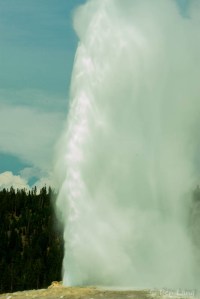
After a 20-minute tease, Old Faithful erupts!

It’s not at all what I expect. The faint scent of sulphur is not present here. The strong powerful sounds of gushing water I expected are definitely absent as well; instead, it sounds like faint ocean waves.

After a couple of minutes, Old Faithful settles down, and many people clap and start to move away. It’s kind of weird to think about, Sarah says. It’s like everyone is congratulating earth on being earth… “YAY! Earth!” But I just HAD to get a picture with Old Faithful in the background.

Me and Jenny crouched down with a calm Old Faithful in the background

We zip inside another store for road snacks. Dwight buys a bag of grapes for $8 and Ben buys more road cheesies. I get a Gatorade and Sarah buys her snacks – we all spend a small fortune on road food.

We take our last bathroom break before piling into the car. Jenny – as she’s done all the way through this trip – finds the accessible stall without my asking her to do so. Sarah keeps telling me how impressed she’s been with Jenny on this trip, and while I can dwell on Jenn’s mistakes and missteps, I have to agree with Sarah. Jenn laps up the water I set down for her by the sink, and we’re all ready to hit the road.

Old Faithful – Grandview CampGround

Distance: 308 miles (496 km)

Travel Time: 6 hours (including stops)


We keep our travel configurations from this morning as we pile into the car. Ben’s got a Google map on his phone and is hopeful that he can still navigate in these areas with no cell service. Just twenty minutes out of Old Faithful, Sarah spots the geisers they wanted for pictures, and Ben pulls in.

Dwight and I stay in the car, talking. We haven’t really had an opportunity to do so on this trip, and I confess my feelings of uselessness. I’m not a seasoned camper, and Ben and Sarah seem to frequently have everything under control. Sure, I’ve rolled a sleeping bag or two, or helped set up the tent, but to me it doesn’t feel like nearly enough. Dwight offers some perspective that I desperately need – that I have been contributing, but that I need to temper my need to be needed with the practicalities that come alongside camping with experienced campers. My blindness has nothing to do with it. I’m not sure I feel any better, but I feel better for having talked about it.

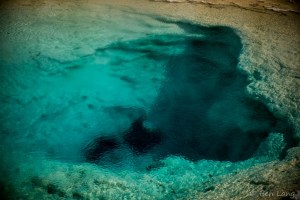
Sarah and Ben come back to the car, thrilled with the pictures they’ve taken of this area. It’s called the Painted Pots. There are signs that state that you must stay out of the water; it’s so clear and so hot that you would never come out.

The Painted Pots

We’re ready to go again. Sarah and Dwight chat in the back while Ben follows the route he sees on Google maps. There’s a motorist in front of us who keeps speeding up and slowing down and speeding up and slowing down. Ben finally gets so annoyed that he takes the first available turnoff and hopes it’s the right one.

The highways are well-paved and well-maintained. We’ve driven for about half an hour before Ben thinks he made a mistake – turning left instead of right. His google map is useless up here, and he asks me for directions. I pull up Nearby Explorer, put in the address of Grandview Campground, and start giving directions (basically, keep going straight and take one turn or another).

As we travel, Dwight and Sarah nap while Ben and I chat. I talk to Ben about my feelings of inadequacy, and he’s quick to reassure me that I have pulled my weight – heck, I’m the one navigating on this leg of the journey!

The signs for Bozeman appear, and we are all tired. It’s 20 minutes to Bozeman now, and someone points this out. Dwight says that’s a perfect name for a band, and we all laugh and agree.

In Bozeman, we stop for gas. We’re getting hungry and find a burger place with a drive-through. We order massive burgers and fries, and we’re all impressed as we munch. Only Ben seems disappointed by his waffle fries (I try one and agree that my traditional fries are better). Sarah has cell reception, so she calls Grandview and tells them our ETA appears to be about 9:30. They thank her for her call and tell her they’ll see us when we get there.

As we drive through Bozeman, Ben and Sarah express a strong liking for the city. The architecture looks cool, and now I think we’re all sorry we won’t get a chance to explore it further.

Nearby Explorer continues to map our route – go straight. we pass small towns and lovely scenery as the sun sets. Even I can see the sunset filtered through the trees, with mountains in the background on either side. I’m blown away by the majestic beauty of this sunset as I munch my fries and tell Ben to continue to go straight, through county after county, past unpopulated areas or tiny hamlets.

We reach Billings. It’s a big city, too, and we all agree that tomorrow, we will go into Billings, split up for a couple hours, and do our own thing. As we leave the city limits, I start to worry about directions to Grandview. The email says GPS can sometimes be wrong, and we have no cell service to contact them if we get lost.

I worry for nothing. As we pull into Hardin, pass the gas station indicated on the email, the sign is clearly marked. We pull in to the drive at 9:00, and Ben and I get out of the car. Lori arrives just a couple minutes later and opens the office/gift shop. She’s warm and welcoming and she’s thrilled we got in earlier than we’d estimated and gives us a rundown of the campsite information. We’re given directions to the showers and our campsite, change for the laundry facilities (open 24 hours), a Wifi password, and kitty cuddles from the resident cat. We can dry our clothes! AND see kitties? With showers and wifi, we’ve hit the camping jackpot!

We get back to the car and tell Sarah and Dwight about our good fortune. We pull up to our assigned space, and the guys get to work on pitching the tent. Sarah and I haul the mattress bags full of wet clothes to the dryers. The first dryer eats Sarah’s quarter, so we have to go back to the car and get more. We move the wet clothes from one dryer to another, and I constantly drop them. Sarah and I laugh giddily as she loads the second= – hopefully functional – dryer with our clothes. They fit in one load, and the dryer takes our quarters with no fuss.

We get back to the tent, which has been completely set up. Our air mattresses are inflated and sleeping bags unrolled. Jenny is bounding around the camp site like she’s never seen such a beautiful grassy area, and I’m struck by the sound of crickets I hear. If you’ve ever seen a movie that has a night-time scene with crickets in the background, these crickets sound like that. It feels like I’m in a movie, and I’m so happy I could burst.

We check on the clothes in the dryer, and they are – miracle of miracles – all dry. We stuff them into the mattress bags again and put them in the car; we’ll take care of them in the morning.

It’s 10:00 PM, and I’m ready for sleep. I crawl into the tent and bury my face in my pillow. Jenny will not leave my side, squishing my legs under the weight of her Labrador frame. The movie-crickets sing me to a restful, contented sleep.

Book Review: No barriers

31 Thursday Aug 2017

Posted by blindbeader in Book reviews, Nonfiction

≈ 2 Comments

Tags

adventure, blindness, growing, learning lessons, mountains

Several months ago I reviewed Erik Weihenmayer’s first book, “Touch the Top of the World.” When I learned his second book (and continuation of his autobiography), “No Barriers“, was coming out earlier this year, I snapped it up quickly, and read it just as fast.

No Barriers: A Blind Man’s Journey to Kayak the Grand Canyon
By: Erik Weihenmayer

Erik Weihenmayer is the first and only blind person to summit Mount Everest, the highest point on Earth. Descending carefully, he and his team picked their way across deep crevasses and through the deadly Khumbu Icefall; when the mountain was finally behind him, Erik knew he was going to live. His expedition leader slapped him on the back and said something that would affect the course of Erik’s life: “Don’t make Everest the greatest thing you ever do.”
No Barriers is Erik’s response to that challenge. It is the moving story of his journey since descending Mount Everest – from leading expeditions around the world with blind Tibetan teenagers to helping injured soldiers climb their way home from war, from adopting a son from Nepal to facing the most terrifying reach of his life: to solo kayak the thunderous whitewater of the Grand Canyon.
Along the course of Erik’s journey, he meets other trailblazers – adventurers, scientists, artists, and activists – who, despite trauma, hardship, and loss, have broken through barriers of their own. These pioneers show Erik surprising ways forward that surpass logic and defy traditional thinking.
Like the rapids of the Grand Canyon, created by inexorable forces far beneath the surface, No Barriers is a dive into the heart and mind at the core of the turbulent human experience. It is an exploration of the light that burns in all of us, the obstacles that threaten to extinguish that light, and the treacherous ascent toward growth and rebirth.

Continuing the Journey, with New Friends along the Trail

This book re-introduces us to key people in Erik’s life – his father, his siblings, his wife and daughter. We get to know and see some of their dynamics play out, discover their demons some kept at bay (and later taking over), grow and change with everyone. One thing that the author has done well – in both books – is balance interpersonal dynamics without verging far into sappy emotional supposition or stale dialogue re-creation.
In addition to getting re-acquainted with Erik’s family, we meet new key people in his life. We meet his son, who is sweet and precocious and is too young to express his grief at being taken far away from the only life, country and culture he’s ever known. The challenges of culture shock when adopting a child from a foreign country (and the bureaucracy that goes with it can almost be felt by the reader; I can only imagine what it felt like going through it at the time. And so many people were instrumental in building this relationship – on both sides of the world.
We also meet other disabled people – from sheltered blind children who learn they were capable of doing more than they thought possible, to veterans who struggled through their own mental and physical barriers to climb mountains, to doctors and adventurers and entrepreneurs and bureaucrats and kayaking guides… Erik’s books are always about people; I never once came away with the idea that Erik was this big hot shot who’s done all these cool things, but he had others with him every step of the way.

A Few Too Many Rabbit Trails

Unlike “Touch the Top of the World”, “No barriers” is a long book with many components to it. We travel up a Tibetan mountain with blind teenagers, learn about the BrainPort (a nifty piece of technology that produces visual information on the wearer’s tongue, laugh and cry at the journey of creating a new family, experience the merger between two nonprofits and the pitfalls along the way… it’s all useful and important, but at times I just wanted to get back to Erik’s journeys as an adventurer – climbing mountains, kayaking rivers – or reading more about his family. “Touch the Top” was a much tighter and more cohesive read, but I do understand why all these components were included, to describe a journey of peaks and valleys, of falling down and getting back up again.

Seeing the Forest for the Trees

One of the most profound experiences in the book is not when Erik kayaks the Grand Canyon (though that experience is well-described and riveting), but when he trains and takes a small group of blind Tibetan teenagers and their guides to Tibet’s tallest mountain. Erik is put in touch with Sabriye Tenberken, a blind German social worker who founded Braille Without Borders, a school and training center for the blind of Tibet. Eventually they decide that, both as an educational experience for the teenagers and as a way to break down barriers placed on them by Tibetan society, a mountain climbing trip is in order. Erik is a goal setter – he has a plan, and he is going to achieve it, making adjustments along the route but with the understanding that achieving the goal (in this case, climbing the mountain) is the most desirable end result. But when threatening weather adds further danger to this trek, Erik and Sabriye have vastly different opinions on whether or not to proceed.

Sabriye, affter thoughtful consideration, tells Erik that she has taken what he’s told her to heart, that she needs to respect the mountains and their beauty. She tells him bluntly but kindly that she’s noticed the sound of the wind in the trees, the feel of the glaciers, the stillness of the air. She has done what he’s asked, to appreciate the mountains for all that they offer, but it’s his turn to do what she’s asked and respect their people enough to acknowledge that they’ve already done more than they could’ve ever imagined, and now it’s time to keep them safe.

I read this book months ago, and Sabriye’s idea (though paraphrased here) has never left me. Goals are important, but sometimes we focus so much on the end result that we miss the little things along the way.

Conclusion

This book is well worth your time – at a sprawling 480 print pages and more than 19 recorded hours, it will take a lot of it. It’s profound and moving in ways I didn’t expect. That being said, some passages could have been shortened for a more cohesive read.

4/5 stars.

Summertime… when I Feel More… Respected?

24 Saturday Jun 2017

Posted by blindbeader in blindness

≈ 1 Comment

Tags

autonomy, blindness, dignity, employment, respect, sunglasses

This time last year I remember (and facebook reminded me) getting up for a 9:00 AM job interview. I opened my eyes and got hit with a sudden burst of intense stabbing pain… right in both eyes. I had two options: reschedule the interview (as I had already done the day before because I was feeling absolutely awful) or attend the interview with a light-sensitive migraine. If I chose the second option, I had two options stemming from that: suffer through it, or do the somehow stereotypical “blind” thing and walk in with sunglasses.
It was far from an easy decision. To me, sunglasses were for sunny days, not moderately cloudy ones, and absolutely never ever ever indoors. I looked so… blind in them (I still don’t know what I meant by that thought). When I asked several people I knew – sighted and blind – through the instant question-answer format of social media, I received so many answers, and many conflicted with each other. All paraphrasing is mine, but the general ideas went something like this.
“Absolutely not! Your interviewer NEEDS to at least have the semblance of eye contact.”
“Why not? Your eyes hurt; you need to be functional.”
“It’s SUCH a blind thing to do.”
“If they’re fashionable, wear them!”
I chose to wear the sunglasses. They had been purchased years before and were both fashionable and moderately functional for my purposes. The frames were basic black with round lenses, and they didn’t scream “blind person!” to anyone who looked at them. The instant I put them on, just before leaving my house, I felt my entire face relax, and the stabbing pain in both eyes magically disappeared.
The interview bombed. It bombed worse than almost any other interview I went on the year I was unemployed. It had nothing to do with my glasses, my headache, or anything else. The job and I were simply not a good fit.
But when I left the interview and went about my day, my sunglasses still in place, I noticed something else I hadn’t considered before.
People treated me better.
You see, if you were to look at my eyes directly, you would know that I am blind. My left eye is, for all purposes, unusable. My right eye won’t stay still. Walking down busy downtown streets that morning – even with a guide dog – while wearing those sunglasses, people seemed more inclined to make general non-blindness-related conversation with me, or accepted my assertions that I didn’t require their assistance. This old pair of sunglasses seemed, in a way, to be magical to me, to open a doorway to some previously rarely-found milieu of autonomy and dignity.
During the course of a few weeks, the more I wore my sunglasses, the less blind I appeared to others. The less blind I appeared, the more people left me alone (or at the very least respected my polite declining of their assistance, something they offered less frequently). I loved how it felt.
But those glasses I wore to that interview no longer flattered my face the way they had years ago when I had first purchased them. I needed, as a friend stated, a more fashionable pair.
So what does a girl do when she needs a stylish pair of sunglasses that she doesn’t need to see clearly through? She goes to Walmart, and finds the coolest, most professional-looking pair of sunglasses they have that also covers her eyes and flatters her face. I spent a grand total of $15 on my sunglasses, and the complements from friends, family, and strangers make me feel like I should’ve spent more. And when I wear them, people generally treat me better, like I’m any other office worker or customer or pedestrian.
I wonder why that is.

And I wondered why I had resisted them for so long.

When discussing this topic, I had no idea the types of division I would stir up. Some people were very comfortable with their choice to wear glasses, others firmly confident in their decision not to, and many fell somewhere in the middle. Comments ranged from “No blind person should wear glasses, ever, because it makes them look pathetic,” to “I wear them on sunny days because the glare bothers me, but I’m still uncomfortable doing so… it’s such a blind thing to do,” to “I wear glasses because my eyes hurt otherwise,” to “I wear them because I know my eyes are damaged due to accident or illness, so I wear them for the general comfort of those around me.” Others hadn’t considered them one way or the other, either because they were never encouraged to wear them, or because it was really never an issue; while my sunglasses made me look “less blind”, some believed that their wearing them would call attention to their blindness in a way that their uncovered eyes never do. Still others believe that wearing sunglasses means that they are hiding a part of themselves – their blind eyes – even if they are imperfect.

But one friend, whose blindness is due to Retinoblastoma, described in vivid detail being forced by parents or teachers to wear them. She would get in trouble in school if she took them off, and even now – as a grown woman – if she’s in her family’s company, the comment is made that she needs to wear them. Like it or not, she is judged on her appearance. Retinoblastoma can sometimes lead to facial scarring that may be off-putting to some, so some may argue that if it can be covered by makeup or glasses, then why not use them? And yet, my friend has a very complicated relationship to glasses today, for the simple reason that they were pushed at her so much as a child and teenager and even now as an adult.

A simple accessory to some, to others a way to make it through the day. To some they bring freedom, to others a sense of complicated shame. I had no idea that the job interview a year ago would start me on this journey of asking questions about an accessory that most people wear without a second thought. It’s opened up far more questions for me than it’s answered, and yet, I’ve made my own piece with my sunglasses. My cute sunglasses make others more comfortable with me, which makes me more comfortable with myself. I hate that this is so. And I hate that others would receive the exact opposite reaction because their uncovered eyes don’t make them look blind.

So for now, while the days are long and the sun is so bright that almost everyone has to squint to navigate the world visually, I’ll take that automatic respect that these lenses and frames seem to have granted me. Now the question is… can this continue in the winter?

Book Review: Touch the Top of the World

28 Tuesday Feb 2017

Posted by blindbeader in Book reviews, Nonfiction

≈ Leave a comment

Tags

acceptance, blindness, mountain-climbing, teamwork

210209_0124Download

I’ve always been a little put-off by the idea of superblinks – those blind people who do everything extremely well (have AWESOME jobs, perfect independent living skills, or are the first blind person to do something that would be a huge challenge for ANYONE), and think that all of us should be like them. Yet I have vivid memories of a news interview with Erik Weihenmayer, the first blind man to summit Mt. Everest, and thinking “WOW! That’s amazing!” – not in an amazing-for-a-blind-guy sort of way, but more like amazing-because-it’s-HARD. Years ago, I heard of Erik Weihenmayer’s first book, “Touch the Top of the World“, and when friends of mine described the author as a “superblink”, I put the idea of reading his book on a top shelf in my reading closet. After all, I’m not that interested in mountain climbing, and who wants to read a book about a perfect accomplished blind person? Not me!

But when I saw his second autobiographical book, “No Barriers” was being released early in February, which sounded like an interesting read, I figured I would go in from the beginning. Sure, I thought, I’m interested enough in mountains to make “Touch the Top of the World” worth my time, and maybe, just maybe, I could slog through how perfect this guy’s life was and how effortless he made everything seem…

Um… I was so very wrong.


About the Book


Erik Weihenmayer was born with retinoscheses, a degenerative eye disorder that would leave him blind by the age of thirteen. But Erik was determined to rise above this devastating disability and lead a fulfilling and exciting life.

In this poignant and inspiring memoir, he shares his struggle to push past the limits imposed on him by his visual impairment-and by a seeing world. He speaks movingly of the role his family played in his battle to break through the barriers of blindness: the mother who prayed for the miracle that would restore her son’s sight and the father who encouraged him to strive for that distant mountaintop. And he tells the story of his dream to climb the world’s Seven Summits, and how he is turning that dream into astonishing reality (something fewer than a hundred mountaineers have done).

From the snow-capped summit of McKinley to the towering peaks of Aconcagua and Kilimanjaro to the ultimate challenge, Mount Everest, this is a story about daring to dream in the face of impossible odds. It is about finding the courage to reach for that ultimate summit, and transforming your life into something truly miraculous.


Family Comes First


Erik has not always been totally blind. While he was visually impaired most of his early childhood, he still played sports with his brothers and friends at school. His family knew that his vision would change and eventually be non-existent, but Erik used the vision he had when he had it. When he discovered one day he couldn’t see things as clearly to ride his bike down the ramp that had been constructed, his father painted huge visible lines on it so he could still enjoy his bike tricks. Erik’s mother hoped for a cure for her son’s blindness, while his father (a military man) pushed him to do whatever he did to the best of his ability – even if it was done differently, even if it was scary, even if it included having others beside him and behind him cheering him on.

This sets up a backdrop of immense family support. When Erik lost his remaining vision and was forced to rely on a white cane, his anger boiled over. He would throw his canes into the river, purposefully break them, drop them down sewer grates. He refused to read braille and use other adaptive techniques. He was neither belittled or pitied, but was told to get back up and learn to deal. But he was not going to live his life of blindness alone. Sadly, his mother died very suddenly not long after Erik lost his sight completely. One of the main sources of encouragement and support was gone. But he still had his siblings and father to help him push through.


A Place of Acceptance


Something changed when Erik tried out for the wrestling team. He discovered that blindness was not a factor. He didn’t have to try to learn to do things differently because of his blindness, but he didn’t feel like he had to downplay it, either. He grappled and wrestled and got hurt and got back up again. And it made an incredible mark on his life; he later became a wrestling coach.

Somewhere along the way, Erik discovered that it was so much simpler to adapt to his blindness rather than fight it. He went on to college, tried to find a job (where, familiar to blind job-seekers the world over, he was told he couldn’t do job duties XYZ and shown the door), and continued with sports and hiking with his family and friends.

He landed a job teaching school in Arizona, where he met the two great loves of his life – his wife Ellie… and rock-climbing.


It’s Not Just about Erik


When you read news articles or hear interviews about Erik being the first blind person to summit Mt. Everest, the team beside and behind Erik – if they are mentioned at all – are downplayed. Not so in this book. The friends, family and guides who supported him with both practical and physical help when he began climbing rock faces – and, later, the tallest peaks in the world – are fully fleshed out. From one team member who was perpetually cracking practical jokes, to another who was constantly late or forgetting gear (most notably a headlamp, when Erik was the lead climber on a night-time descent), to a young man whose dream of summiting one mountain was cut short due to a serious health concern… Erik makes no apologies for being part of a team. Sometimes he felt like he slowed down the team, forcing them to accommodate him; and other times, his ability to navigate in the dark made him a strong asset. Those on the peaks and those on the ground were all part of this journey, and Erik is not shy about sharing this information.


Conclusion


We knew – upon publication of this book – that Erik had summitted Mt. Everest. This, however, was not detailed in this book. I didn’t realize until recently that he hadn’t hit the summit of the tallest mountain on each of the seven continents until 2008 (more than six years after the book’s publication). I can’t decide if this adds to this book’s charm – Erik Weihenmayer is a work in progress – or if I find the publisher’s summary misleading.

If you’re at all interested in books about mountaineering, this book is a unique look at the challenges and successes of a blind climber. Like many climbers, Erik has a deep respect for the mountains – for their unique weather, their surface, their ruggedness, their beauty. Blindness was sometimes a factor in climbing, sometimes not.

As a memoir of blindness, I found this book both riveting and complicated. Erik felt like both an asset and a liability on the peaks, but he was never afraid to pull his weight. Sometimes this meant learning to do things flawlessly – because his life, and that of his teammates – depended on it. He had to abandon more than one climb due to illness, injury, or poor weather. Sometimes he powered through intense pain to summit a mountain, and paid for it later. Sometimes he knew when it was time to let it go for now and try again.

“Touch the Top of the World” is more than a memoir about blindness, adaptation, or mountains. It’s about all three in a terrific combination. It’s about grit and determination, about learning your own limitations and sometimes redefining them. I laughed and cried at various points, both poignant and amusing. Erik Weihenmayer may have been described by my friend all those years ago as a “superblink”, but I’m not sure I agree. He’s a man who loves the mountains, who loves to set goals for himself, and realizes the important value of teamwork.

5/5 stars.

Book Review: Not if I See you First

31 Tuesday May 2016

Posted by blindbeader in Book reviews, Fiction

≈ Leave a comment

Tags

blindness, perception, portrayal, running, Young Adult

Whenever I pick up a book – particularly a novel – knowing one of the main characters is blind, I approach it with equal parts dread and optimism. Optimism because without that I wouldn’t bother reading the book at all; dread because so many depictions of us include such inaccurate tropes as “superhero with mystical extrasensory powers” or “severely incapable infantalized adult.” Though Young-adult fiction hasn’t been one of my preferred genres in a very long time, Eric Lindstrom (the author of this book) and a few other authors might change that in short order.


Not if I see You First

By: Eric Lindstrom


It’s been more than fifteen years since I was the age of Parker Grant, the main character in Eric Lindstrom’s novel published late last year. Then how is it possible that I see so much of myself in her? Part of it is her in-your-face attitude; the other part is her bravado that masks a deep sense of insecurity. This has been me. This is me. Oh, and did I mention she runs, too?


Summary


The Rules:
Don’t deceive me. Ever. Especially using my blindness. Especially in public.
Don’t help me unless I ask. Otherwise you’re just getting in my way or bothering me.
Don’t be weird. Seriously, other than having my eyes closed all the time, I’m just like you only smarter.
Parker Grant doesn’t need 20/20 vision to see right through you. That’s why she created the Rules: Don’t treat her any differently just because she’s blind, and never take advantage. There will be no second chances. Just ask Scott Kilpatrick, the boy who broke her heart.
When Scott suddenly reappears in her life after being gone for years, Parker knows there’s only one way to react-shun him so hard it hurts. She has enough on her mind already, like trying out for the track team (that’s right, her eyes don’t work but her legs still do), doling out tough-love advice to her painfully naive classmates, and giving herself gold stars for every day she hasn’t cried since her dad’s death three months ago. But avoiding her past quickly proves impossible, and the more Parker learns about what really happened–both with Scott, and her dad–the more she starts to question if things are always as they seem. Maybe, just maybe, some Rules are meant to be broken.


A note about Audio


The narrator of the commercial audio edition, Lauren Fortgang, became Parker Grant. Her voices for the supporting cast were distinct and memorable, even if not always pitch-perfect and pleasing (hey, not all people have pleasant voices, either). If you can, scoop this up in audio format; it enhances the reading experience.


Parker, the Mirror


Parker Grant. The take-no-prisoners, hands-off, say-what-she-thinks main character of this book. She’s book-smart, fiercely independent (she runs alone every morning at 6:00AM), and doesn’t give two hoots about what anyone says or thinks about her. Around her is a small group of friends who love her for who she is, even if she’s emotionally distant to them and can be incredibly self-absorbed. Even though some of the specifics were different between me growing up (and maybe even now) and Parker Grant, it was like Mr. Lindstrom held up a mirror in front of my face, with the reflection screaming at me “THIS IS YOU!”


Reasonable Tropes and Refreshing New Looks


As Kody Keplinger wrote in her terrific review of this book, for the most part Lindstrom shies away from tropes for Parker. It became important to him for Parker to have no vision – a common trope for blind characters – for a variety of reasons, primarily for her to misunderstand or simply not consider visual nuance. Even Parker’s fierce independence is in line with her as a risk-taker because that’s who she would have been, blind or not. She also evidences insecurities about herself in small ways – not wanting to eat “messy” foods like lasagna in front of a date. Instead of the dark glasses that are not uncommon in books and movies with blind characters, Parker chooses to wear blindfolds (bandanas or scarves over her eyes) as both a unique fashion statement that can’t be duplicated and as a way to hide her insecurity. I respectfully disagree with Kody that the latter explanation overshadows the former; both are consistent with who Parker is and can both motivate her actions simultaneously. This bravado-meets-insecurity makes her a complex, nuanced character that avoids many of the inaccuracies written into blind characters in mass media.


With a Little Help from My Friends


Lindstrom also avoids the trope of the “poor loaner blind girl.” Parker has old friends Sarah and Faith – and the ghost of Scott’s friendship – with her, and new potential friends Jason and Molly. Surprisingly, Lindstrom depicts female friendships incredibly well, with none of the cattiness and all of the miscommunication, strong bonding, and tough love that filter through even the deepest of female friendships. But his grasp on the male-female relationships were unconvincing; something was missing from Parker’s interplay with Scott and with Jason. Jason just seemed to be… there… to be Mr. Almost-Perfect, while Scott patiently waited in the background for Parker to come to her senses and talk to him. Neither really rang true as a romantic interest for some reason, but Parker’s ultimate realizations about Scott provided some messy, touching, Hollywood-worthy moments with just enough nuance to avoid slipping into really sappy territory. There was no true “resolution”, but life is like that sometimes – messy and incomplete and sometimes you just don’t know.


Conclusion


Parker is not always the most likeable of characters, which is in fact what I loved about her. She’s prickly, feisty and opinionated; she loves her friends and hates to be buttonholed into what is expected of her. I saw enough of myself in some pretty scary ways that I wanted to rip the headphones out of my ears, give her a shake (if she didn’t run away or hit me first), and provide her some pearls of wisdom as someone who has traveled many of the same paths as she has and emotionally responded in many of the same ways.

But, since I can’t do that, I can at least encourage you to spend some time with Parker. Tell-it-like-it-is types will love her take-no-crap attitude. If you’re an empath, you’ll want to comfort her when that shell cracks wide open. Runners will marvel at her discipline. If you’re none or all of these things, go along for the ride; it’s well worth your time to support an author who created a blind character that is so nuanced and human. You’ll never forget Parker Grant is blind, and she wouldn’t want you to; but don’t get in her way!


5/5 stars.

The Empowered Series: Abigail Style

15 Sunday May 2016

Posted by blindbeader in The Empowered Series

≈ 2 Comments

Tags

beauty, blindness, disability, perceptions

One of the most interesting things about being a blogger is the ability to reach and be reached by a ton of different people. As part of the Empowered series, meet Stephanae McCoy, owner/operator of Abigail Style, who wishes to use fun, everyday products to show, visually, that blindness does not mean a lack of confidence and/or fashion sense.


About Stephanae

Stephanae (Steph) McCoy is a retired 55 year old mother to three grown sons and a ridiculously cute 3 year old grandson whom she’s “just ga-ga over”. According to the Meyers Briggs Personality Assessment she’s a true INTJ who is an introverted, analytical, somewhat judgmental and intensely focused person who follows the rules. If you ask her sons, she says they would probably say she’s a buzz-kill but with a great sense of humor, who loves playing practical jokes on people she’s close to and seeking change especially when someone is being treated unjustly.
Steph’s vision impairment was diagnosed in 2005 after regular vision checkups, which meant that some conditions such as glaucoma were caught early but needed operation. Seven years ago she had “The talk” with a doctor at the Cleveland Clinic, who advised her that even though she did all the “right things”, due to surgeries and extreme myopia, her vision loss was irreparable.

About Abigail Style

Abigail Style (named after the white cane icon Abigail) is an online apparel and novelties boutique whose message is designed to “Improve humanity by changing the way blindness is perceived. All Abigail Style products carry her signature stylish image and fun slogans. Currently the products offered are women’s, men’s and children’s t-shirts, women’s tanks, coffee mugs, tote bags and iPhone 6/6s cases. Artist Jennifer Barrile designed the logo, and Steph created the images to be printed on the products.
Abigail Style has been open for business for a very short time, but in the future the hope is to hire a marketing director, social media strategist, and a stylist, and increase the product line to include posters, decorative pillows, and baseball caps.

Why Abigail, and What got Her Started?

There are so many stylish women who are blind or have sight loss that Steph felt it was time for a fashionable icon to represent them. Abigail is a beautiful image that evokes power, movement, independence, chicness, confidence and success, a woman on the move stepping forward with purpose.
After Abigail was created Steph reached out to her online community to request their input on a name for her. Abigail was chosen as a play on the word “abilities,” and Nightingale (the small bird that’s known for its beautiful song) – since it looks like she is wearing a divine feather dress.”

What’s Next?

Steph wants to see how far she can take Abigail as she believes the sky’s the limit. Blindness or sight loss has always been one of those taboo topics and it’s time to change this. Is it challenging for people who have previously seen to learn how to adapt to sight loss? Yes it is, but a meaningful life shouldn’t be dependent upon having eye sight and she hopes to see the negative mindset on blindness and sight loss diminish.
Once, an eye doctor told Steph that it would be a tragedy for her to learn how to use the white cane when in fact she believes the real tragedy is the shame many people feel when losing their eyesight. Having a visual image that evokes beauty, confidence and purpose is a way to change the stigma surrounding blindness and/or vision loss.

Conclusion

I want to thank Stephanae for being so open with me, and for taking the time to answer my nosy questions!
If you know someone with a disability who runs their own organization or business, please leave me a comment or find me on Twitter; I would love to feature them here. The word “inspiration” is so often used to describe us, but empowerment is what we do for ourselves.

First They Denied Access…

09 Saturday Apr 2016

Posted by blindbeader in blindness

≈ 1 Comment

Tags

access, blindness, dignity, disability, discrimination, guide dogs, hard truths, respect

Earlier this week, my friend Meagan wrote a brilliant blog post about selective discrimination. If you haven’t read it yet, you should, because it’s important. I had full intentions of writing about a similar topic from another angle; thankfully she is gracious enough not to point out that SHE wrote about it first…

Over the past six months or so, since becoming more involved in the disability rights movement and meeting more people, I’ve come face-to-face with some of my own ideas about disability, access, and availability of information. People with a wide range of disabilities – those who are deaf or hard of hearing, who use wheelchairs, who are on the autism spectrum, who live with PTSD – have been far more patient than I deserve. I’ve had my own sense of privilege pointed out – just because I have access to something doesn’t mean that everyone does, and how dare I sit back and be content that I have access to facilities, employment, or information, when the fight for equality is far from over for everyone else? If you live with a disability, and even if you don’t, I hope you’ll consider the next few paragraphs carefully, make whatever necessary changes in yourself, and realize that it’s up to you and me to make things happen, even if it doesn’t directly benefit us.

Let’s start with a few examples. Several followers on twitter have recently opened up a huge discussion about a popular podcasting website that provides audio posts for their blind followers, but delays (if it publishes at all) the publication of transcripts so that deaf or deaf-blind followers can follow along. Many blind people are pushing for TV networks and video-on-demand services like Netflix to provide descriptive video, even as closed captioning has been part of TV networks for years now so that those who are deaf or hard of hearing can more fully enjoy movies and TV programming. In either example, many of those who have received access to the information or service are strangely silent on pushing for others with different accessibility needs to have that same access for themselves. What about physical access to buildings? Just because I have two strong feet and the ability to use them to propel myself forward, how dare I take for granted the ability to walk into any building I choose – a shop, a restaurant, a concert venue – and not even have to think twice about it? Many wheelchair users have to contact restaurants ahead of time to ensure there are ramps to the building, or make sure the seats they purchased for that blockbuster concert are truly accessible. Many are too gracious to point out that we all have our own struggles, but that’s hardly the point now, is it?


Among service dog users, the guide dog is the most commonly recognized. But many other service dogs exist. What gives guide dog users (myself included) the right to police what specific services another’s service dog provides so long as it mitigates a disability? How dare we sit smugly by when other legitimate service dog teams are denied access to public facilities just because we are the privileged and most recognizable? What gives other service dog users the right to tell guide dog handlers how much more training our dogs need than theirs? I’ve seen all of this and more… and it’s ugly. And I’m not even touching on the service dog fakers…


The blind community in and of itself is not exempt from such stances of privilege. There is an outspoken outrage when a guide dog user is denied access to a restaurant, movie theatre, or taxi. Yet, in moments of vulnerability and candor, some blind people who prefer to travel with canes acknowledge that there’s a teeny tiny part of themselves that is grateful that the battle for access isn’t directly related to them. Until this past week when two blind friends using canes were refused entry to a restaurant because the eating area was upstairs, modern instances of service denial to the blind traveling with canes are exceedingly rare. Several of my deaf-blind friends have had blind people question their dignity and right to access information, resources, and employment services. None of these things are right, and no one should ever indicate that discrimination in any form is OK… and yet…


I’m going to go out on a limb and borrow an oft-quoted and paraphrased poem by Martin Niemöller. Maybe this will help the disability community realize that we’re not so different after all, and denying access to some of us should be considered equally as horrible as doing so to all of us:


First they denied access to the service dog handler, and I did not speak out—
Because I was not a service dog handler.

Then they denied access to buildings for the wheelchair user, and I did not speak out— Because I was not a wheelchair user.

Then they denied access to information for the deaf, and I did not speak out—
Because I was not deaf.

Then they denied access and accommodations for the autistic, and I did not speak out— Because I was not autistic.


Then they denied access and dignity to those with PTSD, and I did not speak out— Because I did not have PTSD.


Then they denied access to me—and there was no one left to speak for me.

Book Review: All the Light we Cannot See

31 Thursday Mar 2016

Posted by blindbeader in Book reviews, Fiction

≈ Leave a comment

Tags

blindness, Book reviews, perceptions

Life has a funny way of being coincidental. I was about halfway through reading this book – written by Anthony Doerr – when this review came out. I contemplated putting the book down and letting that review stand on its own, but I decided to finish the book and publish my own review, if for no other reason than to form my own opinion. I’m glad I did!


Publisher’s Summary

Marie-Laure lives with her father in Paris near the Museum of Natural History, where he works as the master of its thousands of locks. When she is six,
Marie-Laure goes blind and her father builds a perfect miniature of their neighborhood so she can memorize it by touch and navigate her way home. When
she is 12, the Nazis occupy Paris and father and daughter flee to the walled citadel of Saint-Malo, where Marie-Laure’s reclusive great-uncle lives in
a tall house by the sea. With them they carry what might be the museum’s most valuable and dangerous jewel.

In a mining town in Germany, the orphan Werner grows up with his younger sister, enchanted by a crude radio they find. Werner becomes an expert at building
and fixing these crucial new instruments, a talent that wins him a place at a brutal academy for Hitler Youth, then a special assignment to track the resistance.
More and more aware of the human cost of his intelligence, Werner travels through the heart of the war and, finally, into Saint-Malo, where his story and
Marie-Laure’s converge.


A Note about Audio

If you know French – and even if you don’t – skip the commercial audio narrated by Zach Appleman. The narrator’s French is butchered so badly that I had given up on two previous attempts to finish this book in audio. I got through about a third of the audiobook this time before I gave up and switched to a text copy.


Poetic Language

I’ve always been fascinated and interested in books taking place in Europe leading up to and during World War II. I felt the despair in the children’s home where Werner grew up, the changing landscape of Paris before the Germans occupied it, and the town of Saint-Malo (and other cities and towns) as the war raged on. Some might find the shifting in time confusing, as the stories of Werner and Marie-Laure diverge and converge, but the book is so poetic that I found myself glued to the pages. Using darkness as a plot device both physical and figurative was beautiful and heartbreaking and brutal, sometimes in the same breath. The importance of radios was also integral to the story, as – even without the ability to see due to blindness or ambient darkness – the radio allowed the characters to not feel so alone and to communicate, often under the radar.


Marie-Laure: A Perpetual Child

At first I had high hopes for Doerr’s character of Marie-Laure. Her father, after the shock of her blindness sets in, builds a tactile map of their neighborhood in Paris (and later Saint-Malo), forcing her to memorize it and use it to help her navigate her way around. His intentions are laudable, even though a piece of me cringes at the painstaking lengths he went to to make it happen. The ideas about blindness in the 1930s and 1940s are unknown to me. Other reviewers have been frustrated by her counting of storm drains to navigate, but who am I to judge this? Perhaps my way of navigating the world would seem odd and juvenile to those who will come along in seventy years. But in some important and damaging ways, Doerr does not allow Marie-Laure to grow up normal. She has no friends to speak of, she appears incapable of dressing herself even as a teenager, and the adults in her life tell her what she can and can’t do and where she can travel alone. before her father leaves, he washes his 12-year-old daughter’s hair, something that can be seen as tender, inappropriate and/or patronizing, depending on your viewpoint. When Marie-Laure asks questions, they are asked in the way an impish, precocious child would ask them. Maybe the war made those around Marie-Laure more protective than they otherwise would have been, maybe not. But I do think that Doerr could have made Marie-Laure a more complex character during that war than a young girl in a teenager’s body, maybe one who still loved the sea but also helped to care for herself and those around her.

I must also interject here that the image of Marie-Laure as a capable, independent thinker is much more pronounced toward the end of the book. Even so, it was largely because she had to be, making life choices when bombs were falling around her home, not because she chose that path for herself. Her post-War life is only referenced at the very end of the book. But by the time the reader gets to that point the image of a charming, docile girl is foremost in their mind.


Werner: A Man Too Young

From the first time Werner and his sister listened to a radio they found, deep into the night, at the children’s home, I was glued to their story. Werner is a young man who grows up with nothing, living with his sister in (effectively) an orphanage in a mining town in Germany. He is book-smart, good with numbers and formulas and mechanical things, thus earning himself a place at a school for Hitler Youth. His sister is back at the children’s home, young and naive in some ways, wise beyond her years in others. Werner is not a brutal man and seems powerless to stop what goes on at the school and later on the battlefield, where it’s his job to locate clandestine radio transmissions throughout Europe. The Hitler Youth school tries to break the goodness out of him, and somehow it succeeds in making him unwilling to speak up, and yet at his core he is a decent man-child. He cannot understand the brutality, in small ways tries to avoid it, but a deadly mistake truly costs him his innocence. Such passages are hard to read, and yet necessary to his development as a complex character. When he meets Marie-Laure, it’s his chance at redemption…


In Conclusion

I don’t regret reading this book. Maybe I read it in spite or of because of the overwhelmingly positive or negative reviews. Mr. Doerr is certainly an author to watch. His depictions of Werner’s life – both before and during World War II) were engrossing and believable. While I wish he would’ve portrayed Marie-Laure (and the actions of those around her) differently, it only slightly took away from my enjoyment of the book. If Marie-Laure’s post-War life had been more well-represented than the last handful of pages – an independent woman with a career, a sexuality, a family – it would’ve made her father’s and uncle’s protection of her (war-time or not) easier to swallow.


4/5 stars (3 if it were audio).

← Older posts
Newer posts →

Subscribe

  • Entries (RSS)
  • Comments (RSS)

Archives

  • December 2025
  • January 2024
  • December 2023
  • April 2023
  • January 2023
  • December 2022
  • October 2022
  • June 2022
  • April 2022
  • January 2022
  • December 2021
  • October 2021
  • August 2021
  • June 2021
  • April 2021
  • March 2021
  • February 2021
  • January 2021
  • November 2020
  • October 2020
  • August 2020
  • July 2020
  • June 2020
  • April 2020
  • February 2020
  • January 2020
  • December 2019
  • November 2019
  • September 2019
  • March 2019
  • February 2019
  • January 2019
  • December 2018
  • September 2018
  • August 2018
  • July 2018
  • June 2018
  • May 2018
  • April 2018
  • March 2018
  • February 2018
  • January 2018
  • November 2017
  • October 2017
  • September 2017
  • August 2017
  • July 2017
  • June 2017
  • May 2017
  • April 2017
  • March 2017
  • February 2017
  • January 2017
  • December 2016
  • November 2016
  • October 2016
  • September 2016
  • August 2016
  • July 2016
  • June 2016
  • May 2016
  • April 2016
  • March 2016
  • February 2016
  • January 2016
  • December 2015
  • November 2015
  • October 2015
  • September 2015
  • August 2015
  • July 2015
  • June 2015
  • May 2015
  • April 2015
  • March 2015
  • February 2015
  • January 2015
  • December 2014
  • November 2014
  • October 2014
  • September 2014
  • August 2014

Categories

  • Blind Lady Gets Sh*t Done
  • blindness
    • My Sorta Kinda Maybe (In)accessible Life
  • Book reviews
    • Fiction
    • Nonfiction
  • Epic Road Trip of Awesome
  • Exploring Edmonton
  • Finance Friday
  • Guide Dog 2.0
  • New York vacation
  • The Empowered Series
  • The Intrepid Journey 2018
  • Ultimate Blog Challenge
  • Ultimate Blog Challenge, Part 2
  • Ultimate Blog Challenge, Part 3
  • Uncategorized

Meta

  • Create account
  • Log in

Support my blog!

Buy Me a Coffee at ko-fi.com

What’s gotten folks talking?

RoseQuartz's avatarRoseQuartz on If you Had Told Me…
Carol anne's avatarCarol anne on If you Had Told Me…
Annie Chiappetta's avatarAnnie Chiappetta on If you Had Told Me…
Carol anne's avatarCarol anne on Guide Dog 2.0: One Year L…
Carol anne's avatarCarol anne on Guide Dog 2.0, One Year Later:…
Carol anne's avatarCarol anne on Guide dog 2.0, One Year Later:…
Carol anne's avatarCarol anne on Guide Dog 2.0, One Year Later:…

Enter your email address here and receive new posts by email!

Join 207 other subscribers

Blog at WordPress.com.

  • Subscribe Subscribed
    • Life Unscripted
    • Join 207 other subscribers
    • Already have a WordPress.com account? Log in now.
    • Life Unscripted
    • Subscribe Subscribed
    • Sign up
    • Log in
    • Report this content
    • View site in Reader
    • Manage subscriptions
    • Collapse this bar
 

Loading Comments...