• So, who am I, anyway?

Life Unscripted

~ Living Life as I see it… or Don't

Life Unscripted

Category Archives: blindness

Is This OK With You?

20 Tuesday Feb 2018

Posted by blindbeader in blindness

≈ 7 Comments

Tags

activism, anger, dignity, disability, hard truths, poetry

You’re in a party of six who walks in to a restaurant.
Everyone else is directly addressed,
But when it’s time to place your order, your companion is asked what you would like.
Is this OK with you?

You go to a big sporting or concert event;
There are only a handful of seats available to you, even if the rest of the venue has plenty of tickets for sale.
If you’re really unlucky, the only seats you can get are ones where you can’t see clearly or hear well.
You’re told that these are the only seats specially designed for people like you.
Is this OK with you?

You sign up for a course in an activity you enjoy,
And you are told it’s just “too hard” or “too complicated” to accommodate your participation.
But no one asked what, if any, accommodations are necessary.
Is this OK with you?

You apply for a job with a perfect resume, and get called for an interview.
Your qualifications, skills, and education are briefly discussed, and the rest of the interview feels like you’re having to defend yourself.
You have done nothing wrong, but you walk out the door feeling like you’ve been judged and found guilty.
You get a rejection email or phone call, if you’re lucky; you hear nothing if you’re not.
And sometimes, you’re told it’s because you’re just too much of a hassle.
They don’t put it that way, but that’s what the silences say between their words.
Is this OK with you?

You’re told that you’re not working/able to work because you’re just not trying hard enough.
You don’t have the heart to reply that you’ve had three interviews this month that went badly.
Or that you “wasted your time” by taking care of yourself and your family, volunteering in your community, attending school…
But you should just “keep on trucking” and “keep your chin up,” because that perfect job will come along.
And if it doesn’t, it must be something you’re doing, and you’re “a drain on the system.”
Is this OK with you?

You’re told that your symptoms are all in your head,
That you should just think positively, or do more yoga, or eat better,
And then you’ll be ALL right.
Is this OK with you?

You walk in to a grocery store to buy a quart of milk,
And are loudly demanded to show your ID, leave your medical equipment outside, or get out of the store.
You’re the only person being singled out like this.
Is this OK with you?

Someone stops you on the street and asks if they can pray for you.
They don’t ask what you need or want prayer for; they just pray for the most immediately obvious things.
Then they go on their merry way, asking you to be blessed, and you go your way and feel empty inside.
Is this OK with you?

You’re on your way to run an errand and are stopped by a stranger.
You’re told how inspirational you are for getting out of bed in the morning,
That they would kill themselves if they lived your life.
Is this OK with you?

You’re told that you can do anything you set your mind to.
Except this, and that, and that other thing.
Those would be too hard for you.
No one asked what you thought.
Is this OK with you?

At family gatherings, you’re told that it’s a good thing you are single.
If you have a child, it might “turn out like you.”
If you don’t want children, it’s “completely understandable.”
But when are your siblings/cousins marrying and having babies?
Is this OK with you?

You’re told to accept any attention you get,
Even if it’s negative, detrimental, or not desired.

Even if it’s against all social propriety, against your own wishes… people just “want to help” and you need to suck it up and let them feel good about themselves.
You should be grateful people want to connect with you at all.
Is this OK with you?

You’re told not to let the “little things” get to you,
To give people the benefit of the doubt because they just don’t know how to talk to you.
Is this OK with you?

I – and people I know and love – have lived all of these scenarios and more.
Some of us call ourselves “disabled people.”
Others prefer to be called “people with disabilities.”
even in this small way, we are frequently told how we should refer to ourselves.
And – in all these ways big and small – it’s not OK with us.
It’s not OK with me.

To the Parents of Blind Children, Part 2: Your Child Deserves More

27 Saturday Jan 2018

Posted by blindbeader in blindness

≈ 1 Comment

Tags

autonomy, blindness, children, dignity, disability, independence, parenthood, parenting, pity

I stated in my previous post that I am not a parent. I will probably never know first-hand what challenges a parent faces. Throw an unexpected disability into the mix, and I can honestly say I have no idea what decisions I would reach or mistakes I would make. We are all human; mistakes are inevitable. But they don’t have to determine the course of a child’s life.

I’m a blind adult who has experienced the joy of being a child, whose parents truly did some amazing things to make sure I was as happy, healthy, and autonomous as possible. It wasn’t until I started high school that I began to realize that not all of my peers – especially my blind friends – were given such opportunities and freedoms. As I grew older – through my twenties and now that I’m in my thirties – I frequently notice a truly stifling dynamic toward blind children by their parents. Will some parents be helicopter parents anyway? Absolutely! But when there’s a clear difference in how siblings are treated along disability lines – something I observe regularly – it becomes abundantly clear that blind children are frequently short-changed.

It doesn’t have to be this way. Your blind child deserves so much more…


Your Child Deserves more than A Diagnosis

A diagnosis of vision loss can be devastating, or it can offer a sense of relief. it should neither be hidden from your child nor the focal point of everything they do. I have several friends who struggled so unnecessarily as adults because their parents chose to withhold their child’s vision-loss prognosis from them altogether or denied their child’s expressions of frustration about not being able to process visual information. Others struggled to learn the life skills their siblings learned by imitation because their parents feared their lack of vision would make the tasks impossible. Many have expressed to me that they would have felt less alone if their parents had chosen to be open about their medical information, and they would’ve felt more secure in the world if they didn’t have to learn basic tasks as an adult because their parents were so “stuck” on their blindness. Growing up is enough of a challenge without having to overcome years of denial and lowered expectations.

Vision impairment or blindness is not the only aspect of your child’s growth and development. Just as your height or race or gender is one aspect to your humanity, your child’s blindness is only one lens through which they experience the world.

Your Child Deserves More than Hope for a Cure

I’m one of those people who would not want a cure for blindness if such an opportunity presented itself. Even with my limited vision, I find visual input extremely overwhelming, and the idea that I am broken because my eyes are is truly bizarre to me. And yet I truly respect the desire that some have to regain the use of vision they or their children have lost, or halt the progression of the deterioration of their visual world. Ultimately, the hope for restoring or improving vision should never be at the expense of showing a child how to live confidently and successfully in the here and now; in no way are the two mutually exclusive. Just as a child with diabetes can hope for advances in science and technology to improve their condition and the care of it as they grow older, they still have to learn to monitor what they eat, be aware of their body’s signs of illness, and advocate for what they need if they need to, a blind child can do the same. Why does blindness sometimes facilitate hope for the future at the expense of the present?

But some parents (and medical communities) look into the future and see only fear. The fear of blindness itself. Some fear blindness SO much that they gamble with their child’s life.

One cause of blindness in children is retinoblastoma, a malignant tumour that begins in the retina. Because the tumour can spread to other parts of the body, it is frequently necessary to choose between radiation and the removal one or both eyes when the child is very young. Some parents – on the advice of a medical community that frequently view life without vision is worse than no life at all – choose to take drastic measures to save their child’s vision rather than their life. Is vision really worth more than a full and complicated and messy life? More than a life like the one that you live?

And yet, there are some parents who I can only applaud. They are choosing to treat their daughter’s retinoblastoma with a revolutionary treatment. I not only admire them for their hope and belief in the progress of medical treatments, but because they want to save their daughter’s life and her vision (because, at this point, her vision seems unaffected by the tumor). A quote from her mother in the above article has stayed with me since I read it: “I know that Dania will be successful in whatever she does and if she does have her eye or if she doesn’t have her eye, I think she’ll be fine.”

She will be fine.

Vision is never ever ever worth more than a life.


Your Child Deserves More than Isolation

Sure, some kids are introverts, some are extroverts. I happen to be an incredibly outgoing introvert, which confuses people on many levels; it wasn’t until I was in my mid-twenties that I truly began to embrace my introverted personality, and I find myself better for it. These days, I’m an adult, and I choose when and with whom and for how long I interact. But when I was growing up, I was greatly encouraged to be social, and there were many neighborhood children who were willing to hang out with me. Sure, I didn’t “get” cartoons – even as a child, my idea of “entertaining” TV was an episode of “Jeopardy!” with my parents before bed – but when I had more vision I was more than content to rollerblade or ride my bike or traipse around the neighborhood with my friends. When it came to school, I was content to do my own thing on the playground – sometimes with other kids, sometimes without – but I didn’t make a solid group of friends until high school. I hung out with the science nerds who were more content to get good grades than to party on the weekends, and that suited me fine.

But even as a teenager I noticed how frequently my other blind friends isolated themselves behind books and games and computer screens – not necessarily because they wanted to, but because they felt too awkward to approach their peers (and, in Canada, most of your peers are people who can see). Sure, even the most outgoing person faces insecurity about how they are perceived, and I would never presume that unhealthy or bad “friendships” are better than no friendships at all. But many of my blind friends were left on their own in their rooms to read or chat online or otherwise isolate themselves while their siblings were encouraged or supported to go out there and hang out with their peers. As an only child who saw many sibling dynamics play out, those between my blind friends and their sighted siblings – and how their parents frequently treated their social development – stood out in stark contrast to me.

Of course, social development can never and should never be forced. I hated it when a teacher singled me out (on the rare occasions they did) for other students to work or play with me. My friend Meagan has poignantly described the dynamic she faced as an introvert who was strongly encouraged to go make new friends, and I would never belittle “Internet Friendship“. But she also describes the socially awkward behaviors that continue into adulthood when there is no sense of meaningful communication of any type with a peer group. And all children deserve the opportunity to socialize naturally (not forcibly) with their peers.


Your Child Deserves More than Learned Helplessness

I wrote above about how I have witnessed a troubling pattern of parents doing everything for their blind child. Of course, there is always a learning curve to mastering new tasks  – whether you’re sighted or blind, a child or an adult – but never giving a child the freedom to succeed or fail doesn’t enable them to learn the skills they will need for adulthood. My friend Holly wrote about parents being completely unaware of the advances in technology that have enabled blind people to live, study and work independently and effectively. Of course, not everyone is going to be aware of everything out there, and not all technology is great, but even having an awareness of what’s on the market can greatly increase the future prospects for your child. But a more troubling conversation was detailed in Holly’s post, particularly as it pertains to parents cleaning up after their blind child, even going so far as to enable their child to spit toothpaste into the bathtub instead of the sink because it would be easier to clean. When it was pointed out by blind adults that such behavior is not only socially inappropriate, but sets a very low expectation for a blind child, there was a tone of defensiveness so strong that some chose to leave the conversation altogether.

OK, so you don’t go that far… but how often do you swoop in at the first sign of your blind child struggling with a skill or task? Do you tell them you don’t want them to cook in your kitchen, travel independently, or try a new hobby they might enjoy? I know many blind children – who are now blind young adults – who still struggle to learn new skills or try new things because they spent so many years being told “no”… for no other reason than because they are blind. Some teach themselves how to live independently, others learn these skills at a training program far away from home, and still others simply allow this dynamic to continue.

It should never be this way.


Conclusion

Do you hope for good things for your sighted children? An education, a place of their own, a life partner, children, travel, a good job, a healthy social life, hobbies they enjoy? Most parents do. Any and all of these things are possible for your blind child as well, and you have the power to either stifle them or feed them until they grow into beautiful fruition.

There are many blind adults who have come from environments like mine, like Meagan’s, like Holly’s, and those that have struggled with the family dynamics I’ve listed above. Many of us are open to talk, to listen, to answer questions. Some of us may know what it’s like to be a parent; some of us don’t. But we know what it’s like to be blind, and many of us would be open to helping you help your blind child flourish and succeed.

To the Parents of Blind Children, Part 1: You have SO much Power

12 Friday Jan 2018

Posted by blindbeader in blindness

≈ 2 Comments

Tags

advocacy, blindness, children, disability, education, expectations, parenthood, parenting

Parenthood is a joy and a challenge for most parents. You question yourself, second-guess decisions, worry about your children, and hope that they grow up to be happy, healthy, productive members of society. But what happens if your child is born blind, or becomes blind due to illness or accident, or whose vision decreases over time? Do those worries disappear or amplify? Do those hopes diminish?
I may not be a parent, but I’ve been the child of parents. You may not be blind or know blindness firsthand, but I have, and so have many others who have contributed ideas to this post and the ones that will follow in the coming weeks. You may only recently have received news that your child won’t see the way “typical” children do. You may have fought for a diagnosis or it may have been immediately apparent. Whatever the case, you, as a parent, have both the responsibility and the power to teach your blind child ways to adapt to a world that doesn’t keep them in mind.


You have the Power to Educate


Education is a hot-button topic for many parents. Do you send your child to a public or private school? Is homeschooling the best option? If your child is blind, will they receive an equal education at a school for the blind or at a mainstream school? Many parents of blind children emphasize academics; they realize that blindness does not in and of itself impair intellect, and greatly encourage academic pursuits. Most encourage braille literacy, with which I am in full agreement. As important as education is, it’s also important to listen to your child, to learn their gifts and talents and skills, and not push academia for its own sake. Maybe they want to work with their hands, to become a stay-at-home parent, to create or invent things. If you have sighted children that have the space and encouragement to try new things, to succeed and fail, then don’t deny this to your blind child. Education is important, but higher education is not the only way by which your blind or visually impaired child can succeed.


You have the Power to Empower


Education itself is not limited to the classroom. Children frequently want to explore their surroundings, to learn new skills, to ask questions and get answers. Often times, it’s parents that quell a child’s curiosity because something’s too “dangerous.” Of course this happens with sighted children, too, and of course some activities are dangerous or scary and should be approached cautiously. But experiencing new things is scary for everyone, sighted or blind, and sometimes we do those scary things anyway. You worry about your sighted child riding his bike for the first time, or taking their driving test. Of course you worry when children are young and impulsive and inquisitive. It’s only natural. But blindness doesn’t make a child more of a safety risk than sighted children. You can empower your blind child by harnessing his or her curiosity in productive ways, encouraging them to dream, and letting them make mistakes without swooping in at the first sign of trouble. You, parents, have the power to clip your child’s wings or let them fly.


You have the Power to Inspire


When you think of famous blind people, who comes to mind? Stevie Wonder and Ray Charles both made enormous contributions to the music world. Louis Braille invented the braille code, which allows blind people all over the world to read and write in a wide variety of languages.

But beyond them, blind people have always lived among us. Would you be surprised to know that the inventor of cruise control was blind?

Many of these stories have in common a determined parent (sometimes more than one) who encouraged their child to learn, to dream, to work hard, to persevere.

Blind people are currently holding down successful jobs, serving in political office, raising families, running businesses, volunteering in their communities, climbing mountains… the list is endless. There are blind people in your own community who are shattering stereotypes, working publicly or behind the scenes to make the world a more accessible and inclusive place. And you have the power to encourage your own blind child’s hopes for the future and the world in which they will grow up and live.


You have the Power to Foster Independence


Most blind or visually impaired children are provided with aides to daily living by state, provincial or federal sources. Whether this independence comes in the form of a white cane or a monocular, or later a guide dog, it’s your blind child’s ticket to independence and self-sufficiency.

Not only that, but skills like cooking and cleaning are essential to being the member of any household. Sighted children model what their parents do; blind children need that instruction as well, because most will want to live independently. Not all will be great gourmet cooks or the best housekeepers in the world, but it’s important that they know the skills. And if you can teach and model for a blind child’s sighted sibling, you should do no less for your blind child. Siblings notice inequality, and rightfully would be frustrated at lowered expectations for their sibling. If you’re unsure where to turn, there are blindness organizations with trained staff to help; if those services don’t work for you or your family, the Internet and social media have opened up a wide variety of tutorials and social networks and can get you in touch with blind people themselves who’ve learned to live life non-visually.


You Have the Power to Advocate


As your child grows up, they will likely encounter misunderstanding, inequality, and ableism. When your child is too young to understand these things or express their feelings articulately, it’s up to you to include them in school or church or extracurricular activities. As they grow older, they will begin to model advocacy from what you taught them, and if you teach them both in word and example that they are equally as gifted, valued, and important – with the responsibilities that accompany that knowledge – as their sighted siblings, classmates and friends, the more they will believe it themselves. They will then go on to advocate competently and articulately for their needs as they continue on their life’s journey.


You have all of this power! The power to shape your blind child’s life just as you would have if he or she were sighted. My next post will address what is sometimes accepted as a cheap substitute for this power.


I would love to hear your stories about how you were raised as a blind child. Or, if you are the parent of a blind child or children, what do you wish you had been told at the beginning of this journey? Do you wish your relationship with your parents/child(ren) (as applicable) were different? Parents, are you using the power you’ve been given as a parent, or are you trading it in for a consolation prize? As a blind child, did your parents empower you, or did you need to fend for and empower yourself?

Your stories are important – as parents, as children. Lack of sight does not mean lack of potential, lack of dignity, or lack of worth.

“You’re SO brave!”

25 Saturday Nov 2017

Posted by blindbeader in blindness

≈ 5 Comments

Tags

bravery, changes, edmonton, emotional health, Getting by, life lessons, moving, personal, perspective, reflections

“You are SO brave!”
I hear this phrase a lot. Maybe not as much as I used to, but I do hear it, usually relating to the fact that I’m a blind person who works, has a thriving jewelry-making business, and/or gets out of bed in the morning. I don’t think of myself as particularly brave for doing any of these things, and yet many people bestow this attribute on me.
But there was a time in my life where I heard that phrase – “You’re SO Brave!” – a lot more frequently. I hated to hear it, because I thought it was inaccurate, but looking back, maybe not so much.
This morning, I got an email wishing me a happy 13 years of patronage at the Edmonton Public Library.
THIRTEEN YEARS!
It seems like so very long ago, when I packed up everything I owned, effectively transplanting enough furniture to fill an entire apartment, and sinking my entire life savings into rent for my apartment’s six-month lease. I did this, moving to a city where I knew a grand total of one person – not well – with no job, no work experience, and nothing but a hope and a prayer that I would get one in the near future.
Thirteen years ago – almost to the day – my friends and I stayed up until 2:00 in the morning, eating junk food and drinking pop (we were straight-laced kids) and playing endless rounds of card games. I remember thinking it was pointless to try and get any sleep, since I had a flight to catch at some horribly early hour. Thirteen years ago – almost to the day – I slept through the entire flight, and my mom had to wake me up so I could get off the plane. My furniture hadn’t arrived at my apartment yet, so Mom and I slept on the floor in sleeping bags and I tried hard not to kick the lamp we bought and set on the floor to provide a little light into my apartment’s dark corners. I had the power turned on, but before I contacted phone and Internet providers, Mom and I took the train to the downtown branch of the Edmonton Public Library. I’m such a bookworm that I had a library card before I had phone, Internet, food, and more clothes than those that fit into my wobbly rolling suitcase.
My furniture took over a week to arrive, so Mom left me alone in that apartment for five or six days, where I slept in the sleeping bag on my living room floor until she arrived again on the same day my furniture appeared.
None of this made me feel particularly brave, and yet, over and over and over again, I heard it. “You’re so brave!”
The one person I knew in Edmonton took me under their wing. I was welcomed into their home and community for holidays, gatherings and a Christmas production where everything went horribly wrong. When they would introduce me as their “friend from Vancouver,” who moved to Edmonton for job prospects, and was building a life here, I heard it.
“You’re so brave.”
Months went by where I lived on very little. My parents helped me out when they could, but I lived on a lot of noodles and the kindness of neighbors and newfound friends – some of whom would invite me over for dinner or bring me oranges from their grocery shopping trip. The first job I got was a part-time gig, but it enabled me to renew my apartment’s lease for a year, spring for the occasional pizza, and explore other opportunities (some of which fell flat on their face). Some months I barely made rent – one memorable month I supplemented my income by making balloon animals at a downtown Canada Day festivity. I paid my rent at 10:00 PM on July 1 and lived on heaven-knows-what until I got myself another job later in the month.
Many friends and family back home – and new acquaintances and friends in Edmonton – told me I was so brave for doing all this, but for me it was a matter of emotional survival. The more I heard it – “You’re SO brave!” – the more I wanted to scream. To me, it was about simple mathematics: cheap rent plus job opportunities equals hope. Living at home minus career opportunities equals despair. To me, at age twenty, bravery had nothing to do with anything; to me, I couldn’t just keep doing the same thing over and over and over again an expect different results, so I made a change.
A big change.
A brave change.
Over the last thirteen years, I’ve borrowed hundreds – no, thousands – of books in various formats from the library. I’ve worked an amazing amount of jobs and gone through stretches of unemployment. I’ve married, bought a home, built a life.
And you know what?
I was brave.
But I’m glad I didn’t see myself that way all those years ago. Because if I had, I might have talked myself out of it in the first place. Or held myself up as some inspirational figure. Or denied myself some opportunities because they were “beneath me.”
To me, all those years ago, I did what needed to be done, and in hindsight, I did something brave.
Even now, as I’ve explored new career paths, begun planning an amazing trip, I don’t see myself as brave. Maybe that’s the point. Maybe in the moment, we shouldn’t see our spontaneous or daring actions as “brave.” Maybe, the next time someone comes up to me and tells me I’m brave for getting out there and living my life with blindness, I’ll remember this time in my life, smile at them, and say thank you.
Because they would not be entirely wrong.

What about you? What has made you brave? What has stopped you from doing something possibly scary but that you know will make you grow? What will light that spark in you?

Living in the Middle of the Road

18 Saturday Nov 2017

Posted by blindbeader in blindness

≈ 2 Comments

Tags

advocacy, alienation, anger, comeraderie, defensiveness, learning lessons, moderation, personal

It’s funny, the patterns you see, when looking back. Almost exactly two years ago, I wrote a blog post about how not everything is a fight. Even though they were absolutely right on this count, the person who inspired that post had their own agenda, their own reasons to grind me down. In response to their comments – some that were accurate and some that were cruel – I tried to buckle down, to keep quiet, to not speak out about anything; in effect, I tried to become a quiet little mouse who never uttered a word as it came to perceptions of my blindness. I lost part of myself in the process. I believed most of what this person said – much of it to my detriment – and it took me years to realize that they could be right about one thing and yet still be very very wrong about everything else.

Somewhere along the way, I’ve met some amazing people who’ve helped me become a strong and forceful disabilities advocate. They are compelling and fearless and take no prisoners. I owe a great deal to them, for their willingness to stand up for people with a wide variety of disabilities – not just the unique challenges and triumphs their own disability(ies) present. They’ve made me feel welcome, and since then have encouraged me to share my perspective and kindly corrected me when I made mistakes that hurt them.
And yet, in between those two extremes, is the middle of the road. In many ways, I’ve found myself swerving from one extreme to the other, using bravado and force to overcompensate for the pain of passivity, of having my face shoved into the shoulder of the road.
Recently – and it’s not the first time – a loved one told me that I shouldn’t be upset when someone is surprised that I hold the job I do, and chooses to express this shock with sickly-sweet tones that one usually only hears directed at very young children. This was on top of a bunch of other little things that made the whole day just go sideways, even if nothing itself was earth-shakingly bad. To be honest, I’m still reeling from the comment itself, and the later understanding that I’ve been overloading a loved one with too-frequent complaints about how people respond to my blindness. They have the luxury to decide whether or not to hear about it; but it is such an integral and frequent part of my day that I don’t think twice about sharing it. In the moment of impact, it just didn’t feel fair.

But is it really unfair when I am expecting them to help carry my own burden for me when they’re not willing or able to do so on a regular basis? If I expect understanding from others, should I not offer it in return?

I chose to take that hurtful comment and seek out some self-reflection with the help of trusted friends. As of right now, however, I have no easy answers.
Have I been angry?

Yes.

Have I had cause to be angry?

Yes.

Do I expect others to be angry on my behalf?

If I’m honest, yes. Because I highly doubt they’d put up and shut up about being denied opportunities, infantilized, bodily manipulated, and underestimated on a very frequent basis.

Is that reasonable?

I don’t know.

Is it reasonable for friends and family to not want to hear about it all anymore?

I don’t know. I can’t choose to ignore it all, but I can choose when and with whom I open up these dialogues. It is my responsibility to be considerate and not over-burden loved ones with my own emotional baggage, no matter how reasonable and justified the baggage is. But it is also theirs to remember that no one likes their bruised feelings and interpretation of events dismissed out of hand, especially when they’re releasing some pent-up tension, as we all do.

Is it understandable for frustrations to boil over into a lack of empathy, cruelty and harsh words?

Yes, on both sides of the issue.

So what does this mean for me?

I don’t know.


My blog May look different in the coming weeks or months. Maybe I will take a break. Maybe I’ll do something radical and remove myself from disability spaces. Maybe I’ll do none of these things. Maybe I’ll do all of them.

I doubt I will ever be content sitting on the sidelines long-term, because allowing others to speak for me will limit my own opportunities, and those for the people who come behind me. But I can’t keep swerving between hostile aggression and docile compliance, because neither accomplishes anything. And I can’t keep coasting through, keeping my head down, allowing my presence alone to be an example, because where I am and what I do are only part of my story.

So I’m going back to the proverbial “driver’s manual”, to figure out the best advocacy “vehicle” for myself and my loved ones. Maybe I change what I say and how I say it. Maybe I choose my battles more carefully. Maybe I emotionally check in with my friends and family to see if they’re in a space to carry a particular burden with me. Maybe I take some time out to just exist, particularly on days where everything just goes sideways and I wouldn’t respond objectively anyway. Maybe I have all the tools I need, but I need to teach myself how best to use them. I’m not doing anything drastic, nor will I suddenly become a door mat.

But I am so very tired, on all fronts.

And maybe for now – on this leg of my journey – it’s time for someone else to take the wheel for me.

“Sorry, not Interested!”: How Disability advocacy Is a LOT like Telemarketing

11 Saturday Nov 2017

Posted by blindbeader in blindness

≈ 1 Comment

Tags

allies, disability, equality, perception, rejection, support, telemarketing

Not long ago, I spent several months as a business-to-business telemarketer. It was, by far, the most challenging – and in a way the most empowering – job I ever had. Sales doesn’t come naturally to me, but it was a skill I wanted to cultivate. But as with my ability to grow plants (I think about them and they die), my sales skills looked a little bit scraggly by the time another – more well-suited – opportunity came along.

But during those few months, I couldn’t help noticing how telemarketing is a lot like disability advocacy, and in some unexpected ways.


Read your Audience


When you make a sales call – any kind of sales call – it’s not enough to be friendly. In fact, if you’re too friendly, you can come across as sleazy or a pushover. Conversely, you can’t be too aggressive, because pushiness can be spotted a mile away. No one will buy your product or book an appointment with your service if you make them feel like you’re only in it for the sale. Even slight word changes can be the difference between making that sale and pushing a prospective buyer away.

Similarly, there are so many ways to do disability activism, some more successful than others. The “friendly educator” may get some individual positive results by remaining peaceful, while still feeding into the narrative of disability equating to docile compliance. But the chip-on-the-shoulder anger – over everything – can create equally damaging results, thrusting aside barriers while simultaneously alienating the very people to whom we are advocating.

Whether in sales or activism, it’s important to read an audience. Some people will respond to friendly coaxing; others do require a more forceful approach. In either arena, I have found that reading a situation will likely provide better results than a one-size-fits-all methodology.

And yet, no matter how one presents oneself, it’s important to be authentic; people can see a phony mask of sincerity or bravado a mile away, and few things shut them down more quickly.


It’s Hard, Dirty Work


When I was making sales calls, I felt a certain sense of shame surrounding the work I did to make a living. There’s a huge stigma around cold-calling unless it’s only one part of multi-faceted job duties. It’s not a warm-and-fuzzy industry, and it has been given a bad name by disreputable companies with pushy sales tactics and unethical practices (for the record, I worked for a company that strongly stressed ethical conduct). You make call after call after call, hoping to build enough trust and rapport with each contact to get that sale. If you are successful enough at it, your success can buoy you up when inevitable rejections drag you down. But your job – day after day after day – is to try and try and try again.

In a similar way, unless disability issues directly affect someone, few people seem to want to discuss activism. The main disability narrative – of recipients of charity, of helplessness, of pity – doesn’t leave much room for strong, vocal or visual opposition. And when this gets brought up, it frequently feels like we’re speaking into an echo chamber and hearing the sounds of crickets in response. Sometimes it feels very very thankless and exhausting, and many people seem to think that it’s our full-time job to educate the public on an on-call basis with no compensation – material or otherwise – for it.


You’re doing it Wrong!


There’s always a peanut gallery. It can be both a huge benefit – for encouragement and solidarity – and soul-destroying because of all the second-guessing. In sales, you’re either not pushing hard enough, not creating your own opportunities, not getting the job done. On the other hand, you’re wasting your time on prospects that are just too polite to tell you “no.” In disability spaces, I’ve seen so much finger-pointing. We’re “too pushy”, “too soft”, too understanding, or won’t just let it go, cut our losses and move on. And while I’m all for “best practices” (they’re important to provide some guidance) we all have our unique style of doing things that can still get the job done even if our colleague doesn’t do things exactly the same way. In fact, my successful sales style – and activism style – will differ from someone else’s. And I think they should; that doesn’t make any particular style wrong or bad, just different.


Some people Just Won’t “Buy it”


In sales, you can do everything right, and still your prospect isn’t interested. It’s not personal, not about you, and there’s nothing you can do about it.

Sometimes you make your “sales pitch” at inopportune moments, and sometimes – no matter how gentle you are – any pointing out of inequality or access concerns are just not ready to be received. This doesn’t mean we stop trying; it may mean we need to reflect on our strategy, ask some probing questions, or – in some situations – make an executive decision to cut our losses and move on.


But There are Those that Will


Acceptance can come from some truly unexpected places. I called one company just after they’d watched a Youtube video put together by the company I was fundraising for. They were so startled by the coincidence that they threw a huge commission my way; it was the biggest sale I ever made, and it came out of nowhere.

Sometimes, it’s easy for people with disabilities to constantly be in “fighting” mode (to maintain our right of equal access, personal autonomy, or basic human respect), and we can lose sight of the people in our lives who do “just get it”. Sometimes, they come from unexpected corners – from the teacher who asks great questions to the parent who both nurtures and empowers to the friend who knows how to do just the right things at just the right time to the stranger who asks how they can help and respects our reply. Sometimes, we write off opportunities so easily because we feel so discouraged by all the rejection and mental gymnastics just to get through the day. And yet, those moments of brilliance, of comeraderie, of success, spur us on to keep trying.


So What do we do from Here?


Even seasoned sales reps need to fine-tune their pitch to connect with prospective donors or buyers or customers. Just because something used to work doesn’t mean it will be effective next month or next year. Similarly, I do think disability activism may need a facelift as well, to allow each of us to self-advocate in the way we do best without pointing fingers at how wrong everyone else is. Sometimes aggression is necessary, and sometimes it gets in the way; sometimes we swat flies with a sledgehammer when luring them with honey would’ve been better, and sometimes we let things go that we probably shouldn’t. But the best salespeople – and the best disability activists – are always learning and questioning, fine-tuning their craft. Even though my days as a telemarketer are over, I’m still an advocate for myself if no one else. Everyone hears “no” sometimes, and, in my case, far too often it is because of my disability; but hopefully with more of those great people who do get it, we’ll soon live in a world where there will be more “yes”s than “No”s, and the “no”s are based on facts and bad timing, not negative perception.

Your Fear is Not my Reality

21 Saturday Oct 2017

Posted by blindbeader in blindness

≈ 11 Comments

Tags

dignity, disability, Disability Employment Awareness Month, employment, fear, speaking

I was recently given an opportunity to speak at a conference attended by (among others) social workers, HR professionals, mediators and educators. To share a platform with so many innovative thinkers (some of them well-known) was an incredible honour for me.
After I spoke, regarding (primarily) disability and employment, I took questions from the audience. One of the questions has stuck with me in the weeks since that conference.
Is part of the problem the fact that people with visible disabilities embody a very real fear of one’s own potential of acquiring a disability? When facing the embodiment of that fear, do we project our fears onto that person because their reality scares us?

I had to pause and think.

The reality is, we all – as human beings – have things that scare us. Some of us are afraid of heights, while others can jump out of airplanes. Some of us love traveling, while the idea of leaving the comforts of home is terrifying to others. There are gourmet chefs out there who know people who are afraid of burning the house down if they turn on the stove. Whether fear is rational or not, it’s there, and fear is human.

How it relates to disability?

It seems that fear of one’s OWN disability – because it could happen to anyone – IS projected onto the person living that life. You are not likely – at age twenty or forty – to suddenly wake up in the morning and learn you’re Caucasian rather than the African-American you always believed yourself to be. Nor will you wake up tomorrow and suddenly find yourself – at thirty or fifty – attracted only to men when you’ve been attracted to women your whole life. But you could, conceivably, find yourself either physically or mentally impaired or disabled due to any number of variable causes from medical misdiagnosis to vehicular accidents, assaults, or any number of other biological or physiological factors. It’s true that disability shows no particular favoritism; it IS the only group that anyone can join at any time.

To avoid the disability label, sometimes people go to extreme lengths. Vision can be viewed as sacred, even at the potential of costing a child’s life. Disabled people frequently hear that a person they are talking to would rather kill themselves than be disabled.

Is disability so hard, really?

Or are attitudinal barriers – piled on to the challenges of disability itself – really what’s hard about living with a disability?

These thoughts all jumped around in my head as I stood in front of all of those people. I said some of the following in response, and wish I had said more.

Fear of sudden disability onset IS terrifying. If I woke up tomorrow and I couldn’t move my legs, or if I couldn’t hear my husband speaking to me, I would be devastated. I would try and find out anything I could to make things different. If they couldn’t change, if my condition became permanent, I would be sad and angry and terrified. Any major life change IS difficult, and people who recieve a disability diagnosis will go through stages of grief and recovery and acceptance.

That is human.

What ISN’t reasonable or fair is to project your human fear of going blind tomorrow onto the reality of my existance. The resume on the table in front of you is just as present as I am sitting across from you; the two are not mutually exclusive. I’ve had years to learn and to grow, just as you have in your own way. Disability does not automatically stunt one’s emotional growth, though the prejudices and fears of others can stunt professional or academic growth for us.

Your fear of imminent disability is not the reality I live with every day. If I scare you that much, is that really about me?

And yet I take the fall for it. My disabled friends take the fall for it. We get passed over for job after job, for opportunity after opportunity, not because we don’t have the skills, but because of someone else’s own personal fear.

It’s time to put fear where it belongs, into perspective. Just as I doubt I will ever know what it’s like to be a Sumo wrestler, or the CEO of a Fortune 500 company, you may nevver know what it’s like to be blind. And that’s okay. You can wonder what YOUR life would be like if you went blind tomorrow, just as I can ponder what I would do if I lost my hearing. But what I cannot do – and what you must not do – is to take those fears and questions and uncertainties and place them on the shoulders of those who embody that reality. Our shoulders are not meant to bear your fear, but our hands are capable of providing help and guidance and productivity to your organization, your school or your company. Maybe in ways you never would expect.

“Um… Dad? I got a Tattoo…”

05 Saturday Aug 2017

Posted by blindbeader in blindness

≈ 3 Comments

Tags

autonomy, dignity, disability, Jenny, personal, tattoos

I recently celebrated a birthday. I chose to celebrate it by attending a stellar performance of “Phantom of the Opera” with my husband and a good friend, silencing my phone’s frequent ringtones heralding “HAPPY BIRTHDAY!” messages from all corners of the technological world, and capping it off with a personal-best-speed 6-mile run. In the midst of all this, I received several birthday wishes and instruction from my father, that I could get ANYTHING I wanted…. except a tattoo.
That’s great!
because… I already have one tattoo… and I don’t want any more.
When I told my father this, he seemed surprised. “How did that happen?” he texted me.
Well, in the manner of all things sarcastic, I texted back that I consulted a tattoo artist, had a design drawn, sat in the chair, and got it done.
Isn’t that how all tattoos “happen”?
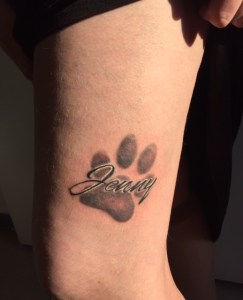
I never intended to keep my tattoo a secret. In fact, my dad reads my blog; I mentioned it here. But for people who’ve just met me or don’t read my blog or missed the whole half-a-sentence mention my tattoo got six months ago… here’s some details!
I chose to get it where it can be concealed in the workplace and shown off in a more casual summer atmosphere. Originally I wanted mine on my shoulder blade, but many friends told me in general tattoo-based conversations about their shoulder pain horror stories, so I nixed that idea. At the time I was working in business-to-business sales, and many colleagues had tattoos. I asked a couple of them where they got theirs done, called a couple of shops, and went in for one consultation.
I know many people who have TONS of tattoos; others are terrified of needles. I fall much closer to the “terrified of needles” camp, so I was kind of scared to get this done. Several friends (blind friends in particular) asked me about my experience getting a first tattoo, if it hurt, what my artist was like, how I knew things would be OK… the whole bit. I had to think a lot about it, because I lucked out; my one consultation was so easy and fluid that I never even considered getting another.
When choosing a tattoo artist, you’re effectively finding a doctor, a therapist and a graphic designer all in one. It’s an intensely intimate process and both artist and “canvas” need to be able to effectively communicate, otherwise…. not-cool things could happen… and they’re pretty permanent!
When I walked in for my consultation on an unseasonably warm Friday in January, I had no idea what I would be getting myself in for. The entire staff was warm and welcoming, and Jessie (the artist who would design and place my tattoo) and I sat and chatted about what I wanted, where, and how she could best describe her design for me as a blind customer. I’m pretty no-muss-no-fuss, and I wanted something I would be happy with but that wouldn’t be too elaborate (see above comments about needles). It was one of the easiest service-provider/customer conversations I’ve ever had in my life, and I knew I’d found the right tattoo artist. Money was pretty tight at that time, and so I told Jessie I would give her a call once things picked up and I could justify the expense, but I definitely wanted the tattoo. Not three weeks later I got my current job offer, paid my deposit, and asked for Ben’s thoughts on some drawings. He wanted his own tattoo, but different from mine, and on the first concept drawings Jessie hit the ball out of the park for both of us.
The designs had been chosen, I left Jenny at home, and I made my way back to the tattoo shop. I don’t know what I expected (some cubicle-style room with a curtain across it? Dingy dark corners where tattoos are applied in secret?) but the open airy room I entered with huge windows along the back wall definitely wasn’t it. While I was nervous about getting the tattoo, Jessie was great about putting me at ease. I even got to put on gloves and feel the tattoo gun (without needles) as it vibrated, and touch the needles in their sterile packaging. As I sat in the chair, Jessie went to work, describing everything she was doing, giving me fair warning if she was using a different needle (yes, they feel different), offering me a break if I needed. We talked about other things, too, like good food and dogs and work and business ownership… life, really. The time flew by, and while the tattoo application hurt a little, it really wasn’t that bad. Just over an hour after we got started, a bandage was placed over my freshly-tattooed skin, and it was done.
I remember telling Jessie at the time that I seriously don’t think anyone has ever just “gotten” communicating with a blind person so well. She admitted to feeling slightly uncertain about how much information to give, but she knew that everything she did would have to be described. One never would have guessed that I was her first blind client, though not her first with a disability (she mentioned having done piercings and tattoos for Deaf clients). Not only did I get a cool-looking tattoo, I got the seamless experience – the true luxury – of not having to explain anything at all about blindness or accommodations or humanity and disability. Remember when I wrote about a tattoo artist being like a doctor, a therapist and a graphic designer rolled into one? I hit the jackpot.
So, if you’re in Edmonton, hit up Jessie at Shambhala Tattoo. Tell her Jenny sent you… because, in a way, she did.


My tattoo of Jenny’s paw print with her name inside it


Raising my Voice: My Thoughts on the Proposed Canadian Service Dog Standards

04 Tuesday Jul 2017

Posted by blindbeader in blindness

≈ 2 Comments

Tags

advocacy, Canada, dignity, disability, service dogs, standards

*** UPDATE: As of April, 2018, the proposed standard has been withdrawn and the CGSB is not planning any meetings at this time.


We’ve all seen the news stories about people bringing their pets into public spaces and pretending they are service dogs. We’ve all been angry at the dishonesty, the danger to ourselves and our legitimate service dog teams, and have various ideas on how to combat this. Some propose service dog registry and identification; others place the burden on businesses to exercise the rights they do have (notably to ask the handler of an aggressive or disruptive dog, service dog or not, to remove it from the premises), rather than the people with disabilities who depend on service dogs to live fulfilling independent lives. Still others want governments to take action.

In Canada, an organization in the Public Works and Government Services (not a government committee) – made up of representatives from service dog training organizations, veterinarians, advocacy groups, regulatory bodies, and individuals – has been hard at work for two years to create a national standard for service dogs. Their stated objective is to provide a universal standard for service dog teams. Over the past month, many friends and advocacy groups have sent the draft standards to me, advising me that there is a public consultation phase that ends on July 14. As I know several groups and members who have helped draft this proposed standard, I chose to take my chances and hope for the best. But as emails and facebook posts flooded my phone and computer this past weekend, I realized that I couldn’t bury my head in the sand anymore. I had to figure out just why my phone was going crazy.

I read the standard, beginning to end, and will be submitting my comments to the board.

What The Committee Is Not

This is not a bunch of egotistical, evil people out to make life harder on service dog teams and handlers. While training programs had voting power, other advocates, professionals and owner trainers had votes in the meetings as well. This is a large group of people, all of whom have valid concerns and objectives: to make sure service dogs, handlers, and the general public are safe. If you choose to comment on this post, please be forewarned that I will delete any personal attacks against the committee or disrespectful talk about how you will never visit my country. If you can’t offer anything constructive (be it praise or criticism), keep it to yourself.

What this Document Is Not

This document is not current legislation. Even if it passed as is tomorrow, it is not law. While it may be used to create universal legislation across the country (so that someone in BC won’t undergo stricter scrutiny when they travel to Saskatchewan), legitimate service dog handlers can wake up on July 15 (after the open consultation period) and go about their lives, hopefully with no public interference.

This document is not a declarative statement on where a Canadian can train for a service dog. I’ve seen a ton of fear-mongering on this topic, that the board is saying Canadians can’t train in the States, and no where is this stated or implied. Guide and service dog programs may be concerned about their ability to serve Canadians due to the standards, but the standards themselves, as written, do not restrict location of training. There are enough legitimate concerns in this document without creating more.

This document is not permanent. That’s why it’s called a “draft”. For future readers of this blog, anything written below is paraphrased from the draft standards published on May 2, 2017. It’s a living document; it will change. We as Canadians can make our voices heard by providing feedback through the Web site. We have an opportunity to push for change, to offer suggestions, in a way that is seldom available. Take it!

What They Got Right

This document is thorough. Whether you agree with it or not, it’s a long comprehensive document. People with a wide variety of disabilities are represented, along with a non-exhaustive list of tasks their corresponding service dogs can perform. It touches on everything from training and behavior to realistic expectation, equipment fit, first-aid… I could go on and on. No one can accuse the standards board of not considering any situations. The needs of both service dog and handler are referenced throughout, with great emphasis being placed on the biological and emotional needs of the dog. The rights of persons with disabilities to access public spaces safely with their service dog are well-documented.

Unreasonable Intrusions

But while it’s clear these standards indicate that handlers should have realistic expectations about their service dogs performing learned tasks or learning new ones, their expectations of obedience are higher and, frankly, not as realistic. According to the draft standards, a service dog must respond immediately to obedience commands, on or off-leash,  in all conditions and circumstances. While later in the draft, there is mention of intelligent disobedience (when a dog disobeys a direct command when it is unsafe), the words “under all” do appear related to obedience (Section 4.2.2).

But what is not specified anywhere in this document is who can assess – and how frequently – whether the handler has “enough” knowledge on any of these things, or when the dog is obedient “enough”, even off-leash, in the home? It does appear that an assessor will at some point enter the home of a person with a disability, just because they wish to use a service dog, and I do wonder about an intrusion of privacy that no pet dog owner has to undergo.

There is also particular concern about the equipment used by a service dog team. Based on the current draft, any slip collars, E-Collars, prong collars, or muzzles would not be considered appropriate equipment (section 5.2.1.1). While I personally have strong opinions on my dog with equipment, it is not my place to judge another handler’s appropriate use of tools; even a flat-buckle collar can be used in an abusive manner. I have used a head halter (frequently mistaken for a muzzle, even though my dog can fully open her mouth while wearing it) to re-shape behavior; this standard does not address that at all. If we are responsible enough to handle service dogs in public, we should be treated as responsible enough to use appropriate tools humanely to mitigate behavior or receive tactile feedback.

A brief note about identification: several people think identification is a good way to weed out the fakes. Section 7 addresses the information that would be made available on identification (on a service dog’s harness/leash, or ID card carried by the handler). It does not appear to provide provision for those who wish or need to make their own equipment or buy from manufacturers whose equipment fits their unique needs as a service dog team, but does not readily identify “service dog”. These draft standards do not – nor can they – address who can ask for service dog team identification, under what circumstances.

One of the many other concerns I have is statements regarding separating dog and handler. Section 5.2.3.3 states that the service dog will “tolerate” removal from the handler (by whom?) when required by circumstance. The draft indicates this will be inspected (section 8.2.2.3) by having a person unknown to the dog promptly remove the dog from the handler and walk away a minimum of 6 meters. While I understand this is to test for aggression, as a visually impaired person who has had her dog forceably removed from her, this is traumatic, and does not show compassion and understanding (as stated in the goals of the inspection). As an aside, my dog might be tolerant of being separated from me, but I wouldn’t be! It would be like someone driving a car and the passenger just ripping off their glasses.

Other Concerns/Questions

A few questions I pondered while reading the standards. At what stage of the service dog’s working life these inspections are administered. What do owner trainers do? Where are the inspections held? How frequently? Who pays for travel? Does the handler have the right to access public spaces before the inspection? Does a Canadian who receives their dog from an American source have to undergo additional testing? So many more questions about the logistics that the standards themselves cannot address. They are only the first step in a complicated process which will need regulatory and legislative bodies to implement and enforce. Many (myself included) have grave concerns about the implementation of the standards. These concerns are not without merit. But at the end of the day, these standards can provide a foundational framework in which all service dogs, handlers and the general public can feel safe alongside each other.

So where do We Go from Here?

I will not throw the baby out with the bathwater. I have had friends whose service dogs have had to retire because of attacks by overly stressed legitimate service dogs or encounters with out-of-control pets in vests. Standards, by themselves, are not a bad thing, and I do see some value in these proposed standards of behavior by both handler and service dog. However, I think there needs to be much more clarity about the inspection process and the access rights of a person with a disability using a service dog. If someone owner-trains their service dog and/or uses third-party equipment without “service dog” markings, are they still protected by each province’s Human Rights legislation? If so, then there needs to be more education of service providers about when a disruptive or aggressive service dog team can be asked to leave, and more teeth to penalties for impersonating a person with a disability to take a pet dog into public.

While I believe there is the best of intentions for this standard, I question its enforceability and the potential intrusion it places on the lives of people who already receive strict scrutiny. While the commentary period is open until July 14, raise your voice in constructive ways. Don’t only point out what’s wrong, but how it could be better. And above all, don’t forget to indicate what was done right.

Summertime… when I Feel More… Respected?

24 Saturday Jun 2017

Posted by blindbeader in blindness

≈ 1 Comment

Tags

autonomy, blindness, dignity, employment, respect, sunglasses

This time last year I remember (and facebook reminded me) getting up for a 9:00 AM job interview. I opened my eyes and got hit with a sudden burst of intense stabbing pain… right in both eyes. I had two options: reschedule the interview (as I had already done the day before because I was feeling absolutely awful) or attend the interview with a light-sensitive migraine. If I chose the second option, I had two options stemming from that: suffer through it, or do the somehow stereotypical “blind” thing and walk in with sunglasses.
It was far from an easy decision. To me, sunglasses were for sunny days, not moderately cloudy ones, and absolutely never ever ever indoors. I looked so… blind in them (I still don’t know what I meant by that thought). When I asked several people I knew – sighted and blind – through the instant question-answer format of social media, I received so many answers, and many conflicted with each other. All paraphrasing is mine, but the general ideas went something like this.
“Absolutely not! Your interviewer NEEDS to at least have the semblance of eye contact.”
“Why not? Your eyes hurt; you need to be functional.”
“It’s SUCH a blind thing to do.”
“If they’re fashionable, wear them!”
I chose to wear the sunglasses. They had been purchased years before and were both fashionable and moderately functional for my purposes. The frames were basic black with round lenses, and they didn’t scream “blind person!” to anyone who looked at them. The instant I put them on, just before leaving my house, I felt my entire face relax, and the stabbing pain in both eyes magically disappeared.
The interview bombed. It bombed worse than almost any other interview I went on the year I was unemployed. It had nothing to do with my glasses, my headache, or anything else. The job and I were simply not a good fit.
But when I left the interview and went about my day, my sunglasses still in place, I noticed something else I hadn’t considered before.
People treated me better.
You see, if you were to look at my eyes directly, you would know that I am blind. My left eye is, for all purposes, unusable. My right eye won’t stay still. Walking down busy downtown streets that morning – even with a guide dog – while wearing those sunglasses, people seemed more inclined to make general non-blindness-related conversation with me, or accepted my assertions that I didn’t require their assistance. This old pair of sunglasses seemed, in a way, to be magical to me, to open a doorway to some previously rarely-found milieu of autonomy and dignity.
During the course of a few weeks, the more I wore my sunglasses, the less blind I appeared to others. The less blind I appeared, the more people left me alone (or at the very least respected my polite declining of their assistance, something they offered less frequently). I loved how it felt.
But those glasses I wore to that interview no longer flattered my face the way they had years ago when I had first purchased them. I needed, as a friend stated, a more fashionable pair.
So what does a girl do when she needs a stylish pair of sunglasses that she doesn’t need to see clearly through? She goes to Walmart, and finds the coolest, most professional-looking pair of sunglasses they have that also covers her eyes and flatters her face. I spent a grand total of $15 on my sunglasses, and the complements from friends, family, and strangers make me feel like I should’ve spent more. And when I wear them, people generally treat me better, like I’m any other office worker or customer or pedestrian.
I wonder why that is.

And I wondered why I had resisted them for so long.

When discussing this topic, I had no idea the types of division I would stir up. Some people were very comfortable with their choice to wear glasses, others firmly confident in their decision not to, and many fell somewhere in the middle. Comments ranged from “No blind person should wear glasses, ever, because it makes them look pathetic,” to “I wear them on sunny days because the glare bothers me, but I’m still uncomfortable doing so… it’s such a blind thing to do,” to “I wear glasses because my eyes hurt otherwise,” to “I wear them because I know my eyes are damaged due to accident or illness, so I wear them for the general comfort of those around me.” Others hadn’t considered them one way or the other, either because they were never encouraged to wear them, or because it was really never an issue; while my sunglasses made me look “less blind”, some believed that their wearing them would call attention to their blindness in a way that their uncovered eyes never do. Still others believe that wearing sunglasses means that they are hiding a part of themselves – their blind eyes – even if they are imperfect.

But one friend, whose blindness is due to Retinoblastoma, described in vivid detail being forced by parents or teachers to wear them. She would get in trouble in school if she took them off, and even now – as a grown woman – if she’s in her family’s company, the comment is made that she needs to wear them. Like it or not, she is judged on her appearance. Retinoblastoma can sometimes lead to facial scarring that may be off-putting to some, so some may argue that if it can be covered by makeup or glasses, then why not use them? And yet, my friend has a very complicated relationship to glasses today, for the simple reason that they were pushed at her so much as a child and teenager and even now as an adult.

A simple accessory to some, to others a way to make it through the day. To some they bring freedom, to others a sense of complicated shame. I had no idea that the job interview a year ago would start me on this journey of asking questions about an accessory that most people wear without a second thought. It’s opened up far more questions for me than it’s answered, and yet, I’ve made my own piece with my sunglasses. My cute sunglasses make others more comfortable with me, which makes me more comfortable with myself. I hate that this is so. And I hate that others would receive the exact opposite reaction because their uncovered eyes don’t make them look blind.

So for now, while the days are long and the sun is so bright that almost everyone has to squint to navigate the world visually, I’ll take that automatic respect that these lenses and frames seem to have granted me. Now the question is… can this continue in the winter?

← Older posts
Newer posts →

Subscribe

  • Entries (RSS)
  • Comments (RSS)

Archives

  • December 2025
  • January 2024
  • December 2023
  • April 2023
  • January 2023
  • December 2022
  • October 2022
  • June 2022
  • April 2022
  • January 2022
  • December 2021
  • October 2021
  • August 2021
  • June 2021
  • April 2021
  • March 2021
  • February 2021
  • January 2021
  • November 2020
  • October 2020
  • August 2020
  • July 2020
  • June 2020
  • April 2020
  • February 2020
  • January 2020
  • December 2019
  • November 2019
  • September 2019
  • March 2019
  • February 2019
  • January 2019
  • December 2018
  • September 2018
  • August 2018
  • July 2018
  • June 2018
  • May 2018
  • April 2018
  • March 2018
  • February 2018
  • January 2018
  • November 2017
  • October 2017
  • September 2017
  • August 2017
  • July 2017
  • June 2017
  • May 2017
  • April 2017
  • March 2017
  • February 2017
  • January 2017
  • December 2016
  • November 2016
  • October 2016
  • September 2016
  • August 2016
  • July 2016
  • June 2016
  • May 2016
  • April 2016
  • March 2016
  • February 2016
  • January 2016
  • December 2015
  • November 2015
  • October 2015
  • September 2015
  • August 2015
  • July 2015
  • June 2015
  • May 2015
  • April 2015
  • March 2015
  • February 2015
  • January 2015
  • December 2014
  • November 2014
  • October 2014
  • September 2014
  • August 2014

Categories

  • Blind Lady Gets Sh*t Done
  • blindness
    • My Sorta Kinda Maybe (In)accessible Life
  • Book reviews
    • Fiction
    • Nonfiction
  • Epic Road Trip of Awesome
  • Exploring Edmonton
  • Finance Friday
  • Guide Dog 2.0
  • New York vacation
  • The Empowered Series
  • The Intrepid Journey 2018
  • Ultimate Blog Challenge
  • Ultimate Blog Challenge, Part 2
  • Ultimate Blog Challenge, Part 3
  • Uncategorized

Meta

  • Create account
  • Log in

Support my blog!

Buy Me a Coffee at ko-fi.com

What’s gotten folks talking?

RoseQuartz's avatarRoseQuartz on If you Had Told Me…
Carol anne's avatarCarol anne on If you Had Told Me…
Annie Chiappetta's avatarAnnie Chiappetta on If you Had Told Me…
Carol anne's avatarCarol anne on Guide Dog 2.0: One Year L…
Carol anne's avatarCarol anne on Guide Dog 2.0, One Year Later:…
Carol anne's avatarCarol anne on Guide dog 2.0, One Year Later:…
Carol anne's avatarCarol anne on Guide Dog 2.0, One Year Later:…

Enter your email address here and receive new posts by email!

Join 207 other subscribers

Blog at WordPress.com.

  • Subscribe Subscribed
    • Life Unscripted
    • Join 207 other subscribers
    • Already have a WordPress.com account? Log in now.
    • Life Unscripted
    • Subscribe Subscribed
    • Sign up
    • Log in
    • Report this content
    • View site in Reader
    • Manage subscriptions
    • Collapse this bar
 

Loading Comments...