• So, who am I, anyway?

Life Unscripted

~ Living Life as I see it… or Don't

Life Unscripted

Author Archives: blindbeader

Book Review: Eyes Wide Open

31 Wednesday May 2017

Posted by blindbeader in Book reviews, Nonfiction

≈ Leave a comment

Over the past few months, I seem to have found myself reading books on self-improvement (working on sales skills, overcoming rejection). And biographies and autobiographies of people with disabilities (because we are all on a similar journey with many paths). A few months ago, I read a terrific article about taking a step back and trying not to read someone else’s intentions and the importance of communicating effectively. When I discovered the author of the article wrote a book, I snapped it up quickly, hoping to be able to learn a few things. I did, but not in the way I expected.


Eyes Wide Open

By: Isaac Lidsky

In this New York Times bestseller, Isaac Lidsky draws on his experience of achieving immense success, joy, and fulfillment while losing his sight to a blinding disease to show us that it isn’t external circumstances, but how we perceive and respond to them, that governs our reality.
Fear has a tendency to give us tunnel vision–we fill the unknown with our worst imaginings and cling to what’s familiar. But when confronted with new challenges, we need to think more broadly and adapt. When Isaac Lidsky learned that he was beginning to go blind at age thirteen, eventually losing his sight entirely by the time he was twenty-five, he initially thought that blindness would mean an end to his early success and his hopes for the future. Paradoxically, losing his sight gave him the vision to take responsibility for his reality and thrive. Lidsky graduated from Harvard College at age nineteen, served as a Supreme Court law clerk, fathered four children, and turned a failing construction subcontractor into a highly profitable business.
Whether we’re blind or not, our vision is limited by our past experiences, biases, and emotions. Lidsky shows us how we can overcome paralyzing fears, avoid falling prey to our own assumptions and faulty leaps of logic, silence our inner critic, harness our strength, and live with open hearts and minds. In sharing his hard-won insights, Lidsky shows us how we too can confront life’s trials with initiative, humor, and grace.


Autobiography

You learn early on that Isaac Lidsky has lived an exceptional life for someone who hasn’t yet turned 40. he’s starred in a hit TV show, clerked for not one, but two, Supreme Court Justices, owns his own company, and is a father of four.
The autobiographical portion of this book is told in “fishing Trips”, lighthearted reads, non-sequential essays. You know his wife gives birth to triplets and health problems arise, but you learn this in the early stages of the book, and don’t learn the outcome until closer to the end. His taking over a struggling construction company is detailed first, then, the next “Fishing Trip” essay is about a threat to his employer (a Supreme Court Justice) three years earlier that included his taking a motorcade to a cigar bar. The autobiography is compulsively readable, but it’s hard to follow, because it’s not written in any linear fashion.


Journey Through Sight Loss


From teen heartthrob to law clerk to entrepreneur, Isaac Lidsky has worked hard to get where he’s at, but he had to first come to terms with his declining vision. He believes that he would not be the person he is today without having lost his vision. When addressing his own journey to sight loss acceptance, he uses terms such as “awfulizing” (considering and brooding on a worst-case scenario). He acknowledges that many people view losing their sight as terrifying – he was once one of them – but likens it to a child who fears a monster under the bed and has to be told again and again that there are no monsters. His way of expressing his own journey through sight loss – from denial to resignation to acceptance – is refreshing; he acknowledges that he has to remind himself that others are where he once was, and needs to take that step back and allow them to fear the “monster” of sight loss and learn the truth about the “monsters.”


Self-Help: Eyes Wide Open


The self-help aspects of the book were where most of my conflict lies. There’s not a lot new here, though some of the analogies put into great words things I’ve never been able to express. Everyone has had an experience where they knew they saw a neighbor, an acquaintance, or a coworker somewhere… only to call their name and discover it’s not them. Heck, even someone who knows me had a similar experience. Lidsky uses this universal experience to drive home the point that perception is not reality, and we would do well to remember that.

But what is most troubling is his assertion that life is what you make it, that people will misjudge you but it’s up to you to not allow their perceptions of you to colour your perception of yourself, or of them. This glosses over the very real problems of ableism, racism, sexism that exist in our world. And being grateful that we can read and write, and live on more than $10 a day, doesn’t address very real obstacles that are placed in our path. Lidsky compares life to a game of poker – of skill rather than luck. Yes, what you do and how you respond to challenges matters – and it matters a lot – but constantly receiveing horrible cards puts you in a situation where you’re supposed to bluff your way through life, or you’re so far in the hole that no amount of skill can get you ahead in the next 27 hands.


Conclusion


Isaac Lidsky has lived a remarkable life. He has worked hard to get where he is, and I would never presume to take that away from him. But in many ways he has been given remarkable gifts of a superior intillect, a supportive family, and a drive to succeed in his chosen career and academic fields. For those who simply want a “normal” life, his advice can lead one to feel that their ordinary dreams are not good enough. The “pull yourself up by your bootstraps” ideas can make those who’ve faced very real ableism, sexism or racism feel marginalized all over again because we “let” someone else get to us and relied on luck rather than skill to dictate the course of our education or career or life.

I’m struggling to rate this book fairly, because I think it tried to be too many things to too many people. As an essayist, I like the way Isaac Lidsky expresses himself. But as a hole, I struggled to read this book straight through. Even picking apart the well-written personal essays – by turns humorous and heartbreaking – I would’ve preferred a more sequential reading. And the self-help “eyes wide open” philosophy – even though it contained some portions that will make me think – doesn’t address some very real problems that do have very real consequences. Yes, we need to step back and ask questions and listen actively, but Lidsky’s glossing over one’s perception of him as a blind man (because, frankly, he has the economic luxury to do so) and encouraging others to do the same, rings quite hollow.

Even so, this book will make you think; it will challenge you. It challenged me in some important ways.

3/5 stars.
Sugar and Spice and Everything Nice? Not on MY Life!

13 Saturday May 2017

Posted by blindbeader in blindness

≈ 10 Comments

Tags

autonomy, disability, grabbing, hard truths, respect

About three months ago, I started a brand new job. I love my job, the people I work with, the location… all of it. Working in a big building downtown wasn’t something I ever thought I’d do again, but I’m thrilled to be where I am. Jenny and I have been welcomed with open arms by colleagues, managers, building regulars, fellow transit passengers… just about everyone.

But working in a big crowded building also brings to the forefront something every disabled person has dealt with at one time or another: the grabbers. Sure, I’ve dealt with them before in other jobs or other places, but working in a very large building open to the public 5 days a week puts me in touch with many amazing people… and many grabbers.

And you know what?

I’m done being nice to grabbers.

Over the span of the past month, I’ve had numerous encounters with someone (several someones) who thinks that grabbing my body to direct me is acceptable. My shoulders have been turned to direct me, someone steered me by the waist, my hands and arms have been grabbed so frequently (and at one point so hard) that I swear I can still feel marks on my body from the other person’s fingers. Depending on the situation, the closeness of quarters, and the willingness of the other party to observe both visual and verbal queues, my reaction is situationally specific, made in a split second, when I’m not stunned motionless and speechless by someone’s lack of personal boundaries.

But why should I have to think about it? Why should I need to make judgment calls on an appropriate reaction on a frequent basis simply because I have a disability and people get weirded out about it? Why should I have to be nice because someone “meant well”? Meaning well means asking first. Meaning well means listening to my response. Meaning well means not doing something that would reasonably get one punched, kicked, screamed at or sprayed in the face if the action was directed at anyone without a disability.

And think I’m exaggerating?

A blind friend on a facebook discussion on this very topic “only gets rudely grabbed twice a week or so.”

Only?

ONLY?

There is no ONLY!

This behavior is unacceptable. We can all agree that able-bodied people aren’t frequently grabbed, manhandled, pushed, prodded, or otherwise bodily manipulated. We can all agree that such behavior is wrong. So why does disability make it right? The fact that it happens so frequently to people with visible physical disabilities that we think it “only” happens twice a week or so should appall you. The only time to grab someone is if they are actually falling and you need to catch them, or you need to pull them back from real danger (like an oncoming bus a split second away). That does not happen twice a week or so.

My tongue bleeds sometimes from my biting all of this back, from keeping quiet, from being nice. If I had fingernails, the palm of my right hand would have half-moon shaped scars from clenching my fist in my pocket. But I’m done bleeding and scarring because of my own desire to blend in, to simply go about my day. Grabbers, you are the problem, and I’m done taking out my frustration on myself. I’m done being nice because being nice has gotten me – and society – nowhere. So your intentions don’t matter; keep your hands to yourself. I’m taking my equality into my own hands. A woman without a disability can fend off an attack? Your firm grip on my hand, wrist, arm, shoulder, hips, waist, or mobility aid without my knowledge or consent is an attack, and I will respond accordingly. If grabbing me is your way to ensure my safety, I plan on learning and training and finding out how I can keep myself safe… from you. You don’t ask me if I want your help; you think you can and should decide for me. That decision is not yours to make.

The Good Old Hockey Game

23 Sunday Apr 2017

Posted by blindbeader in blindness

≈ 1 Comment

Tags

accessibility, cheering, hockey, Oilers, playoffs

Ahhhh, hockey, how I love thee.

Ahhhh, playoff hockey… how much MORE I love thee.

Edmonton has been gripped by hockey fever since the Edmonton Oilers made the playoffs for the first time in eleven years. Back then, I had lived in Edmonton for 18 months, had left my first job, was starting to seriously consider Bible school, and was way too broke to be attending any games.

Now, I’ve started a new job, been married for nine years, and am still too broke to attend a live playoff game…

But I could go to Rogers Place – the new hockey arena – and join what felt like the rest of the city in watching the away-game on the big screen.


First Period: Preparation

Our friends invited us to the Watch party at Rogers place. You get in for $5 and can watch the game on the big screen. If the Oilers had been playing at home, by all accounts we’d be spending hundreds of dollars on nosebleed tickets. But for this away-game we could soak in the atmosphere and watch the game for the cost of a pricy coffee.

Let’s go Oilers!

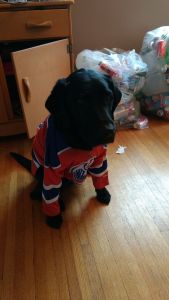
We all had our jerseys on – me, Ben, even Jenny! Jenn sported her running harness both for asthetic (Oilers colours!) and practical (comfortable) reasons, her Newtrix, and her MuttMuffs – we knew it would be loud!

We met our friends (who had our tickets) at Ford Hall, where the party was already started. The music was booming, and the Montreal-New York game was playing on the screen. We located our seats and asked if they had anything announcing the play-by-play of the game, and Guest Services provided us with an FM transmitter that would’ve relayed some information from the home-game announcers to a user’s headset, but not the exact play-by-play. I figured I could use my phone to stream the play-by-play, but the delay was so far back that I would miss the atmosphere and the action itself. Thankfully, as the game was streamed from a TV into the arena, I could hear more of what went on than I would’ve if it had been a home game.

We got to our seats, posed for pictures, and even got photo bombed by the cousin of a friend of Ben’s. The national anthems were sung – the whole house singing Oh Canada, remaining on their feet and singing The Star Spangled Banner.

Then… puck drop!


Second Period: Shots on Goal

The Oilers scored two fairly quick goals in the beginning of the second period. I felt bad that I had sent Ben to the concession for a drink for me, but he came back with food just as the second goal was scored and the crowd was screaming. As the game progressed, we started to believe that we COULD win this game – and this series – and move on to the next one. We cheered for our goals, for blocked shots, for penalty kills, for close calls. We cheered for each other, for our players, for our town.


Third Period: Gettin’ ‘er done, Bringing it Home

The Sharks scored a goal in the third period, and the tension ramped up. Nails were bitten, particularly when Edmonton got a penalty for too many men on the ice. The last five minutes, I couldn’t hear any of the play-by-play, so I screamed at Ben to tell me when something was going on. The cheers grew even louder, our eyes grew wide with incredulity as an Edmonton player went to shoot into an empty Sharks net and broke his stick. The last minute of the game, all you could hear was the shouting and cheering and screaming of thousands of Edmonton Oilers fans, on their feet, wanting to be heard all the way in San Jose. Edmonton’s team captain sealed the deal, and with an even louder roar, Edmonton Oilers fans raised the roof on Rogers Place.


I’ve been to hockey games before, particularly a memorable one in New York City, but nothing compares to this. As we left Rogers Place, buzzing with the thrill of the game, thousands of people flooded the hallways. Chants of “Let’s go Oilers!” and “We want the Cup!”, honking horns, and jubillant celebration could be heard at the arena, on the train, and on the road on the drive home.

I’ll never forget this game, and I can’t wait to see what round two will bring!

LET’S GO OILERS!!!

Rest in Peace… While I fall Apart

04 Tuesday Apr 2017

Posted by blindbeader in Uncategorized

≈ 2 Comments

Tags

cats, changes, Dash, grief, letting go, love, mourning, personal, remembering

I’m writing this post in the hope that I don’t have to post it. But if you are reading this, it’s a sad day in our home today. Last night, we said goodbye to our cat, Dash, after a sudden, fierce illness that we can’t completely explain. If you are reading this, Ben and I decided as a couple that the kindest thing was to let her go. I am writing this with tears running down my face, but I’m writing this now, days before the end, when I can still remember Dasher’s meow and her purr and the way she demanded attention until she decided seemingly arbitrarily that it wasn’t needed anymore. By the time this post is published – if it is published at all – it’s been nearly 24 hours since we held Dash in our arms, buried our faces into her soft fur coat, and said our farewells. It’s been nearly 24 hours since we cried at the kindness shown by the vet clinic, lighting a candle with a sign that said someone was mourning their beloved pet. While I still remember her for the gentle fighter and protective cat she is, not how she was during the last week of her life, I want everyone to know her for the quirky ball of CAT that was Dash.

Dash and Wayne settling in for the Winter

Dear Dash,

I don’t know if I ever told you these stories while you were curled up with me at night, while your purr rumbled me to sleep, while I laughed at your high-pitched, attention-seeking “Meeeeeeeeeeow!” But you’ve been part of this family almost as long as our little family existed, and my heart aches that you’re no longer making memories with us.

Ben and I talked about you, Dash… in the way of many conversations like this. The “We should get another cat… someday” conversation we had not long after we got married. We had Annie, of course, but another cat seemed like a good idea… in a someday-we-will sort of way. That summer day in 2008, we visited friends on a farm and were told one of their barn cats had just had kittens. I sat on their back porch and a little gray ball of fluff came up and demanded my attention. I lifted it up in my arms and it purred contentedly and I asked it if I could take it home. Ben was playing football with the guys, but when he came back to the porch, this same ball of fluff – you – curled up on his chest and fell fast asleep. He looked and me and asked if we could take you home. How could I say no? We drove to a friend’s house and grabbed a diaper box to drive you home in. Somehow, on that trip home, we named you Dash, and your little kitty paws and your big-kitty purr stole our hearts.

You became your name, Dash, sneaking out of the house at every opportunity, destroying Ben’s glasses your first night home, trying so hard to charm Annie who was singularly disinterested. You grew into a cat who was so particular about the “right” way to come up for cuddles (pacing back and forth three times, then hopping up), insisting there was only one way to climb up on the bed (always using my nightstand and boombox), creating the nightly ritual of sticking your paw between bed and headboard and batting at our heads, even straightening a painting you knocked askew during one of your “kitty crazies.” Trees held a fascination for you, until you tried to climb one and nearly choked yourself when you suddenly realized how high you were… and then you ran home in a huff. You broke yourself out of the habit of jumping onto the dining room table by falling through it when we took the tabletop off for refinishing. All these years later, we still laugh at your kittenness, and we never stopped calling you “Kitten”.

You grew older and wiser, your body filling out and matching the size of your big long tail, your formerly loud purr (once nicknamed the buzz saw) turning into a deep rumble. I used to ask you where you got your gorgeous gray fur coat, and for some reason you would never divulge that secret to me.

You hated us moving to our big scary house. There were all these places to go and explore, but it was too much for you. You climbed up on the kitchen counter and tried to melt into the particle board. Annie tried to comfort you but jumped down when she saw that we noticed her. But you owned this house, you made it your own, finding all the cool hiding spaces in the ceiling tiles and jumping into the windows anytime you could.

Not long after we moved in, we brought home… a new cat. he was a boy cat who wanted to be everybody’s friend. Annie grew annoyed with him quickly, and I think the two of you conspired to barricade him in the litter box. But somewhere along the way, though, you and Wayne (the Boy) became friends. You would run and play and wrestle all the time, even slowing down once to let me feel how you played.

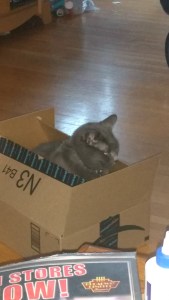
Over the years, you’ve been the negotiator in the kitty kingdom. You’ve quietly put Annie in her place, befriended the Boy so much that when he ran away you moped around the house for a week until he came home. You befriended Jenny, this enthusiastic spitfire of a dog, showing her with patience and gentleness how to interact with kitties. Your farm-cat skills came in handy whenever a mouse crossed the threshold of our home. You loved being outside in the back yard, rolling around in the dirt. And if you snuck outside between my feet, after a few minutes you would hang around on the neighbor’s fence, meowing your head off because being outside wasn’t fun anymore. You love boxes so much that we leave empty Amazon boxes around the house just so you could have somewhere to nest… so much that when we said goodbye to you, we chose a box rather than an urn for your ashes – you would’ve turned your nose up at the urn, anyway.

Dash – the Box Cat

I would give anything for one more cuddle with you, Dasher. One more snuggle with that deep purr rumbling against my chest. One more time laughing at your back-and-forth back-and-forth back-and-forth JUMP! onto my lap on the couch. One more time that you and Jenny negotiate the best way to share the sunbeam streaming through the window, or the best configuration to share her doggie bed. One more time wondering what you’re “meeeeeeeeeeeeeeeeowing” about. One more time getting my attention by stepping on my foot. One more time that you’re so happy to be with me – and I am NOT done petting you, thank you very much! – that you’re biting my wedding ring and purring at the same time.

I want to remember you for all these things, Dash, because that’s who you were. You were funny and quirky and standoffish and SUCH a wonderful cat.

I’ll never forget you.

Rest in peace, Kitten. May you find all the boxes to sleep in and all the dirt to roll in and all of the cuddles you want ONLY when you want them.

Goodbye, my sweet girl… You’re not hurting anymore.

Book Review: Britt-Marie was here

31 Friday Mar 2017

Posted by blindbeader in Book reviews, Fiction

≈ 5 Comments

I first heard of the Swedish author Fredrik Backman when Audible had his first novel, “A Man Called Ove”, on a Daily Deal. It was such a charm of a novel that I eagerly snapped up every other book he’d written that had been translated into English. Backman has a knack of fleshing out characters, giving them nuance with turns of phrase that make you laugh out loud or stop in your tracks because that’s absolutely 100% how you feel.

“Britt-Marie was Here” spins off from Backman’s previous novel, “My Grandmother Asked me to Tell you She’s Sorry”. While I read both books, Britt-Marie was here stands sturdily on its own two feet.

About the Book


From the best-selling author of the “charming debut” (People) A Man Called Ove and My Grandmother Asked Me to Tell You She’s Sorry, a heartwarming and hilarious story of a reluctant outsider who transforms a tiny village and a woman who finds love and second chances in the unlikeliest of places.
Britt-Marie can’t stand mess. She eats dinner at precisely the right time and starts her day at six in the morning because only lunatics wake up later than that. And she is not passive-aggressive. Not in the least. It’s just that sometimes people interpret her helpful suggestions as criticisms, which is certainly not her intention.
But at 63, Britt-Marie has had enough. She finally walks out on her loveless 40-year marriage and finds a job in the only place she can: Borg, a small, derelict town devastated by the financial crisis. For the fastidious Britt-Marie, this new world of noisy children, muddy floors, and a roommate who is a rat (literally) is a hard adjustment.
As for the citizens of Borg, with everything that they know crumbling around them, the only thing that they have left to hold on to is something Britt-Marie absolutely loathes: their love of soccer. When the village’s youth team becomes desperate for a coach, they set their sights on her. She’s the least likely candidate, but their need is obvious, and there is no one else to do it.
Thus begins a beautiful and unlikely partnership. In her new role as reluctant mentor to these lost young boys and girls, Britt-Marie soon finds herself becoming increasingly vital to the community. And, even more surprisingly, she is the object of romantic desire for a friendly and handsome local policeman named Sven. In this world of oddballs and misfits, can Britt-Marie finally find a place where she belongs?
Zany and full of heart, Britt-Marie Was Here is a novel about love and second chances and about the unexpected friendships we make that teach us who we really are and the things we are capable of doing.


It Takes a Village


This book is not about soccer (football, I know, but I’m Canadian, okay?). Yes, soccer is played, talked about, argued over, disdained and loved. But this book is not about soccer as much as it is about Borg, the charming, economically depressed town where (to paraphrase one character) you don’t have the luxury to choose your best friend, because even if he’s a criminal he’s the one who helped carry your brother on his back to escape your abusive father. No one is as they seem  – in all the right ways. The community comes together to support the soccer team, not just because it’s soccer (though everyone but Britt-marie loves football), but because it’s all about supporting Borg… and don’t you dare mention that team from “town.”


More than One Disabled Character


There’s much disability representation in this book. It’s clear that Britt-Marie lives with OCD – compulsive list-taking, cleaning, etc. When I started reading this book, I got incredibly frustrated with the frequent repetitions and rationalizations, until I took a step back and realized that Backman was getting inside Britt-marie’s head – things had to be done a certain way, because there’s no other way to do them.

Other characters use wheelchairs or are blind, and are in various stages on the journey to disability-acceptance. I grew frustrated with the fact that we never know the wheelchair user’s name (“Somebody”), and yet I wonder if it stems from Britt-marie’s thought process of first impressions or memories continuing to colour their interactions.

Borg, overall, seems to be accessible for “Somebody” to move in her wheelchair. She runs the pizzeria/post office/hospital/whatever, doing what needs doing to help keep the town going. It’s clear she has a massive drinking problem, but whether that’s disability or economically related, I couldn’t say. She’s plucky and resourceful and very comfortable with who she is, and as a character (though I never knew her name) I adored her.


Bank: “I’m not BLIND… I’m Visually Impaired”


Bank is not a major player in Britt-Marie’s story, but she plays a crucial role. She is losing her vision as an adult, and based on her overall grouchy demeanor, she does not appear to have come to a place of acceptance. Bank goes around town with a walking stick that she pokes or hits people with at various convenient opportunities, and totes around a little dog (though very clearly stating that it’s not a guide dog, it’s just a dog). Her home is filthy, and Britt-Marie suspects it’s because she can’t see it, but Bank cooks for herself and travels throughout the small town with a walking cane – not a white cane – because of a bad leg.

Bank played soccer as a youth and was really really good, and – vision or not – when she gets a chance to be an official coach of the Borg team for the upcoming indoor cup, she throws her history into the faces of officials that believe the team is useless. She doesn’t listen to anyone who thinks she can’t do something because she can’t see (though in Borg that’s very few people), but quietly and grumpily and with pluck just goes out and does them.

The reader in me finds her character fascinating and nuanced. The blind person in me, however, is extremely conflicted by Backman’s choices for her. Britt-marie points out to Bank where all the former soccer pictures were hung on her walls while thinking that she keeps a dirty house because of course she can’t see it. And I cringed at Bank’s “accidental” pokes and swats with her stick – in front of a policeman, no less.


Conclusion


I love the author’s way of turning individuals’ quirks into strengths, of cracking open the shells of people who annoyed me with their habits or attitudes. But everyone has wisdom to share if you just look for it. With a few hiccups along the way, Britt-Marie was here shows just how much we all can impact each other by simply being there.

3.5/5 stars.

Happy birthday, Jenny! If I Could… I’d Give you Cake

04 Saturday Mar 2017

Posted by blindbeader in blindness

≈ 12 Comments

Tags

guide dogs, independence, life lessons

Click here to listen to a reading of this postDownload

Dear Jenny,


I wake up this morning, like any other, and realize that nothing has changed. You wake up with a stretch and a yawn and a dozen enthusiastic tail wags and a scratch and a vocal cue that it is really time to go outside now… and nothing has changed for you, either.

But Jenny, my wonderful, enthusiastic, sassy, intelligent, impulsive, quirky guide dog… You’re FIVE YEARS OLD today! You may not know the significance of this day, beyond the fact that today you get to go for a long run in the dog park (weather permitting), get to spend some time hanging out with some of your favourite people, and enjoy a brand new beef bone and a brand new squeaker ball… but even the idea of this day leaves me breathless.

It started about a month ago on the bus. I get asked regularly about you, Jenny… about what breed you are and how long we’ve been a team and how old you are. The first time I uttered the phrase “She’ll be five in…” I couldn’t believe what was coming out of my mouth.

Five years old!

But it’s more than this.

About the time I started realizing that your FIFTH birthday was coming up the very same week I started a shiny new job, I looked back at our journeys and how truly, truly interconnected they really are, and always have been.

Let’s remember, shall we?

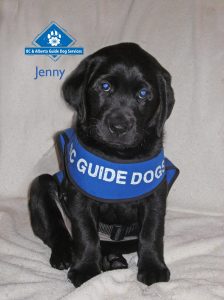
Jenny at 7 weeks old

Jenny at 7 weeks old

When you were born, on March 4, 2012, I was working in an office at a job I loved fiercely. What I didn’t yet know was how much my job would change over the next couple of weeks. I still loved my job, my coworkers, and some of the new changes… but I wasn’t doing the job I was originally hired to do. These changes opened up doorways to my future, just as you would in the years to come; they also gave birth to the advocate in me, something I would need when fighting for access rights, employment, and personal autonomy.

Jenny at 6 months old.

When you were six months old – getting bigger, learning new things, eating pages out of library books – I knew my time at that job would soon come to an end. Growing is painful, and necessary. Change is painful and necessary. But As I was struggling and wriggling out of the safe cocoon of that long-time job, you were getting bigger and changing and taking steps forward and backward and forward again. By the time you turned ten months old, I had turned my face to the wind and waited to embrace new employment opportunities.

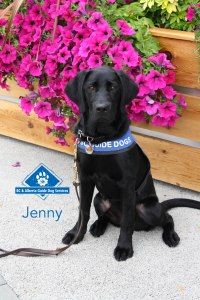
Jenny at 10 months old

You grew bigger and stronger, still curious about life. You lost interest in library books and gained interest in training. You made mistakes but were given the opportunity for another chance to make things right. I’ve since learned how very very important this is to you.

jenny-in-chinatown-in-front-of-post-with-asian-writing

You started advanced training in May 2013. At this time, after months of searching, I started work at a call center for a pizza restaurant. I enjoyed the work and the flexibility it offered (enough flexibility to enable us to train together and still keep my job). I know you enjoyed time with your boarder and her dog and time spent with your brother and the other dogs in the training van – everyone told me so.

I got the call that you and I were a match just two days before my birthday. I couldn’t think of a better present. That summer was a challenge for our little family, but we were all excited about welcoming you to it.

I remember our first walk – just after our first meeting – like it was yesterday. You went FAST! This little spitfire of a black lab was going to give me a run for my money. All I remember thinking was… why is this dog swerving? When I learned that you were avoiding all of those poles along the sidewalk that my cane hit on a regular basis, just because that’s what you were trained to do. Our speed, your precise movements… I knew you were the best dog for me. We started training the day before you turned 18 months old.


From that point on, we’ve been a team. Sometimes we’ve been so in tune with each other that I can’t believe we’ve only known each other for 3.5 years – think running along the paths of our neighborhood, our trip to New York City, or going through a sudden job loss and more job interviews than I can count. Sometimes our communication clearly sucks – one of us clearly doesn’t want to listen (and usually it’s me). You communicate so effectively that I swear you could learn English if you wanted to – from telling me a best friend is at the door, to signalling your painful allergy symptoms, to groaning your boredom during long meetings… no one needs a Jenny dictionary. You’ve made dozens of friends – both human and dog – and won them all over with your charming personality, your big brown eyes, and open heart. You may never understand what you’ve brought to me. Even this past week in navigating a new office, you’ve impressed me with your willingness to just go with your gut and see if we’re going the right way – and by the end of the week, we’re not lost in a maze of hallways and cubicles anymore.


Jenny, my girl… I want to be just like you when I grow up. I want to love my routine but be ok with sudden changes. I want to make snap decisions, right or wrong, and follow the path I take – because my gut (and yours) is usually right. I want to love openly and completely, with no reservations, qualifications, or expectations beyond time, presence, and returned affection. I want to be so joyous that the world will know that it’s a beautiful place… and I want my joy to be so evident that a rare grumpy day will be just as obvious.


I wouldn’t be the woman I am today without you. As much as guide dog training taught us to work together, you taught me even more about life. You’ve taught me to let go of my rigid expectations, to go with the flow. You’ve shown me that you can make mistakes – even big ones – and learn from them if you don’t give up. You’ve shown me that it’s OK to be scared but to face your fears anyway. Over the years, we’ve faced some scary situations – from cars pulling out in front of us, to a fight breaking out around us, to the sudden sound of automatic hand dryers. We’ve been through them together. You’ve literally saved my life more than once – from speeding buses or creepy people who want to pick me up at bus stops. You’ve left such a mark on my life and my heart that just last week I got a tattoo of your pawprint with your name inside it. It’s a visible reminder of all the things you’ve given to me so selflessly. I can’t wait to see what the next five years of our journey will bring!


Since I can’t give you cake, a ball and a wrestle and a snuggle will have to do. But it doesn’t seem nearly enough.


Happy birthday, Jenny Pen. Here’s to many more.

With all my love.


P.s. HUGE thanks to BC and Alberta Guide Dogs, Jenny’s puppy raisers, boarders, trainers, my husband, friends, and family, and all of those who’ve loved her along our journey.

P.p.s. Pictures courtesy of BC and Alberta Guide Dogs.

Book Review: Touch the Top of the World

28 Tuesday Feb 2017

Posted by blindbeader in Book reviews, Nonfiction

≈ Leave a comment

Tags

acceptance, blindness, mountain-climbing, teamwork

210209_0124Download

I’ve always been a little put-off by the idea of superblinks – those blind people who do everything extremely well (have AWESOME jobs, perfect independent living skills, or are the first blind person to do something that would be a huge challenge for ANYONE), and think that all of us should be like them. Yet I have vivid memories of a news interview with Erik Weihenmayer, the first blind man to summit Mt. Everest, and thinking “WOW! That’s amazing!” – not in an amazing-for-a-blind-guy sort of way, but more like amazing-because-it’s-HARD. Years ago, I heard of Erik Weihenmayer’s first book, “Touch the Top of the World“, and when friends of mine described the author as a “superblink”, I put the idea of reading his book on a top shelf in my reading closet. After all, I’m not that interested in mountain climbing, and who wants to read a book about a perfect accomplished blind person? Not me!

But when I saw his second autobiographical book, “No Barriers” was being released early in February, which sounded like an interesting read, I figured I would go in from the beginning. Sure, I thought, I’m interested enough in mountains to make “Touch the Top of the World” worth my time, and maybe, just maybe, I could slog through how perfect this guy’s life was and how effortless he made everything seem…

Um… I was so very wrong.


About the Book


Erik Weihenmayer was born with retinoscheses, a degenerative eye disorder that would leave him blind by the age of thirteen. But Erik was determined to rise above this devastating disability and lead a fulfilling and exciting life.

In this poignant and inspiring memoir, he shares his struggle to push past the limits imposed on him by his visual impairment-and by a seeing world. He speaks movingly of the role his family played in his battle to break through the barriers of blindness: the mother who prayed for the miracle that would restore her son’s sight and the father who encouraged him to strive for that distant mountaintop. And he tells the story of his dream to climb the world’s Seven Summits, and how he is turning that dream into astonishing reality (something fewer than a hundred mountaineers have done).

From the snow-capped summit of McKinley to the towering peaks of Aconcagua and Kilimanjaro to the ultimate challenge, Mount Everest, this is a story about daring to dream in the face of impossible odds. It is about finding the courage to reach for that ultimate summit, and transforming your life into something truly miraculous.


Family Comes First


Erik has not always been totally blind. While he was visually impaired most of his early childhood, he still played sports with his brothers and friends at school. His family knew that his vision would change and eventually be non-existent, but Erik used the vision he had when he had it. When he discovered one day he couldn’t see things as clearly to ride his bike down the ramp that had been constructed, his father painted huge visible lines on it so he could still enjoy his bike tricks. Erik’s mother hoped for a cure for her son’s blindness, while his father (a military man) pushed him to do whatever he did to the best of his ability – even if it was done differently, even if it was scary, even if it included having others beside him and behind him cheering him on.

This sets up a backdrop of immense family support. When Erik lost his remaining vision and was forced to rely on a white cane, his anger boiled over. He would throw his canes into the river, purposefully break them, drop them down sewer grates. He refused to read braille and use other adaptive techniques. He was neither belittled or pitied, but was told to get back up and learn to deal. But he was not going to live his life of blindness alone. Sadly, his mother died very suddenly not long after Erik lost his sight completely. One of the main sources of encouragement and support was gone. But he still had his siblings and father to help him push through.


A Place of Acceptance


Something changed when Erik tried out for the wrestling team. He discovered that blindness was not a factor. He didn’t have to try to learn to do things differently because of his blindness, but he didn’t feel like he had to downplay it, either. He grappled and wrestled and got hurt and got back up again. And it made an incredible mark on his life; he later became a wrestling coach.

Somewhere along the way, Erik discovered that it was so much simpler to adapt to his blindness rather than fight it. He went on to college, tried to find a job (where, familiar to blind job-seekers the world over, he was told he couldn’t do job duties XYZ and shown the door), and continued with sports and hiking with his family and friends.

He landed a job teaching school in Arizona, where he met the two great loves of his life – his wife Ellie… and rock-climbing.


It’s Not Just about Erik


When you read news articles or hear interviews about Erik being the first blind person to summit Mt. Everest, the team beside and behind Erik – if they are mentioned at all – are downplayed. Not so in this book. The friends, family and guides who supported him with both practical and physical help when he began climbing rock faces – and, later, the tallest peaks in the world – are fully fleshed out. From one team member who was perpetually cracking practical jokes, to another who was constantly late or forgetting gear (most notably a headlamp, when Erik was the lead climber on a night-time descent), to a young man whose dream of summiting one mountain was cut short due to a serious health concern… Erik makes no apologies for being part of a team. Sometimes he felt like he slowed down the team, forcing them to accommodate him; and other times, his ability to navigate in the dark made him a strong asset. Those on the peaks and those on the ground were all part of this journey, and Erik is not shy about sharing this information.


Conclusion


We knew – upon publication of this book – that Erik had summitted Mt. Everest. This, however, was not detailed in this book. I didn’t realize until recently that he hadn’t hit the summit of the tallest mountain on each of the seven continents until 2008 (more than six years after the book’s publication). I can’t decide if this adds to this book’s charm – Erik Weihenmayer is a work in progress – or if I find the publisher’s summary misleading.

If you’re at all interested in books about mountaineering, this book is a unique look at the challenges and successes of a blind climber. Like many climbers, Erik has a deep respect for the mountains – for their unique weather, their surface, their ruggedness, their beauty. Blindness was sometimes a factor in climbing, sometimes not.

As a memoir of blindness, I found this book both riveting and complicated. Erik felt like both an asset and a liability on the peaks, but he was never afraid to pull his weight. Sometimes this meant learning to do things flawlessly – because his life, and that of his teammates – depended on it. He had to abandon more than one climb due to illness, injury, or poor weather. Sometimes he powered through intense pain to summit a mountain, and paid for it later. Sometimes he knew when it was time to let it go for now and try again.

“Touch the Top of the World” is more than a memoir about blindness, adaptation, or mountains. It’s about all three in a terrific combination. It’s about grit and determination, about learning your own limitations and sometimes redefining them. I laughed and cried at various points, both poignant and amusing. Erik Weihenmayer may have been described by my friend all those years ago as a “superblink”, but I’m not sure I agree. He’s a man who loves the mountains, who loves to set goals for himself, and realizes the important value of teamwork.

5/5 stars.

The Sound of Cold

10 Friday Feb 2017

Posted by blindbeader in Uncategorized

≈ 2 Comments

Much of Canada and the USA have spent the past week in the deep freeze. From unprecedented snowfalls to dangerously low temperatures, it’s pretty clear that winter is making its presence known. The most common phrase I’ve heard around the city this week is “IT’S SO COLD!”

When running some errands earlier this week, I was thinking about all of the ways we use the word “cold” in the English language. We use it to describe temperatures, temporary illnesses, and even fellow human beings.

Cold is probably one of the only states of being that incorporates all five senses. Because cold – in all its permutations – has a sound.

Sure, you can feel it in the numbness of your fingers as you run from heated vehicle to heated building.

You can taste the sweetness of an ice cream on your tongue.

You can see your breath make clouds in front of your face on the coldest day you can remember.

You can smell the most recent dusting of snow on the ground – or, if you have a cold, you wish you could.

But we often overlook the sound of cold, of coldness.

It’s the sound of packed snow and ice under heavy boots. The wheezing of reluctant automobiles to get moving. Chattering teeth and quick breaths and stomping feet.

If you’re “under the weather” (a term I will investigate at some point) and have a cold, it’s the sound of sniffling and Kleenex and mangled consonants. Of dropped voices and weary tones.

But what about “cold” people? Do they have a telling sound?

I think they do.

It’s the sound of despair. Of idle or indifferent chit-chat that purposefully goes no deeper than the surface. Of prejudice wrapped in the trappings of well-meaning “compliments”.

Would I have noticed these things if I’d focused on my tingling fingers or chattering teeth or stuffy nose or personal frustrations?

Maybe not.

Sometimes, it’s fun to discover – or maybe re-discover – something I hadn’t considered before.

Book Review: The Fault Tree

31 Tuesday Jan 2017

Posted by blindbeader in Book reviews, Fiction

≈ 2 Comments

Who doesn’t like a good mystery? years ago, that’s all I read. One day I realized I was moving away from the genre because I got tired of the shoot-’em-up finales where someone always wound up dead. But years ago, when this book was first released, I read it and loved it because it featured a blind protagonist with a job and everything! I decided recently to re-read and review it on this blog… have my views changed?


The Fault Tree

By: Louise Ure


For one woman, the dark is a dangerous place to be, and it’s the one place she cannot escape. Arizona auto mechanic Cadence Moran is no stranger to darkness. She was blinded in a horrific car accident eight years ago that also took the life of her three-year-old niece. She knows she was only partially to blame, but that doesn’t make the loss any easier to bear. She’s learned to get by, but there are still painful memories. When she is almost run down by a speeding car on the way home from work, Cadence at first thinks that she is the victim of road rage or a bad driver. But that’s not the case. In fact, she is the only witness to the murder of her elderly neighbor, and now the killer believes that she’s seen the getaway car. Louise Ure paints the glare of a Southwestern summer with the brush of a blind woman’s darkness in this novel of jeopardy and courage…. and the fine line between them – as Cadence fights to stop a killer she can’t see.


(Second) First Impressions


The first thing I noticed was that this book had no cheesy title about sight, darkness, or vision. Most books that have blind protagonists fall into cliched titles like this, I was thrilled that Louise Ure chose to forego this. Instead, she uses the “Fault Tree” to symbolize guilt, punishment (by oneself or others) and pennence. The second was the fact that Cadence is a tough-talking blind woman with an unconventional job as a car mechanic. The third was the fact that she truly hadn’t come to terms with her blindness.


Word Pictures


Louise Ure paints verbal word pictures of the Arizona desert. It’s rugged, beautiful, harsh landscapes are described in ways that engage all of the senses, from the prickly cactus to the sounds of the night to the desert heat. Part of this, I am sure, was to get inside of Cadence’s head; partly, I am also sure, because this author loves this land.


Cadence and Discord


I’ve written above about how I love Cadence’s unconventional job. As a blind car mechanic, she doesn’t fall into a stereotypical job, and she’s a true part of the team at the shop. She uses her ears to listen for engine troubles, the other guys help her with visual work. Some might take offense to her nickname (“Stick”) and how incredulous the shop owner was when she applied for a job, but it’s a tough industry and it’s painted realisticly. Cadence travels independently, using her other senses to orient herself. She cooks well, labels things, and does other things that blind people all over the world do.  her brother created a special cane for her because she doesn’t like the white ones (this was, again, written at a time before coloured or customized canes were more common), and he takes her flying in an airplane to celebrate her birthday every year (something that comes in handy later).

That being said, I have HUGE problems with Cadence. This book may have been written before the iPhone became mainstream, but computers were definitely in use, and Cadence chooses not to use them. She touches peoples’ faces (sometimes without permission) and doesn’t seem to want anyone else to know that she’s blind. This last point puts her in danger when a killer thinks that she’s seen him leave the scene of a crime.


Other Frustrations


The heightened-other-senses trope. Can it just die already? Cadence smells things, feels things, hears things, and relies on them too much. Sometimes she’s right and (thankfully) sometimes she realizes that they’re just excess information. But the police either dismiss her outright or they think she’s got super-powers.

About three quarters of the way through the book, we know who the murderer is, and we know why. The last quarter is devoted to the police interviewing neighbors and family, while Cadence finds herself in the crosshairs of a murderer. Cadence shows terrific problem-solving skills to get herself and her niece out of a jam, but some of it stretches credibility.


Conclusion


It’s not a bad way to spend an afternoon, reading this book. You need to stretch credibility pretty far, but the descriptions of the Arizona summer almost carry this book. I found that Cadence, in particular, frustrated me. She would’ve frustrated me as a headstrong sighted character, too, but as a blind one she just made me want to shake her for making things harder on herself.

2.5/5 stars.

Removing the Bubble Wrap: Freedom to Fail

20 Friday Jan 2017

Posted by blindbeader in blindness

≈ 2 Comments

Tags

disability, effort, perceptions, perfectionism, protection

Listen to a reading of this postDownload

When you think of disability, what do you think of? Do you think of struggle, tragedy, inspiration? Do you think of incompetence or hope? Do you feel the overwhelming need to protect people with disabilities from all harm?
None of these – tragedy, protection, inspiration, incompetence – are what disability is about. It’s the only condition that transcends ethnicity, nationality, race, religion, gender, age, sexual orientation or economic status.
Disability IS humanity.
So why do we in the disability community – whether we’re disabled ourselves or are a loved one, teacher, spouse, or caregiver of someone who is – swing to the extremes of over-achievement and low expectations?

Those who know me well (OK, and if I’m honest, even those who don’t) learn pretty quickly that I’m a perfectionist. I like to do things well because I hate backtracking and doing my work over again. I’d like to think I’m more tolerant of the true limitations, weaknesses and eccentricities of those around me than I am of my own, but the jury’s still out on that. This isn’t to say I agree with lazy or apathetic attitudes (I don’t), but I realize we’re not all blessed with the same personality traits, gifts, skills and talents.
But why do we raise or lower the bar only because of disability? How can parents sometimes deliberately make their blind child stand out by not teaching them how to perform basic living tasks? And what makes us, as disabled people, feel the need to do absolutely everything perfectly by ourselves just because it can be done? Why do we believe the lie that we cannot fail at anything? Ever?
I’m currently working in a field that does not come naturally for me. It’s uncomfortable. It’s discouraging sometimes (okay, a lot of times). But in an odd, uncomfortable way, it’s also been the most empowering experience of my life. If one day it reaches the point where it’s not working out, I can honestly say that I threw my whole weight behind it… and I didn’t give up. I’ve been publicly compared to Rocky Balboa, and I wear that badge proudly, with the metaphorical black eye, split lip, and everything.
Why do I do this?
Because far too frequently, I’m not given the chance to succeed or fail on my own merits. I’m either not given an opportunity at all because of the preconceptions of my blindness, or I’m told that any effort I give is good enough. Both are wrong. Often times, people with disabilities are robbed of a crucial part of a growing process because these opportunities are denied us by those who “mean well.” We’re not wrapped in cotton, we’re not precious little beings who need to be patted on the head for every little thing we do that our non-disabled classmates, coworkers, or friends do just because its expected. We’re not achieving something simply because we do it “in spite of” or “because of” our disabilities. We are people, period, and we should be able to embrace our talents, be encouraged to make an effort to expand our horizons, and be met with the inevitable challenge of falling flat on our face sometimes.
So throw away the bubble wrap. We’re going to get hurt sometimes. But look back on your life. Tell me, what are the times you grew the most? Was it the time when things came easy to you? Or the times you looked yourself in the face (metaphorical black eye and split lip and all), squared your shoulders, and told yourself that you’d give it one more try?
Disabled people may need help with some things, with some tasks, with some alternatives. Or we may not. But what we need, more than anything, is the opportunity, on an equal and level playing field, to succeed or fail on our own merits, based on our own personalities, skills, talents and effort. No one should deny anyone else those growing pains and glimmers of hope, and disability doesn’t change that.

← Older posts
Newer posts →

Subscribe

  • Entries (RSS)
  • Comments (RSS)

Archives

  • December 2025
  • January 2024
  • December 2023
  • April 2023
  • January 2023
  • December 2022
  • October 2022
  • June 2022
  • April 2022
  • January 2022
  • December 2021
  • October 2021
  • August 2021
  • June 2021
  • April 2021
  • March 2021
  • February 2021
  • January 2021
  • November 2020
  • October 2020
  • August 2020
  • July 2020
  • June 2020
  • April 2020
  • February 2020
  • January 2020
  • December 2019
  • November 2019
  • September 2019
  • March 2019
  • February 2019
  • January 2019
  • December 2018
  • September 2018
  • August 2018
  • July 2018
  • June 2018
  • May 2018
  • April 2018
  • March 2018
  • February 2018
  • January 2018
  • November 2017
  • October 2017
  • September 2017
  • August 2017
  • July 2017
  • June 2017
  • May 2017
  • April 2017
  • March 2017
  • February 2017
  • January 2017
  • December 2016
  • November 2016
  • October 2016
  • September 2016
  • August 2016
  • July 2016
  • June 2016
  • May 2016
  • April 2016
  • March 2016
  • February 2016
  • January 2016
  • December 2015
  • November 2015
  • October 2015
  • September 2015
  • August 2015
  • July 2015
  • June 2015
  • May 2015
  • April 2015
  • March 2015
  • February 2015
  • January 2015
  • December 2014
  • November 2014
  • October 2014
  • September 2014
  • August 2014

Categories

  • Blind Lady Gets Sh*t Done
  • blindness
    • My Sorta Kinda Maybe (In)accessible Life
  • Book reviews
    • Fiction
    • Nonfiction
  • Epic Road Trip of Awesome
  • Exploring Edmonton
  • Finance Friday
  • Guide Dog 2.0
  • New York vacation
  • The Empowered Series
  • The Intrepid Journey 2018
  • Ultimate Blog Challenge
  • Ultimate Blog Challenge, Part 2
  • Ultimate Blog Challenge, Part 3
  • Uncategorized

Meta

  • Create account
  • Log in

Support my blog!

Buy Me a Coffee at ko-fi.com

What’s gotten folks talking?

RoseQuartz's avatarRoseQuartz on If you Had Told Me…
Carol anne's avatarCarol anne on If you Had Told Me…
Annie Chiappetta's avatarAnnie Chiappetta on If you Had Told Me…
Carol anne's avatarCarol anne on Guide Dog 2.0: One Year L…
Carol anne's avatarCarol anne on Guide Dog 2.0, One Year Later:…
Carol anne's avatarCarol anne on Guide dog 2.0, One Year Later:…
Carol anne's avatarCarol anne on Guide Dog 2.0, One Year Later:…

Enter your email address here and receive new posts by email!

Join 210 other subscribers

Blog at WordPress.com.

  • Subscribe Subscribed
    • Life Unscripted
    • Join 210 other subscribers
    • Already have a WordPress.com account? Log in now.
    • Life Unscripted
    • Subscribe Subscribed
    • Sign up
    • Log in
    • Report this content
    • View site in Reader
    • Manage subscriptions
    • Collapse this bar
 

Loading Comments...